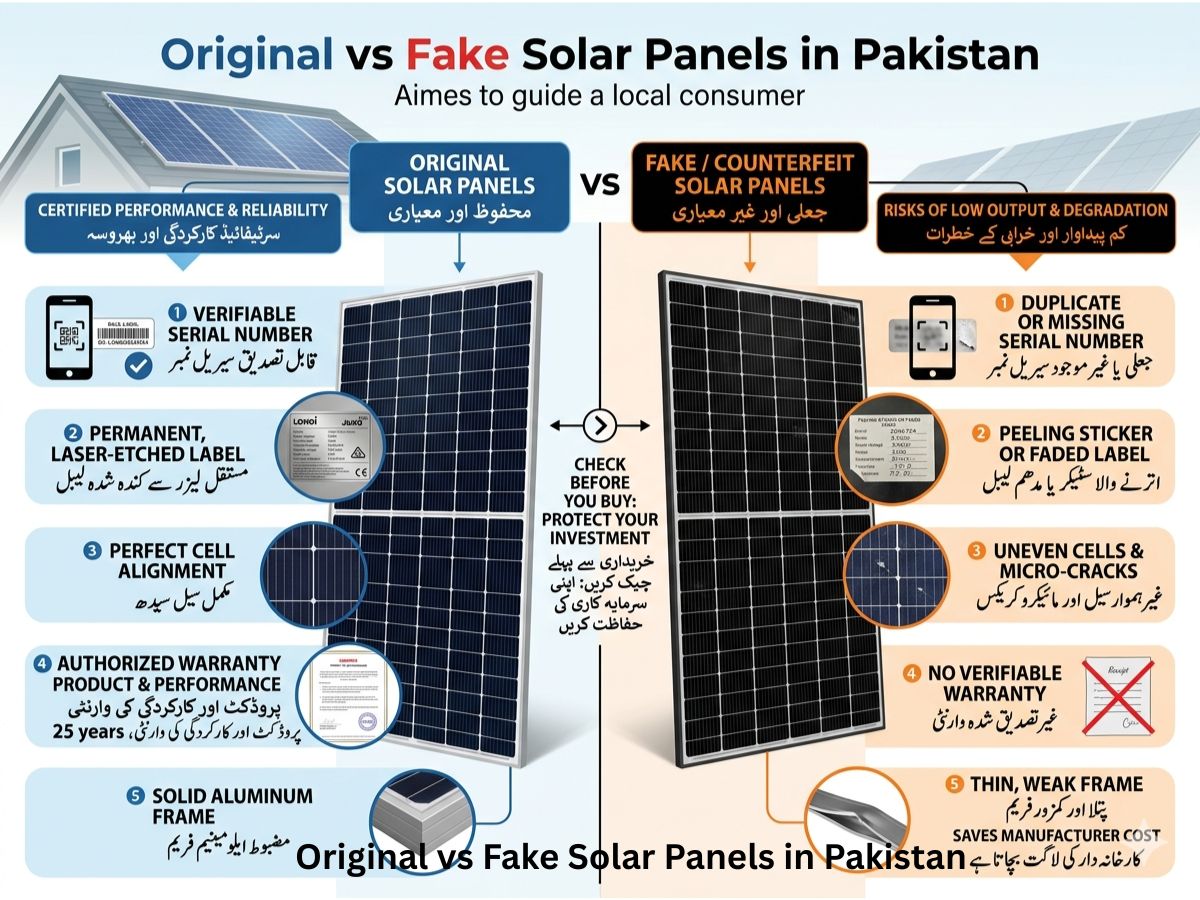
There, we will discuss completely Original vs Fake Solar Panels in Pakistan and their advantages and disadvantages. The original solar panels have unlimited benefits by generating huge amounts of energy for many years in Pakistan. The original solar panels have the highest efficiency rate, almost 25% or more, as well as the highest life, almost 25 years minimum.
I have checked and verified that the original solar panels have the ability to generate free electricity for a lifetime and save thousands to millions of rupees in Pakistan. Original solar panels deliver their rated wattage consistently, ensuring you get the full return on every rupee you invest.
My personal experience: They come with genuine 25-year performance warranties backed by the manufacturer, protecting your system for decades. Most importantly, they are built with certified materials that are safe, durable, and engineered to withstand Pakistan’s harsh heat and weather conditions.
On the other hand, the fake solar panels have many drawbacks or disadvantages when installed at home. The fake solar panels can generate electricity in short amounts for only 2 to 3 years. They do not have the longest life nor the highest efficiency rate, which may be less than 10% in the world.
Why Fake Solar Panels Are Rampant in Pakistan?
To understand the problem, you first need to understand why it exists. Pakistan’s solar market has exploded in a very short time. According to industry observers, solar imports into Pakistan crossed billions of rupees worth of equipment annually, yet the regulatory framework to monitor quality and authenticity has not kept pace.
Several factors have created the perfect environment for counterfeit solar panels that we will discuss here.
High demand, low awareness. Most buyers know they want solar, but have little technical knowledge to verify what they are buying. A salesman who speaks confidently can easily mislead someone who is shopping on price alone.
Weak import controls. While NEPRA (National Electric Power Regulatory Authority) and the Pakistan Standards and Quality Control Authority (PSQCA) have taken steps toward quality regulation, enforcement at ports and in open markets remains inconsistent.
Grey-market imports. A significant volume of panels enters through informal channels, bypassing official distributors entirely. These may be rejected batches, B-grade factory seconds, or outright counterfeits.
Price pressure. When a genuine 550-watt Longi panel costs a certain amount, and a “Longi-branded” panel at a small shop is being offered 30–40% cheaper, buyers are tempted. Sellers exploit this temptation mercilessly.
What Exactly Are “Fake” Solar Panels?
The word “fake” in the solar context covers several different types of deception, and it is important to distinguish between them:
1. Counterfeit Panels
- These are panels manufactured by unknown factories, usually in China, and stamped with the branding, serial numbers, and even QR codes of premium brands.
- The cells inside may be low-grade, recycled, or completely different from what the label claims.
- The wattage printed on the panel is inflated; a solar panel labelled 540W may actually produce 380W or less.
2. B-Grade or Rejected Factory Seconds
Major solar manufacturers have strict quality control. Cells or panels that fail inspection — due to microcracks, delamination risks, uneven efficiency, or cosmetic defects- are supposed to be destroyed or recycled.
Instead, some factory employees or middlemen divert these rejects into secondary markets, where they eventually end up in Pakistan.
These panels carry real brand names because they were partially produced at genuine factories, but they never passed quality checks.
3. Misrepresented Wattage
Some panels are genuine products but are sold under false wattage claims. A 450W panel may be relabelled as a 550W panel.
The physical appearance is identical; the sticker is different. Buyers only discover the fraud months later when their system consistently underperforms.
4. Outdated Technology Passed Off as New
Older polycrystalline panels, which are less efficient and now largely phased out globally, are sometimes sold as monocrystalline PERC or TOPCon technology at premium prices.
My personal experience: The buyer pays for cutting-edge tech and receives a product from five years ago in Pakistan.
How to Identify Original Solar Panels: A Practical Checklist
Check the Serial Number and QR Code
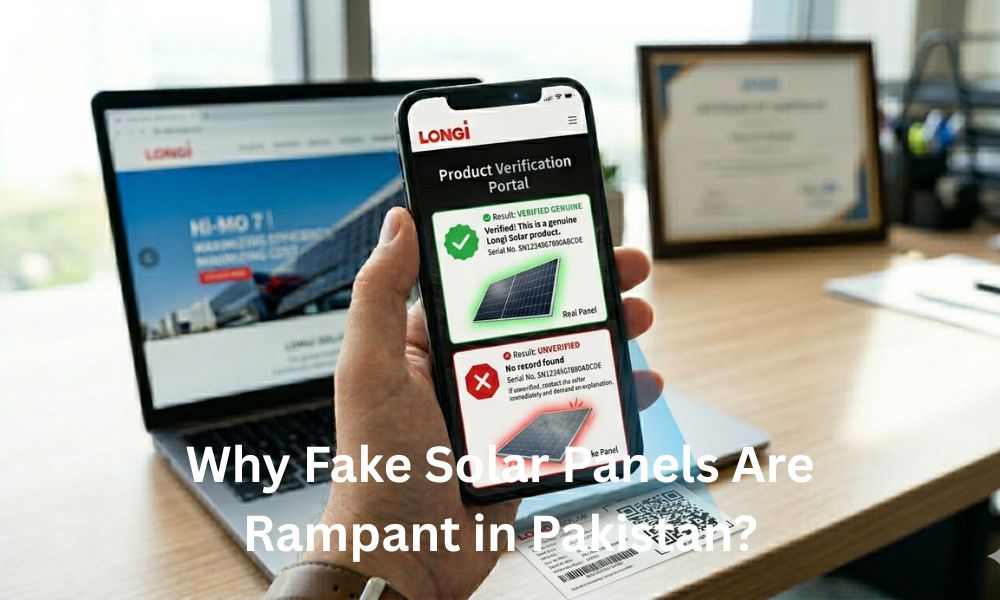
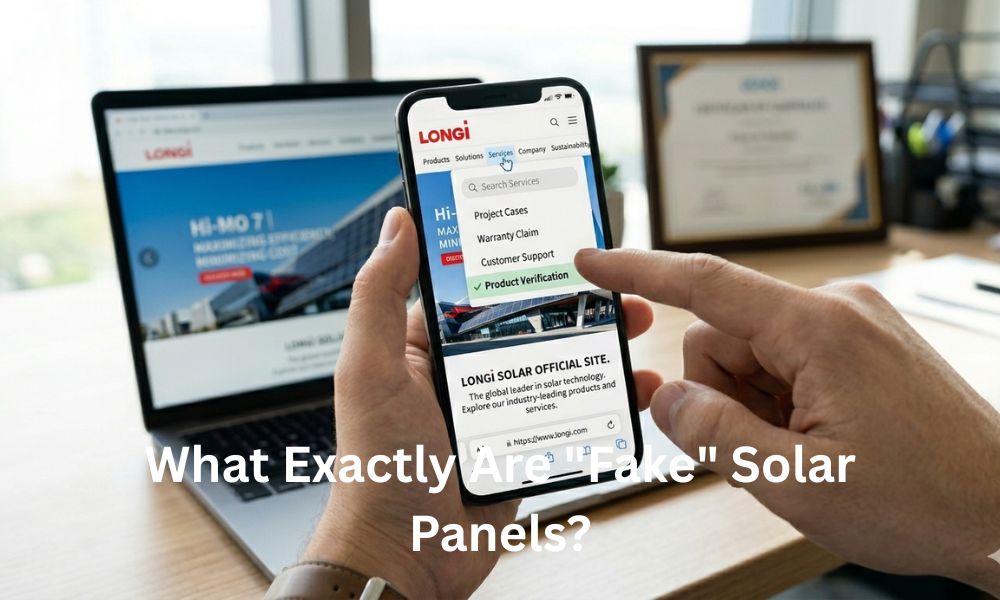
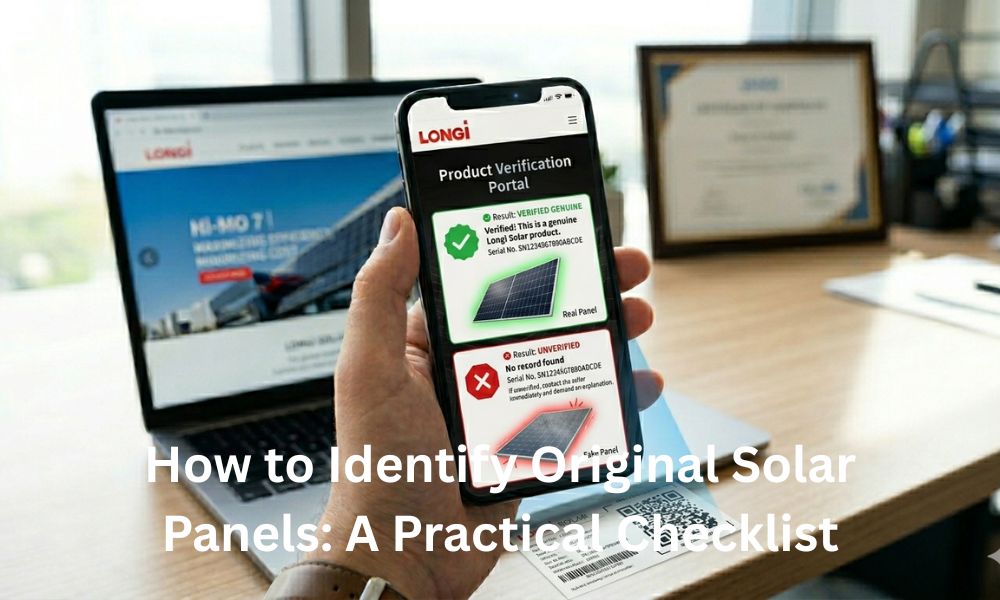
It is very important to note that every reputable solar panel brand embeds a unique serial number on each panel. Longi, JA Solar, Jinko, and Canadian Solar all have official websites or mobile apps where you can verify a solar panel’s serial number.
- Visit the brand’s official website (e.g., longi-solar.com, jasolar.com, jinkosolar.com).
- Enter the serial number from the panel’s back label.
- If the number does not exist in their database, you have a fake.
- If the number exists but is registered to a different country or distributor, something is wrong.
Some brands have dedicated verification apps. Ask your dealer to walk you through the verification in front of you before purchase.
Examine the Label Quality
My personal tip is that Genuine solar panels have labels printed with high-resolution, weather-resistant ink. The text is crisp, consistently formatted, and includes complete technical data.
open-circuit voltage (Voc), short-circuit current (Isc), maximum power voltage (Vmp), maximum power current (Imp), temperature coefficients, and certification marks.
Red flags on labels include:
- Blurry or smudged text
- Spelling errors or inconsistent fonts
- Missing technical specifications
- Certification logos that look slightly “off” (check the exact appearance of IEC, TÜV, and UL logos online)
- Labels that peel easily or look like stickers applied on top of original labels
Inspect the Frame and Build Quality
Original panels from Tier-1 manufacturers use anodised aluminium frames with tight tolerances. Run your hand along the frame:
- The corners should be perfectly joined with no gaps, rough edges, or visible adhesive.
- The frame should feel rigid and heavy for its size.
- Fake panels often use thinner, lighter aluminium that flexes noticeably.
Look at the Solar Cells
Open the packaging and examine the cells under natural light:
- Monocrystalline cells should be uniformly dark black or very deep blue with no visible grainy texture.
- Polycrystalline cells will show a shimmery, multi-crystalline blue pattern — this is normal for that type.
- Warning signs: visible cracks (even hairline), uneven colouration, cells that look faded or have different shades within the same panel, or visible gaps between cells.
A small flashlight can reveal microcracks that are invisible to the naked eye in normal light. Shine the light at an angle across the cell surface and look for any irregular dark lines.
Check the Junction Box
The junction box is the small plastic box on the back of the panel where the wires exit. On genuine Tier-1 panels:
- The box is made of UV-stabilised, fire-retardant plastic.
- The connectors (MC4 type on most modern panels) snap firmly and require a tool to disconnect.
- The box lid closes flush with no gaps.
On fake panels, the junction box is often flimsy, poorly sealed, and uses connectors that wiggle or do not click properly. A poorly made junction box is also a fire hazard.
Weigh the Solar Panel
My pro tip is that all the Genuine solar panels have a known weight published in the manufacturer’s datasheet.
A 550W monocrystalline solar panel from a major brand typically weighs between 27 and 30 kilograms.
If a panel is noticeably lighter than the specs say, it may have a thinner glass layer, smaller cells, or missing materials.
Request the Datasheet and Match It
Ask the dealer for the official datasheet for the exact model being sold. Download the same datasheet from the manufacturer’s official website yourself. Compare every figure:
- Rated wattage
- Efficiency percentage
- Dimensions and weight
- Cell type and configuration
- Temperature coefficient of power
If the numbers do not match between what the dealer gives you and what the official site publishes, walk away.
Popular Brands and What to Watch For in Pakistan 2026
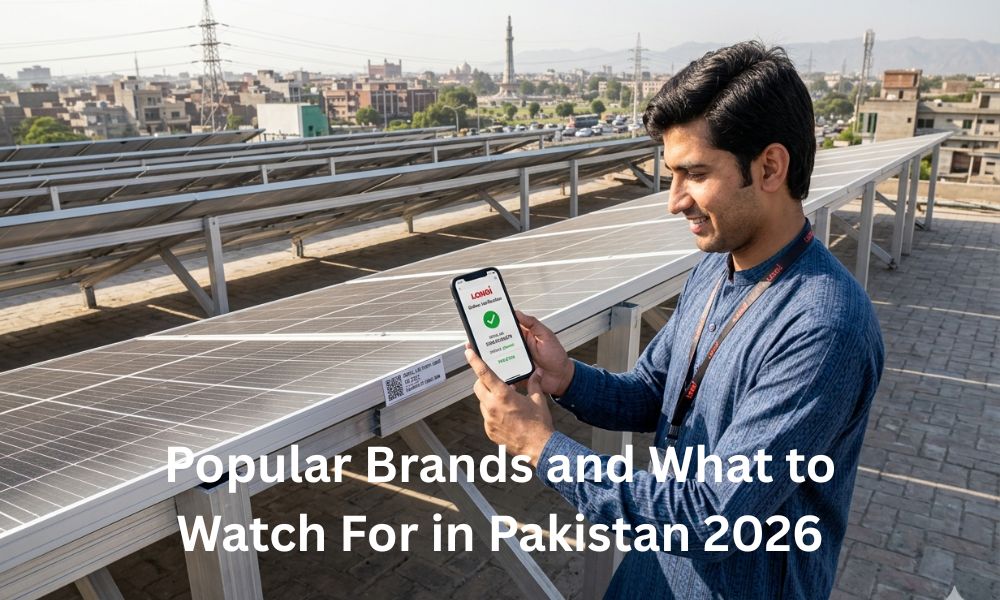
There are also many Popular Brands and what to Watch For in Pakistan 2026, and here we will discuss them in detail.
Longi Solar (LONGi Green Energy)
It is informative news that Longi is the world’s largest solar panel manufacturer and extremely popular in Pakistan. It is also one of the most counterfeited.
My pro tip: Genuine Longi panels have a distinctive “Hi-MO” series naming (Hi-MO 5, Hi-MO 6, Hi-MO X6, etc.) and can be verified on the Longi official website.
It is very important to note that Pakistan has authorised Longi distributors; buying through them significantly reduces your risk.
JA Solar
My personal experience: Another heavily counterfeited brand in Pakistan. JA Solar has a product verification system on its website.
Their solar panels have a specific label format with a QR code that links directly to product verification.
Jinko Solar
Jinko operates a verification portal where serial numbers can be checked. Pakistan has official Jinko distributors, and Jinko themselves have publicly warned about fake products in the Pakistani market on multiple occasions.
Canadian Solar
Despite the name, Canadian Solar manufactures primarily in Asia. They too have a verification system. Their panels are less commonly faked than Chinese brands, but not immune.
Local and Unknown Brands
There is nothing inherently wrong with buying a lesser-known brand if it is honestly labelled, priced accordingly, and backed by a real warranty.
The problem arises when unknown-origin panels are sold under a famous brand name. If someone offers you a “Longi” panel without any way to verify the serial number, it is almost certainly not Longi.
The Real Cost of Buying Fake Panels in Pakistan nowadays, 2026
Many buyers focus on the initial price difference and underestimate the true cost of going for a cheap or fake. Here is what happens over time:
Power output loss: A fake 540W panel that actually produces 380W means your entire system is undersized. Your investment in inverters, batteries, and installation is partially wasted.
Faster degradation: Genuine Tier-1 panels are rated for less than 0.5–0.55% annual power degradation, with 25-year performance warranties. Fake panels can degrade 3–5% per year or more, meaning within five years, you have lost a quarter of your output.
Voided inverter warranty: Many inverter manufacturers (Huawei, Sungrow, SolarEdge) specify that their warranties apply only when paired with certified, genuine panels. Using fake panels may void your inverter warranty — an expensive problem.
Fire risk: Substandard junction boxes, poor cell soldering, and thin back sheets can lead to hotspots and, in worst cases, fires. There have been reported cases in Pakistan of rooftop solar systems catching fire due to counterfeit components.
No warranty support: Fake panels come with either no warranty or a fake warranty that is useless in practice. When the panel fails in year three, the dealer who sold it to you may have disappeared.
How to Buy Original Solar Panels Safely in Pakistan
After everything said above, here is a practical action plan for a safe purchase:
Buy from authorised distributors. Every major brand has a list of authorised distributors in Pakistan. Check the brand’s official website or call their regional office. Buying from an authorised dealer does not guarantee perfection, but it dramatically reduces your risk.
Ask for an invoice with the brand name, model number, and serial numbers listed. A legitimate dealer will have no problem providing this.
Verify serial numbers on-site before payment. Use your own smartphone, your own internet connection, and the brand’s official website — not a link the dealer provides.
Hire an independent solar consultant for large installations. For a home system above 5kW or any commercial installation, paying a qualified solar engineer a few thousand rupees for an independent assessment can save lakhs in losses.
Check AEDB registration. The Alternative Energy Development Board (AEDB) registers solar companies in Pakistan. While registration does not guarantee product authenticity, unregistered companies have fewer accountability mechanisms.
Compare prices with the market. If a price is more than 20–25% below what established distributors are quoting for the same product, the panel is almost certainly not genuine.
Request test data or a live output test. A dealer with genuine panels will not object to testing a sample panel under sunlight with a clamp meter to measure actual output.
A Word on the PSQCA and Regulation
Pakistan’s PSQCA has been working to establish mandatory quality standards for solar panels. There have been policy discussions about requiring imported panels to meet IEC 61215 and IEC 61730 standards, the same standards required in Europe and the United States.
Progress has been slow, and enforcement remains patchy. The burden of protection, for now, still falls on the individual buyer.
However, buyers should know their rights: if you purchase a product that does not match its label specifications, you have grounds for a complaint under the Sale of Goods Act and consumer protection laws in various provinces.
Consumer associations and NEPRA’s complaint portal are avenues available to those who have been defrauded, though outcomes vary.
Final Thoughts: Original vs Fake Solar Panels in Pakistan
There, we will discuss completely Original vs Fake Solar Panels in Pakistan and their advantages and disadvantages.
The original solar panels have unlimited benefits by generating huge amounts of energy for many years in Pakistan.
The original solar panels have the highest efficiency rate, almost 25% or more, as well as the highest life, almost 25 years minimum.
I have checked and verified that the original solar panels have the ability to generate free electricity for a lifetime and save thousands to millions of rupees in Pakistan.
Original solar panels deliver their rated wattage consistently, ensuring you get the full return on every rupee you invest.