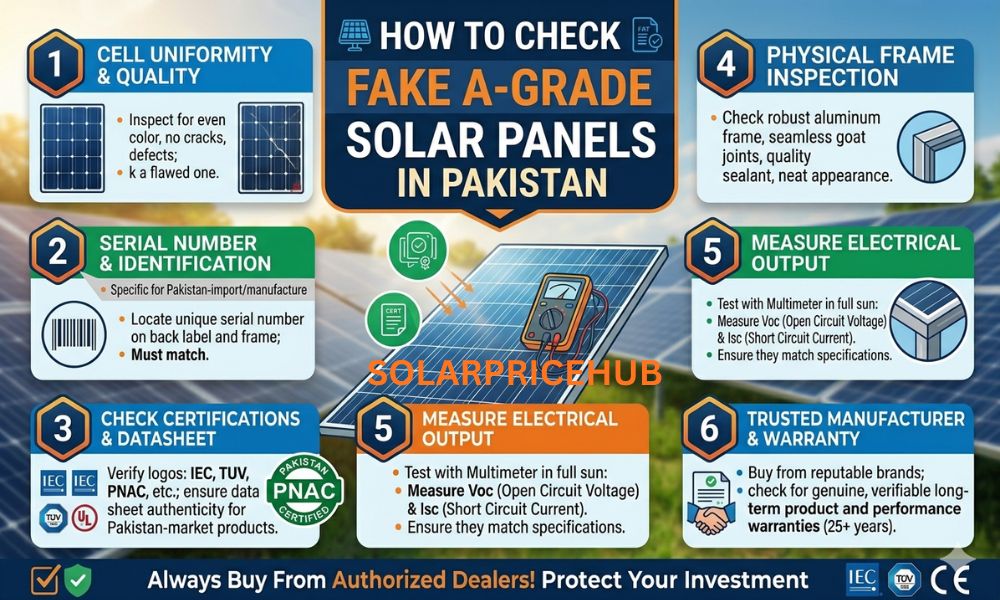
I have a lot of experience in checking fake A-grade solar panels in Pakistan after discussing and watching many shops and their solar panels of all brands in Faisalabad, Lahore, Karachi, and Islamabad. The latest solar panel prices in Pakistan are increasing because of high demand and heavy taxes, which is bad news for new installers.
Buying solar panels in Pakistan can feel like a gamble because the market is filled with fake A-grade panels (which are actually rejected B or C-grade solar panels with fake stickers). A-Grade solar panels generate more electricity for 25 years because they are built in material is best quality.
If you want to protect your hard-earned money and make sure you are getting genuine Tier-1 panels (like Longi, Jinko, or Canadian Solar), you need to be very smart. These are all the best-performing and long-lasting solar panels.
My personal experience: The single best way to check if a solar panel is 100% original is the Barcode and QR Code Test. Every authentic panel has a unique serial number sealed permanently under the front glass, not pasted as a cheap paper sticker on the outside.
My Personal Tip: You can download official apps like LONGi Pakistan or use the online serial number verification portals of brands like Jinko and Canadian Solar to instantly scan and verify the data directly from the manufacturer’s database.
What Does “A-Grade” Solar Panel Actually Mean?
Before we talk about how to detect fakes, let us understand what A-Grade really means, and here we will completely discuss or explain it one by one as follows.
- A-Grade: Perfect cells with no defects, full-rated power output, consistent performance
- B-Grade: Minor cosmetic defects, slightly lower output, lower price
- C-Grade: Visible defects, significantly lower output, very short lifespan
The problem in Pakistan is that many sellers label B-Grade or even reject panels as “A-Grade” and charge premium prices. Some panels are assembled locally using leftover or damaged cells from Chinese factories and sold as branded A-Grade products.
Why Fake Solar Panels Are a Big Problem in Pakistan
There we are discussing completely Why Fake Solar Panels Are a Big Problem in Pakistan one by one as follows.
The Scale of the Problem
My personal experience is that Pakistan’s solar industry grew explosively after 2022, when the government encouraged net metering, and solar adoption skyrocketed due to rising electricity prices.
This rapid growth attracted hundreds of unverified importers and local assemblers who saw an opportunity to make quick money in Pakistan. Therefore, they import a lot of fake grade solar panels to get more money or benefits.
It is also important to note that, according to solar technicians and installers across Lahore, Karachi, and Islamabad, a significant portion of budget solar panels sold in local markets are not genuine A-Grade products, even when they carry well-known brand names.
What Happens If You Buy Fake Panels?
There are also some disadvantages or issues that occur when we buy bad or fake solar panels in the world, and here we will discuss them as follows.
- Your solar system produces 30–50% less electricity than expected.
- Solar Panels degrade much faster, sometimes within 2–3 years instead of 25 years.
- You may face hot spots and fire risks from damaged solar cells.
- Your investment never pays back properly.
- Warranty claims go nowhere because sellers disappear or refuse service.
My personal tip: Always buy the best quality solar panels from trusted retailers or shops to save money and generate more solar power. A-grade solar panels have 25% potentail to generate more electricity in Pakistan.
5 Physical Signs of Fake A-Grade Solar Panels
There are also five major Physical Signs of Fake A-Grade Solar Panels nowadays in the solar market, and here we will discuss them completely.
1. Check the Cell Surface Under Bright Light
Hold the solar panel at an angle under sunlight or a strong light. A genuine A-Grade panel will have some features as follows.
- Uniform, consistent color across all cells — usually dark blue or black
- No cracks, chips, or micro-fractures on any cell
- Perfectly aligned busbars (the thin silver lines running across each cell)
Fake or B-Grade panels often show:
- Color inconsistency — some cells look slightly lighter or darker than others
- Tiny spider-web cracks (called micro-cracks) that are hard to see but destroy performance
- Chipped edges on cells
- Uneven or broken busbars
My Pro Tip: Take a flashlight with you when visiting a solar shop. Shine it across the panel surface at a sharp angle. Micro-cracks and surface defects become visible immediately.
2. Inspect the Frame and Backsheet
The frame and backsheet quality tell you a lot about the overall build quality of solar panels, and here we will also explain it in key points as follows.
Frame checks:
- Genuine A-Grade panels have thick, solid aluminum frames with clean corner joints
- Fake panels often have thin, flimsy frames that bend slightly under pressure
- Corner joints should be sealed tightly — gaps mean water can enter and damage the panel
- The frame should have no visible scratches or dents (a used panel sold as new is a red flag)
Backsheet checks:
- The back of a genuine panel should be pure white or light grey, smooth, and clean
- Look for bubbling, yellowing, or delamination (layers peeling apart) — these are serious defects
- A dirty or stained backsheet on a “new” panel suggests it was stored improperly or is actually used
3. Read the Label and Serial Number Carefully
My pro tip is that every genuine solar panel has a label on the backsheet with important information, and here we will discuss some key points as follows.
- Brand name and model number — is it clearly printed, not a sticker that peels?
- Serial number — does it look professionally printed or hand-stamped/stickered?
- Power rating (Watt peak) — does it match what the seller told you?
- Manufacturing date — some sellers import panels that are 3–5 years old and sell them as new
- Country of origin — “Made in China” is fine for genuine brands, but a handwritten or unclear origin is suspicious
Key Test: Go to the official brand website (JA Solar, LONGi, Jinko, Canadian Solar, etc.) and enter the serial number.
Most genuine A-Grade brands have online serial number verification. If the number does not exist in their system — walk away.
4. Check the Junction Box at the Back
It is also important to note that the junction box is the small plastic box attached to the back of the panel where the wires come out. Some key points as follows.
- The junction box is sealed tightly with no gaps
- It has a good quality IP67 or IP68 waterproof rating printed on it
- The cables coming out are thick, flexible, and properly insulated
- Connectors (usually MC4 type) should be firmly attached and click securely
Warning signs:
- Loose or poorly sealed junction box — water will enter and destroy the panel
- Thin, stiff wires that look like they’ll crack in Pakistan’s heat
- No IP rating printed on the junction box
- Generic connectors that don’t fit standard MC4 connections properly
5. Weigh the Solar Panel If Possible
My Personal experience: This sounds unusual, but it works. A genuine 550W–600W monocrystalline A-Grade panel typically weighs 25–28 kg.
If a seller is offering a “600W solar panel” that feels noticeably light, it may have fewer or smaller cells than claimed.
3 Technical Tests to Verify Solar Panel Quality
There are also three major Technical Tests to Verify Solar Panel Quality, and here we will discuss them completely as follows.
My pro tip: These tests can help us to get the best solar panels in Pakistan and save thousands of rupees.
1. Ask for the Flash Test (EL Test) Report
A genuine A-Grade panel from a reputable factory comes with an Electroluminescence (EL) test report. This test uses infrared imaging to check every single cell in the panel for cracks, dead zones, and defects.
- A-Grade result: Clean, uniformly bright image with no dark spots
- B-Grade or fake result: Dark patches, shadows, or irregular bright spots showing damaged cells
Ask your supplier: “Can you show me the EL test certificate for this batch?”
My personal experience: A genuine importer will have this. A fake seller will make excuses or show you a certificate that doesn’t match the serial numbers of the panels being sold.
2. Test with a Solar Panel Tester or Clamp Meter
If you are buying a large installation (10kW or more), it is absolutely worth hiring an independent solar technician to test panels before installation.
The basic test: Under full sunlight (between 11 am and 2 pm on a clear day), the panel should produce:
- Open Circuit Voltage (Voc): Should be within ±3% of the value printed on the label
- Short Circuit Current (Isc): Should be within ±3% of the label value
- Actual wattage output: Should reach at least 95% of rated power under Standard Test Conditions
A 540W panel producing only 380–400W in direct full sunlight is not an A-Grade panel — no matter what the label says.
3. Check the Degradation Warranty Terms
Genuine A-Grade panels come with two warranties:
- Product/Material Warranty: 10–12 years against manufacturing defects
- Performance/Linear Warranty: 25–30 years, guaranteeing the panel will produce at least 80–82% of rated power after 25 years
Fake or low-quality panels, either:
- Offer no written warranty at all
- Offer a warranty with no local service center or contact address
- Show a warranty card that is photocopied or poorly printed
- Have warranty terms written only in Chinese with no Urdu or English translation
Always ask: “Where is your registered office in Pakistan? Who do I contact for warranty claims?”
How to Verify Solar Panel Brands in Pakistan
There, we will also discuss completely how to verify Solar Panel Brands in Pakistan one by one as follows.
Trusted Brands with Official Pakistan Presence
These brands have either official distributors or verified local representation in Pakistan as of 2025–2026:
- LONGi Solar (Hi-MO series) — widely available, has an official distributor network
- JA Solar — popular in Pakistan, look for JASOLAR.COM verification
- Jinko Solar — check JINKOSOLAR.COM for serial number verification
- Canadian Solar — available through authorized dealers
- Risen Energy — growing presence in the Pakistan market
My personal tip: Always buy the best quality solar panels from trusted retailers or shops to save money and generate more solar power.
Red Flags for Unverified Brands
Be very cautious with:
- Brands you cannot find with a Google search
- Brands with no official website or only a Facebook page
- “European brand” or “German technology” claims with no verifiable address
- Panels with brand names that look similar to famous brands (e.g., “Longi Solar” vs “LONGi Solar” — note the lowercase g)
Common Tricks Pakistani Solar Sellers Use
There are also some Common Tricks Pakistani Solar Sellers Use to sell solar panels, and here we will discuss them one by one in some detail.
The “Re-labeled” Panel Trick
A seller imports cheap B-Grade or reject panels, removes the original label, and prints a new label showing a famous brand name and higher wattage. Always cross-check the serial number on the official brand website.
The “Watt Inflation” Trick
A panel rated at 500W by the real manufacturer gets relabeled as 580W. You pay for 580W but get 500W performance. This is extremely common in Pakistan. Always test output with a clamp meter before final payment.
The “Old Stock as New” Trick
Panels that were manufactured in 2019–2020 and stored in a warehouse are sold as “fresh 2024 stock.” Solar cells degrade even in storage if conditions are not perfect. Check the manufacturing date on the label — it should be within 12–18 months of your purchase.
The “Sample Swap” Trick
A seller shows you a genuine A-Grade panel for inspection, but the actual panels delivered to your rooftop are a different, lower-quality batch.
My pro tip: Always inspect panels after delivery and before installation, not just at the shop.
Step-by-Step Buying Checklist for Pakistan
There we will also discuss completely Step-by-Step Buying Checklist for Pakistan as follows.
Before Visiting the Market
- Research the brand model you want and note its official specs
- Note the expected weight, Voc, Isc, and wattage for that model
- Identify the official Pakistan distributor from the brand’s website
At the Shop
- Inspect cells for color consistency and micro-cracks
- Check frame thickness and corner joint quality
- Inspect the backsheet for yellowing or bubbling
- Read the label — confirm model number, wattage, and serial number
- Check the junction box seal and cable quality
Before Final Payment
- Verify the serial number on the official brand website
- Ask for the EL test report for the batch
- Request a written warranty with local service contact
- Have a technician test at least one panel with a clamp meter
- Get everything in writing — model, wattage, warranty terms, price
At Delivery
- Count panels — make sure you receive exactly what was agreed
- Inspect each panel physically before installation
- Photograph the serial numbers of all panels for your records
Best Places to Buy Genuine Solar Panels in Pakistan in 2026
There are also many Best Places to Buy Genuine Solar Panels in Pakistan in 2026.
Where to Buy Safely
- Official brand distributors — find them through the brand’s official Pakistan website
- AEDB-registered solar companies — The Alternative Energy Development Board maintains a list of verified installers
- Established solar companies with 5+ years of operation and physical office addresses
- Companies that offer site visits and post-installation support
Where to Be Extra Careful
- Hall Road, Lahore, Saddar Karachi electronics markets — many genuine sellers but also many fakes mixed in
- Online marketplaces (OLX, social media pages) — very hard to verify quality remotely
- Unknown shops offering prices significantly below market rates
Frequently Asked Questions
Q: What is the price difference between genuine A-Grade and fake panels?
Genuine A-Grade panels from brands like LONGi or JA Solar typically cost PKR 22,000–30,000 per panel (550W–600W), depending on exchange rates. If someone is offering the “same” panel for PKR 12,000–15,000, it is almost certainly not genuine A-Grade.
Q: Can I report fake solar panel sellers in Pakistan?
Yes. You can report to AEDB (Alternative Energy Development Board), PSQCA (Pakistan Standards and Quality Control Authority), and the Competition Commission of Pakistan (CCP). Filing complaints creates pressure on unethical sellers.
Q: Are locally assembled solar panels always bad?
No. Some reputable Pakistani companies assemble panels using genuine imported cells with proper quality control. The key is transparency — a trustworthy local assembler will clearly tell you where the cells come from and provide proper documentation.
Q: What is the difference between Mono PERC and TOPCon panels?
Both can be A-Grade. Mono PERC is the established technology — reliable and widely available. TOPCon is newer with slightly higher efficiency.
Both are genuine if sourced from verified manufacturers. Fake sellers sometimes use these terms to confuse buyers and justify higher prices for low-quality panels.
Final words: How to Check Fake A-Grade Solar Panels in Pakistan
If you want to protect your hard-earned money and make sure you are getting genuine Tier-1 panels (like Longi, Jinko, or Canadian Solar), you need to be very smart. These are all the best-performing and long-lasting solar panels.
My personal experience: The single best way to check if a solar panel is 100% original is the Barcode and QR Code Test.
Every authentic panel has a unique serial number sealed permanently under the front glass, not pasted as a cheap paper sticker on the outside.
My Personal Tip: You can download official apps like LONGi Pakistan or use the online serial number verification portals of brands like Jinko and Canadian Solar to instantly scan and verify the data directly from the manufacturer’s database.