
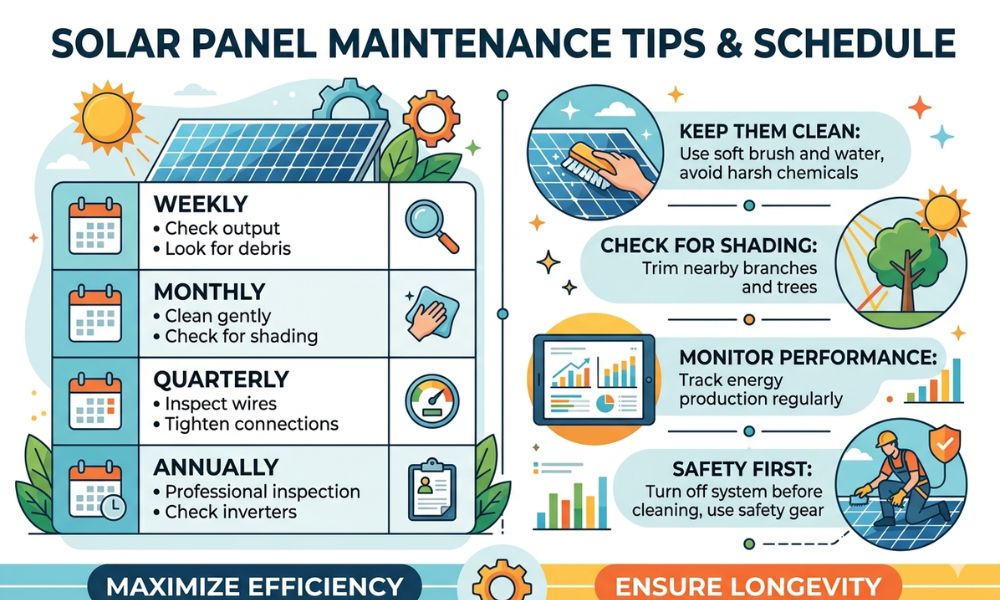
There are many Solar Panel Maintenance Tips to improve solar panel efficiency and generate maximum electricity for longer. If we regularly maintain our solar panels, they will generate solar energy for 25 years, extending their working life by up to 10 years. That’s a massive return on very little effort.
21 Jun 2026 Professional cleaning for solar panels typically costs between $150 and $330 nowadays in the world. For a standard 6 kW system, you can expect annual maintenance to stay under $200 in most regions, including the USA, UK, Brazil, and Canada.
It is very important to protect your investment and maximize your long-term savings. A proactive maintenance routine is key nowadays. This includes visual inspections from the ground every few months, monitoring your energy output through your system’s app, and cleaning the panels two to four times a year.
My personal experience: Investing in solar energy is a smart way to power your home, but like any major appliance, your system requires occasional care to perform at its peak.
While solar panels are incredibly durable and designed for minimal upkeep, factors like dust, pollen, bird droppings, and seasonal debris can form a barrier that blocks sunlight, potentially reducing your system’s efficiency by up to 15%–30%.
Why Solar Panel Maintenance Matters 2026
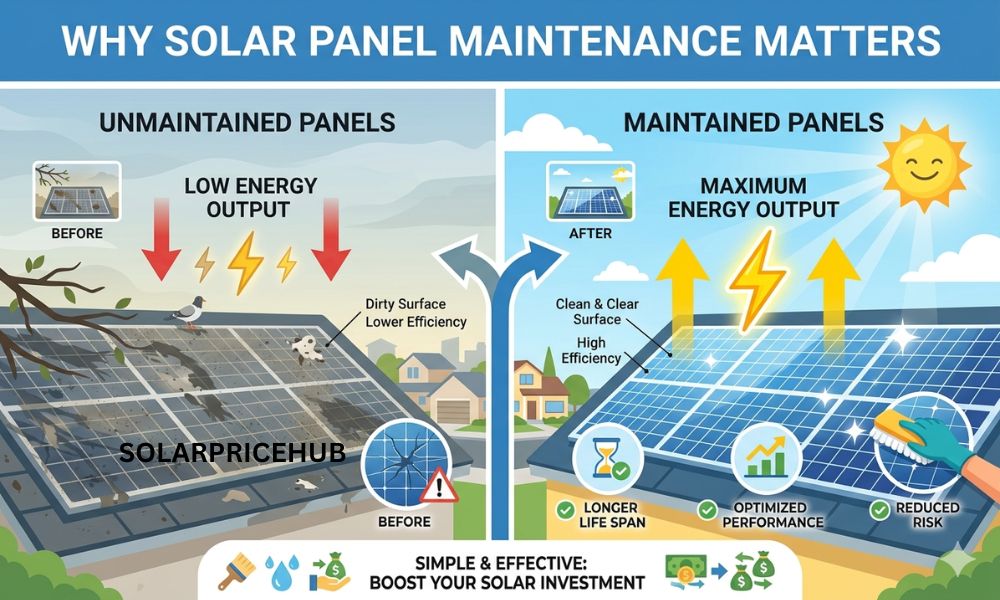
A lot of people assume solar panels are “set it and forget it.” And while they’re far simpler than most home systems, ignoring them is a costly mistake.
Here’s why maintenance matters:
- Dirt and dust reduce output. The National Renewable Energy Laboratory (NREL) confirmed that soiling losses in the US can reach up to 7% annually. That’s real money left on the table every year.
- Regular maintenance increases production by around 15% compared to neglected systems, according to industry research.
- Solar panels degrade at 0.4–0.5% per year. Good maintenance slows that rate down.
- Well-maintained systems last 25–30 years or more. Neglected ones underperform and fail earlier.
- Skipping maintenance can void your warranty. Many manufacturers require documented annual inspections to keep your coverage valid.
Bottom line: a clean, well-checked system earns you more money every single day it’s running.
Top 10 Solar Panel Maintenance Tips You Should Know 2026
1. Clean Your Panels Regularly (But Smartly)
This is the single most important thing you can do. Dust is your solar system’s biggest enemy, reducing the efficiency rate as well as life.
How often should you clean?
- In normal areas: every 2–4 weeks
- In dusty areas in the world, every 1–2 weeks, or after every dust storm
- In cleaner, less polluted areas, once a month may be enough
How to clean properly:
- Clean in the early morning or late evening only. Never during the hot afternoon, cold water hitting hot glass can cause thermal shock and crack the panel
- Use a soft brush or microfiber cloth — never anything rough or abrasive
- Rinse with a regular garden hose. You don’t need high pressure
- For stubborn bird droppings, use a small amount of mild soap with water
- Dry with a clean soft cloth to avoid water spots
2. Watch Out for Bird Droppings
It is also very informative news that these Bird droppings are more than just an eyesore. If left on the panel surface for too long, they create permanent hotspots, small areas where heat concentrates and slowly burns the cell underneath.
My personal experience: Clean droppings off as soon as you notice them, even if it’s not your regular cleaning day. A 5-minute clean now can save you from a damaged panel later.
3. Check Your Inverter Regularly
It is also informative news that your inverter is the brain of your solar system. It converts the DC power your solar panels generate into the AC power your home uses.
Why Important: Most inverters have a small display or indicator lights. Get in the habit of glancing at it every few days:
- Green light = all good
- Orange or red light = something needs attention
- Error codes = call your installer
My Pro Tip: Don’t ignore inverter warnings nowadays. A small issue caught early is a cheap fix. The same problem ignored for months can mean a full inverter replacement, which may cost $500 in 2026.
4. Monitor Your System’s Daily Output
There are also many modern solar systems that come with a monitoring app, either from your inverter brand (Growatt, Solis, Huawei, etc.) or a third-party app.
Use it. Check your daily generation numbers and compare them to what you’d expect based on the weather. If output drops suddenly on a clear sunny day, something is wrong — dust, shading, wiring fault, or inverter issue.
My pro tip: Catching a 15% drop early and fixing it takes an hour. Missing a 15% drop for 6 months costs you real money in either higher bills or lost net metering credits.
5. Inspect for Cracks, Discoloration, or Physical Damage
It is also important that once a month, you take a proper look at your panels from the ground or from a safe vantage point:
- Cracks or chips in the glass — even small ones let moisture in
- Yellowing or browning of the cells inside — signs of heat damage or aging
- White or dark spots forming on the surface
- Loose frames or panels that look misaligned
- Rust or corrosion on the mounting structure
My pro tip: If you see any of these, don’t wait. Call your installer or a qualified technician to solve it.
6. Keep Trees and Shade Away
It is also important that even partial shading on one panel can drag down the output of your entire string. A branch casting a shadow the size of your hand can reduce system performance more than you’d expect.
My personal experience: Trim any trees or shrubs near your panels every few months, especially in spring when growth is fastest. If new construction nearby has started blocking your roof, that’s worth getting a professional assessment.
7. Check Wiring and Connections
It is also informative news that you don’t need to be an electrician for this, just a visual check from a safe distance. Here, we will discuss some tips and save your solar systems without spending any money nowadays.
Look for:
- Wires that seem loose, disconnected, or chewed (rats are a real problem in Pakistan)
- Exposed or frayed wiring near the panels or inverter
- Corrosion or rust around DC cable connections
Important notice: Never touch wiring yourself unless you’re a qualified electrician. Solar DC cables carry high voltage even when the inverter is off. This is purely a “see it and report it” task.
8. Inspect the Mounting Structure
It is also important that your solar panels sit on a metal frame attached to your roof. Over time, especially after monsoon rains, strong winds, or hail, the mounting brackets can loosen. We need to fix it immediately to save your investment.
Check once or twice a year that:
- All bolts and screws are tight
- The frame hasn’t shifted position
- There’s no rust building up on the metal structure
- The roof surface under the mounting points looks intact
My pro tip: Loose mounts are a safety hazard, not just a performance issue.
9. Service Your Battery (If You Have One)
It is the most important factor that if your system includes a battery bank, whether lithium or lead-acid, it needs its own attention. Here, we will discuss some tips to check them at home.
Lithium batteries (most common in newer systems):
- Require minimal maintenance
- Check the battery management system (BMS) app for health status
- Keep them away from extreme heat — don’t install in direct sunlight or enclosed hot spaces
Lead-acid batteries (older systems):
- Check electrolyte levels every 1–2 months
- Top up with distilled water only — never tap water
- Keep terminals clean and corrosion-free
- Check for swelling or leaking — replace immediately if found
10. Schedule a Professional Inspection
It is also informative news that DIY maintenance covers the basics. But once a year, get a qualified solar technician to do a proper checkup. They’ll use thermal imaging cameras to spot issues invisible to the naked eye — failing cells, hot spots, connection problems, and more.
Latest Charges: Professional annual inspections in the USA, UK, CANADA, and Pakistan typically cost (50$ to 100$ ) PKR 3,000–PKR 10,000, depending on system size and the service provider, a little money compared to what a missed problem can cost.
Solar Panel Maintenance Schedule at a Glance 2026
| Frequency | Task |
|---|---|
| Monthly | Check monitoring app, look for alerts |
| Every 3–6 Months | Visual ground inspection, check for shading |
| 2–4 Times Per Year | Clean panels (more often in dusty areas) |
| Annually | Professional inspection, inverter check, wiring check |
| After Severe Weather | Emergency inspection for damage |
| Every 10–15 Years | Inverter replacement |
Monthly Maintenance: 5 Minutes Per Month
You don’t need to get on the roof every month. Just open your solar monitoring app (SolarEdge, Enphase, SMA, etc.) and take a quick look at a few things.
What to check monthly:
- Energy output: Is your system producing what it normally does for that time of year? A sudden drop is a red flag.
- App alerts or error codes: Most modern systems send you notifications if something is off. Don’t ignore these.
- Your electric bill: If your bill is climbing when it shouldn’t be, your solar system may not be performing.
This literally takes five minutes. Think of it like checking your bank balance — a glance can catch a problem early before it turns into something expensive.
Every 3–6 Months: Visual Ground Inspection
You don’t need to climb your roof for this. Grab a pair of binoculars if you need to, and check your panels from the ground.
What to look for:
- Visible dirt, dust, or bird droppings that are building up
- Leaves, branches, or debris sitting on top of panels
- Shading from nearby trees — trees grow, and branches that weren’t a problem last year might be shading your panels now
- Physical damage — cracks, discoloration, or panels that look different from the others
- Loose or shifting mounting hardware — panels should sit flat and secure
My pro tip: Most issues you’ll notice this way aren’t emergencies. But catching them early lets you address them before they affect your output for months without you knowing.
Cleaning Your Solar Panels: How Often, How To Do It Right 2026
How Often Should You Clean?
Most experts recommend cleaning your panels 2 to 4 times per year. But your location matters a lot:
- Dusty or dry climates (Arizona, Southern California, Nevada, Texas): Clean 3–4 times per year. Dust and sand build up fast.
- Rainy climates (Pacific Northwest, Southeast, Midwest): Rain handles a lot of the cleaning. 1–2 times per year is usually enough.
- High pollen areas (Southeast, Midwest in spring): Add an extra cleaning in late spring after pollen season.
- Areas with heavy bird activity or nearby trees: Clean more frequently — bird droppings cause hotspots and can permanently damage panels if left too long.
DIY Cleaning Tips
If your solar panels are on a single-story home with easy roof access, you can clean them yourself safely. Here’s how to do it right:
What you’ll need:
- Garden hose with a gentle spray nozzle
- Soft-bristle brush or squeegee with an extendable handle
- Mild soap (dish soap works, but rinse thoroughly)
- Clean, soft cloths if needed
Step-by-step:
- Clean in the early morning or evening — never in the middle of the day when panels are hot. Cold water hitting hot glass can cause thermal shock and crack your panels.
- Rinse panels with a gentle stream of water first to loosen dirt.
- Use a soft brush or sponge with mild soapy water to gently scrub off stubborn grime.
- Rinse thoroughly — soap residue will attract more dirt.
- Never use a pressure washer — the high pressure can crack the glass or damage seals.
- Never use abrasive scrubbers — they’ll scratch the glass and reduce light absorption.
- Don’t spray water into the wiring or junction boxes.
Safety first: If your panels are on a steep or high roof, don’t risk it. A fall is not worth saving $200 on a cleaning service.
When to Hire a Pro for Cleaning
- Your roof is steep or high
- You have 20+ panels
- There’s heavy soiling, bird nesting material, or tree sap
- You’re not comfortable on a roof
Professional cleaning costs $150–$500 per visit for residential systems, or about $12–$20 per panel. It’s quick, safe, and they often catch other issues during the visit.
Annual Maintenance: What a Professional Inspection Covers
Once a year, you should have a certified solar technician come out for a full inspection. This is the most important maintenance task on this list.
Annual professional inspection costs: $150–$350
A thorough inspection covers:
1. Panel Inspection
- Check for cracks, chips, or broken glass
- Look for discoloration, yellowing, or delamination (the layers of the panel separating)
- Identify hotspots — areas of a panel that overheat and lose efficiency
- Check for microcracks (not visible to the naked eye but detectable with thermal imaging)
2. Inverter Check
The inverter is the brain of your solar system — it converts the DC electricity your panels make into AC power your home uses. It’s also the component most likely to need replacement.
- Check for error codes or warning lights
- Verify output voltage and performance data
- String inverters last 12–15 years. If yours is approaching that age, start budgeting for replacement ($1,000–$2,500).
- Microinverters last 15–25 years and are easier to replace individually.
3. Wiring and Electrical Check
- Inspect all DC and AC wiring for wear, damage, or loose connections
- Check terminals and junction boxes for corrosion
- Look for signs of overheating or melting in wiring insulation
- Verify cable fastening and confirm no animal damage (squirrels love to chew wires)
4. Mounting and Racking Inspection
- Check all bolts, screws, and brackets for tightness
- Look for rust or corrosion on metal components
- Confirm panels haven’t shifted or warped
5. Roof Inspection Around Panels
- Look for damaged shingles or flashing around penetration points
- Check for moisture intrusion under the mounting hardware
- Verify no water is pooling under or around the array
6. Monitoring System Check
- Confirm your monitoring system is accurately reporting data
- Verify all panels are being tracked individually (if you have microinverters or power optimizers)
Seasonal Maintenance Tips
Spring
- Clean panels after pollen season — yellow pollen coating is a real efficiency killer
- Trim any trees or branches that grew closer to your panels over winter
- Check for storm damage from winter weather
Summer
- Clean more frequently if you’re in a hot, dry climate
- Monitor output closely — summer should be your peak production season; if it’s not, something’s wrong
- Avoid cleaning panels in the middle of a hot day
Fall
- Clear leaves and debris before they pile up and hold moisture
- Check that gutters and drains near your solar array aren’t clogged, which can cause water to back up under panels
Winter
- Snow removal: Light snow often slides off on its own. For heavy snow loads, use a soft roof rake — never a metal shovel or anything that could scratch the panels.
- Don’t pour hot water on snow-covered panels — the temperature shock can crack the glass
- Check that your monitoring shows the system recovering after the snow melts; if it doesn’t, panels may need to be cleared or checked
After Severe Weather: Emergency Inspection Checklist
After a hailstorm, hurricane, tornado, or severe thunderstorm, do a visual inspection as soon as it’s safe:
- Look for cracked or shattered panels
- Check that all panels are still properly mounted (no shifting)
- Look for fallen branches or debris on the array
- Check the inverter for error codes
- Compare your monitoring app output before and after the storm
- Look for any exposed or damaged wiring
Call a professional immediately if you see: cracked panels, shifted mounting, exposed wiring, a burning smell, or if your system goes offline.
My personal experience: Most homeowner’s insurance policies cover storm damage to solar panels — check your policy to know what’s covered.
DIY vs. Professional Maintenance: What to Handle Yourself
| Task | DIY? | Pro? |
|---|---|---|
| Monitoring app checks | ✅ Yes | |
| Ground-level visual inspection | ✅ Yes | |
| Gentle rinsing with garden hose | ✅ Yes (if safe roof access) | |
| Leaf/debris removal | ✅ Yes (if ground-level or safe) | |
| Full panel cleaning (steep/high roof) | ✅ Yes | |
| Inverter checks and error codes | ✅ Read display only | ✅ For repairs |
| Wiring and electrical inspection | ✅ Always | |
| Annual system inspection | ✅ Always | |
| Post-storm damage assessment | ✅ Visual only | ✅ For anything on roof |
| Inverter replacement | ✅ Always |
My pro tip: A good rule of thumb: anything electrical, anything on the roof above one story, anything involving actual components, call a professional. The risk of injury or voiding your warranty is too high.
How Much Does Solar Panel Maintenance Cost Per Year 21 Jun 2026
Here’s a realistic breakdown for an average US homeowner with a 6–10kW system:
| Service | Frequency | Cost |
|---|---|---|
| DIY monitoring | Monthly | Free |
| Professional cleaning | 1–2x per year | $150–$500 per visit |
| Annual inspection | 1x per year | $150–$350 |
| Minor repairs (wiring, hardware) | As needed | $100–$300 |
| Total Annual Cost | $390–$720/year | |
| Inverter replacement | Every 10–15 years | $1,000–$2,500 (one-time) |
I have noticed that for most homeowners, annual maintenance costs run $400–$700 per year, a small fraction of what you’re saving on electricity bills in 2026.
It is also informative news that many solar companies offer annual maintenance contracts that bundle cleaning and inspection for a flat fee, which can save you money.
Signs You Need to Call a Pro Right Away
Don’t wait for your annual inspection if you notice any of these, we will discuss each one one by one as follows.
- Your energy output drops 10% or more compared to the same period last year
- Your inverter is showing error codes or warning lights
- You see cracked, discolored, or visibly damaged panels
- You smell burning near your inverter or electrical panels
- Your circuit breaker keeps tripping
- Your system goes completely offline
- You see sparking, smoke, or any sign of electrical fire — call 911 first, then your solar company
FQSs
Do solar panels really need maintenance?
Yes, but not much. Solar panels are very low-maintenance compared to most home systems. The main tasks are keeping them clean, doing visual checks, and getting an annual professional inspection. Skip these, and you’ll lose efficiency and potentially shorten your system’s life.
Can I clean my solar panels myself?
Yes, if your roof is safe to access. Use a soft brush, mild soap, and a garden hose. Never use a pressure washer or abrasive tools. If your roof is steep or high, hire a professional — it’s not worth the risk.
How often should solar panels be inspected by a professional?
Once a year is the standard recommendation. Some manufacturers require annual inspections to keep your warranty valid. After severe weather, get an inspection even if it’s not time for the annual visit.
What happens if I don’t maintain my solar panels?
Dirt and debris reduce your output. Undetected damage can worsen over time. Wiring issues can become fire hazards. And you may void your warranty if you can’t show documented maintenance history.
How long do solar panels last with proper maintenance?
Most solar panels carry 25-year performance warranties, and well-maintained systems regularly last 30 years or more. The inverter is the component most likely to need replacement, typically after 10–15 years.
Does rain clean solar panels?
Rain helps, but it doesn’t do a thorough job. It can remove loose dust, but it won’t handle bird droppings, heavy pollen, tree sap, or deeply settled grime. You still need occasional cleaning even in rainy climates.
Will my homeowner’s insurance cover solar panel damage?
Most standard homeowner’s insurance policies cover solar panels as part of your home’s structure. Coverage varies, so check your specific policy — especially before storm season.
Final Thoughts
Solar panels are one of the best home investments you can make — but only if you protect them. The maintenance routine is genuinely simple: check your monitoring app monthly, clean your panels a few times a year, and get a professional inspection once a year.
Spend $400–$700 per year on maintenance, and your system will reward you with 25–30 years of clean, reliable energy production. Ignore maintenance, and you’ll spend far more fixing problems that could have been prevented.
Your solar system is working every day to save you money. A little attention goes a long way in making sure it keeps doing its job.

I am Muhammad SHAHID, and my education is a Master’s in IT at GCUF. Muhammad Shahid is a passionate solar energy researcher, writer, and renewable energy enthusiast with years of experience in the solar industry.