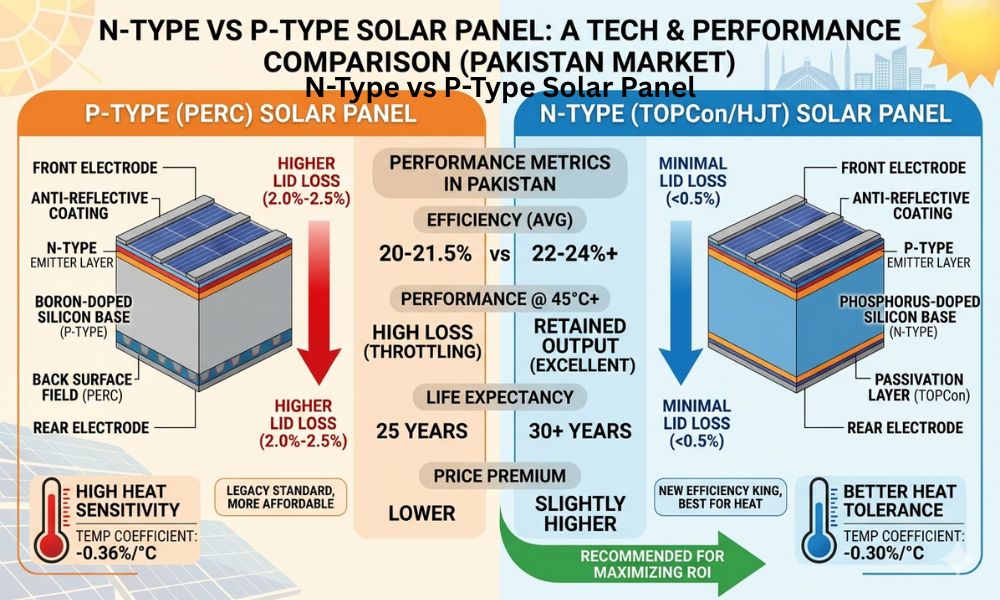
I have checked many shops to understand the difference between N-Type and P-Type Solar Panels in Pakistan and found that N-Type solar panels are the best at generating large amounts of electricity, even in very hot weather, such as in the summer season. These N-Type solar panels are specially designed to withstand hot weather and can perform well even at 40°C to 45°C in Pakistan.
My personal experience: If you are paying 8% to 12% extra for N-Type solar panels in Pakistan today, you deserve a simple explanation as to why. I recently spoke with 20 solar dealers across Lahore and Karachi. Honestly, most of them couldn’t explain the real difference other than simply saying, “N-Type is newer and better.“
It is also very informative news that when afternoon temperatures hit a scorching 45°C, standard P-Type panels (like older Jinko modules) struggle and lose about 12% of their efficiency. On the other hand, newer N-Type panels (like the JA Solar DeepBlue 5.0) handle the heat much better, losing only 8%.
It is also informative news that P-type solar panels use a silicon base doped with boron to create a positive (P-type) charge in Pakistan. As the most widely produced and affordable P-Type solar panels on the market, they are a proven, budget-friendly choice for residential or commercial setups in Pakistan
What Are P-Type Solar Panels?
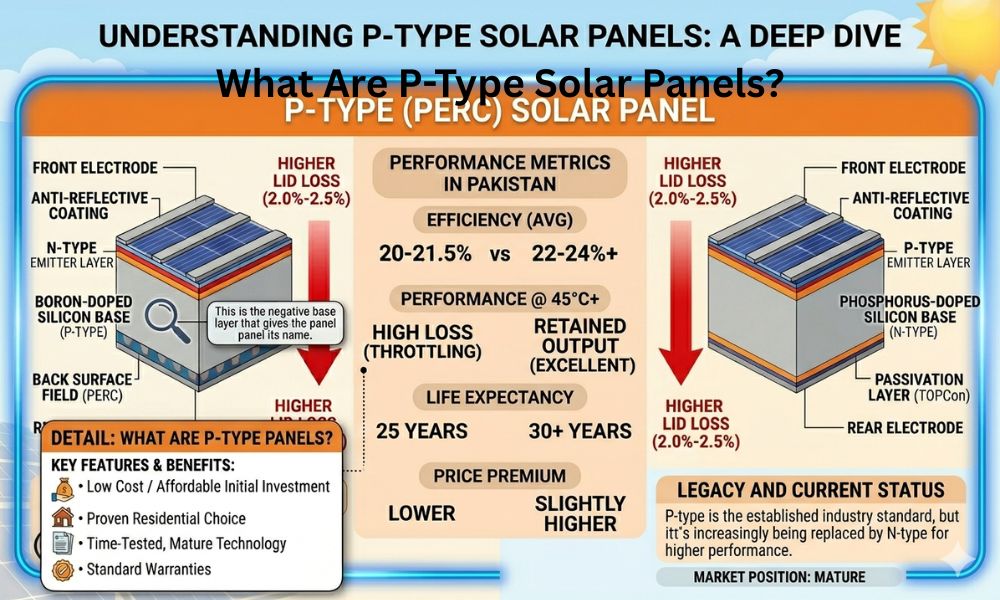
It is very important to know that P-Type stands for Positive-Type. These are the traditional, older-generation solar panels. If you look at solar installations done in Pakistan 5 to 8 years ago, almost all of them use P-Type PERC panels.
Why are they so common?
The best answer is that they are cheaper to manufacture and very easy to find in any local solar market, from Lahore to Karachi to Peshawar in Pakistan.
My personal experience: P-Type panels have one major weakness called Light-Induced Degradation (LID). This means when the solar panel first sees sunlight, it loses a small percentage of its power output permanently. It is not a big drop, but over 25 years, it adds up.
In simple words: P-Type panels are reliable, affordable, and widely available — but they are old technology with small hidden drawbacks.
What Are N-Type Solar Panels?
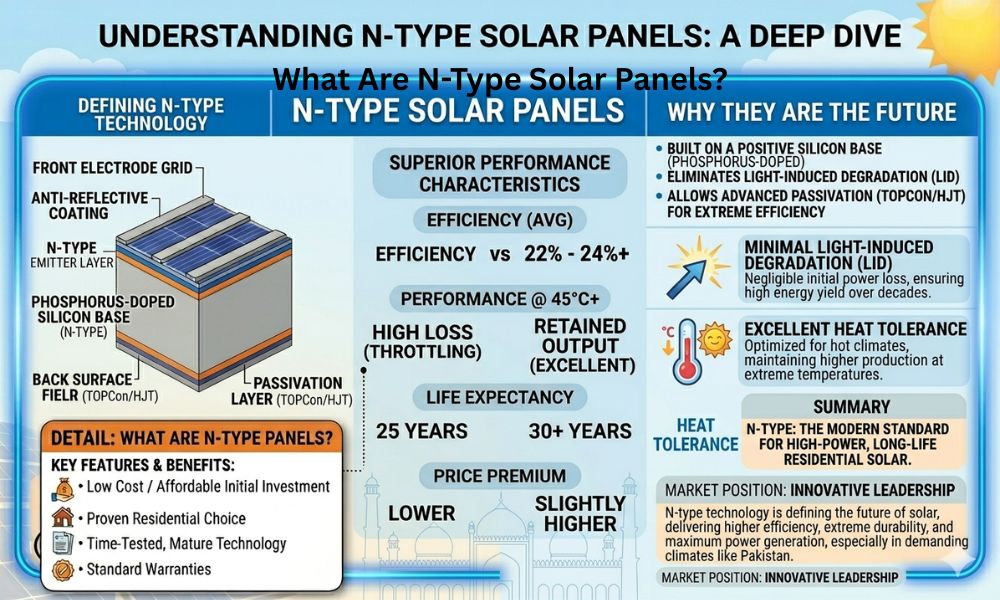
It is also important information that N-Type stands for Negative-Type. This is the latest and most advanced solar technology available today. Popular technologies like TOPCon and HJT are built on N-Type cells.
There are also many manufacturers who use a different chemical doping process, using phosphorus instead of boron, to build these panels. The result is a panel that:
- Produces more electricity from the same sunlight
- Handles Pakistan’s extreme heat much better
- Does not suffer from LID — meaning it stays strong from Day 1
Yes, N-Type panels cost a little more upfront. But they save you significantly more money over their lifetime.
In simple words: N-Type is the upgrade. More power, longer life, better performance — especially under harsh Pakistani conditions.
N-Type vs P-Type Solar Panels: 5 Major Differences
1. Daily Electricity Production (Efficiency)
This is the most important factor for any Pakistani homeowner.
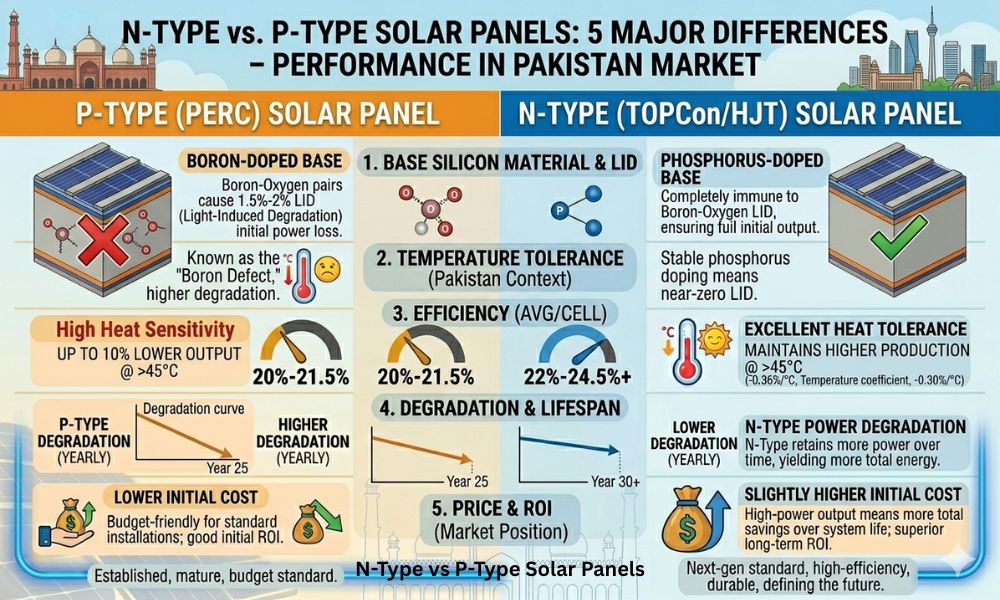
N-Type panels operate at an efficiency rate above 22%. This means they convert more sunlight into usable electricity for your ACs, refrigerators, and fans. P-Type panels sit slightly lower in efficiency.
In practical terms, an N-Type panel produces more units (kWh) per day from the same roof space. More units = lower electricity bill = faster return on investment.
2. Performance in Pakistan’s Summer Heat
Pakistan’s summers are brutal. Temperatures in cities like Multan, Sukkur, and Lahore regularly cross 45°C. Here is the problem — solar panels actually produce less electricity when they get too hot.
This drop in performance is measured by something called the Temperature Coefficient. The lower this number, the better the panel performs in heat.
N-Type panels have a better (lower) temperature coefficient than P-Type panels. This means during the hottest months of June and July — when you need electricity the most — N-Type panels keep producing closer to their rated power, while P-Type panels drop more noticeably.
For Pakistan’s climate, this difference is not small. It directly impacts your savings every summer.
3. Lifespan and Power Degradation
This is normal for every solar panel, which slowly loses power output over time. But how fast it degrades makes a huge difference over 25 years.
P-Type panels suffer from LID in the first year. After that, they continue to degrade at a standard rate. N-Type panels have no LID issue at all. They start strong and degrade very slowly — keeping strong performance for 25 to 30 years.
Think of it this way: after 25 years, your N-Type panels will still be producing significantly more power than a P-Type system installed on the same day.
4. Roof Space Required
This is a practical concern for most Pakistani homes, especially in cities where rooftops are small.
Because N-Type panels are more efficient, you need fewer panels to build the same-sized system. For example, if P-Type requires 12 panels for a 5kW system, N-Type might do the same job with 10 or 11 panels.
Fewer panels = less roof space used = cleaner installation. For homes with limited rooftop area, N-Type is the smarter choice.
5. Price Difference in Pakistan’s Local Market
Here is the part everyone wants to know.
N-Type panels cost approximately 2 to 4 rupees per watt more than P-Type panels in Pakistan’s 2026 market. For a 5kW system, this means an extra investment of roughly PKR 10,000 to 20,000 upfront.
However, because N-Type panels produce more energy year after year and degrade more slowly, they deliver a better overall return on investment over 25 to 30 years. The extra upfront cost pays itself back — and then some.
Best N-Type Brands Available in Pakistan 2026
When shopping in Pakistan’s solar market, look for these trusted Tier-1 brands offering N-Type TOPCon panels:
Jinko Solar — Tiger Neo Series. The most popular brand in Pakistan right now. Their Tiger Neo N-Type panels are specially known for outstanding performance in hot climates like Multan and Lahore.
LONGi Solar — Hi-MO 6 & Hi-MO 7 Series A premium choice with cutting-edge monocrystalline technology. Trusted worldwide and increasingly available across major Pakistani cities.
Canadian Solar & JA Solar. Both brands offer excellent N-Type panels with strong warranty support and competitive pricing in the Pakistani market.
Always buy from verified dealers and check the panel’s QR code or serial number to confirm authenticity.
Which One Should YOU Choose, N-Type or P-Type in Pakistan?
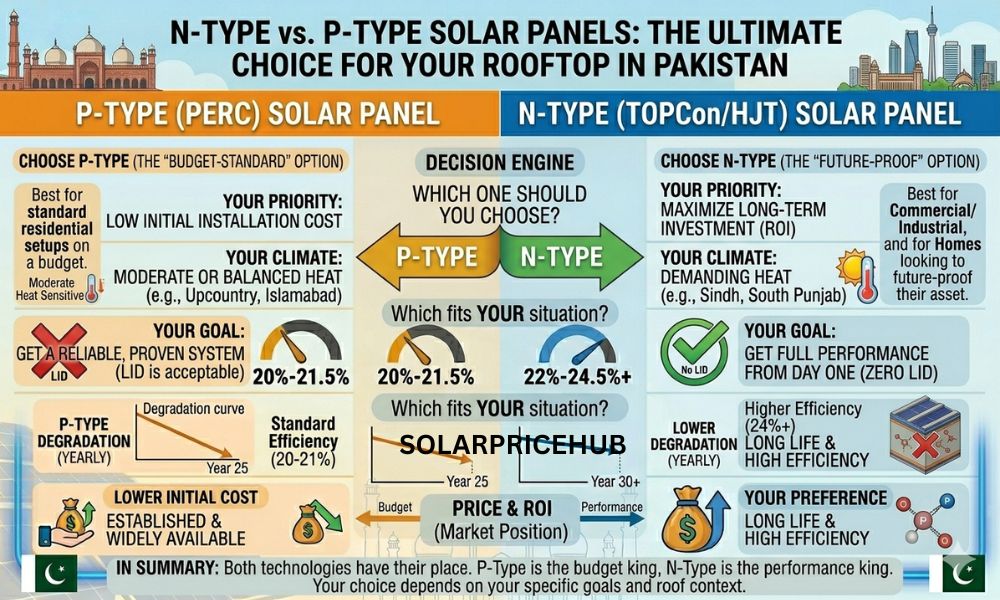
Choose P-Type if:
- Your budget is very tight
- You need a basic, functional solar setup
- You are not concerned about maximum long-term savings
Choose N-Type if:
- You want the best performance in Pakistan’s extreme summer heat
- You have limited roof space and need maximum output per panel
- You are thinking long-term and want the best return on your investment over 25+ years
- You want panels that will still perform strongly decades from now
My personal experience is that the clear winner for Pakistan in 2026 is N-Type (TOPCon). The price difference is small.
The performance difference over a lifetime is massive, especially in a country where summer heat is relentless, and electricity bills keep climbing.
Quick Comparison Table On N-Type or P-Type in Pakistan
| Feature | P-Type (PERC) | N-Type (TOPCon) |
|---|---|---|
| Efficiency | ~19–21% | 22%+ |
| Heat Performance | Average | Excellent |
| LID Issue | Yes | No |
| Lifespan | 25 years | 25–30 years |
| Roof Space Needed | More | Less |
| Price per Watt | Lower | 2–4 PKR higher |
| Best For | Tight budgets | Long-term savings |
Final Words
I have checked many shops to understand the difference between N-Type and P-Type Solar Panels in Pakistan and found that N-Type solar panels are the best at generating large amounts of electricity, even in very hot weather, such as in the summer season.
These N-Type solar panels are specially designed to withstand hot weather and can perform well even at 40°C to 45°C in Pakistan.
1. Which is better, N-type or P-type solar?
My personal and verified tip is that N-type solar is superior because it uses phosphorus instead of boron, making it immune to Light-Induced Degradation (LID).
It delivers higher efficiency (above 22%), performs better in low light, and offers a longer 30-year lifespan.
While P-type is cheaper upfront, N-type provides significantly higher lifetime energy yields and better return on investment.
2. Which solar panel type is best in Pakistan?
My personal and verified tip is that N-type TOPCon panels are the best fit for Pakistan due to their superior temperature coefficient, meaning they lose far less power during blistering summer heatwaves.
They maximize limited residential roof space by generating more watts per square meter, helping homeowners offset high summer electricity bills.
Tier-1 brands like Longi and Jinko have heavily shifted their Pakistani product lineups to this technology.
3. Which is best, P-type or n-type?
My personal and verified tip is that N-type is the overall best choice for long-term savings, offering higher efficiency, slower yearly degradation, and better performance in harsh weather.
P-type is only “best” if you are on a highly restricted initial budget and need the absolute lowest upfront installation cost.
For most modern solar setups, the extra energy N-type generates quickly pays back its slight price premium.
4. What are the disadvantages of N-type panels?
It is very important that primary disadvantage is a higher initial purchasing cost due to the more complex manufacturing processes required to make the cells.
My personal and verified tip is that in local markets, they carry a price premium per watt compared to older, clearing-out P-type stocks.