Jinko Solar Panel 580 Watt price in Pakistan ranges Rs. 22,000 to 32,480 depending on variant. Compare N-Type vs P-Type, A-Grade rates and find the best dealer in 2026. Jinko Solar Panel 580 Watt price in Pakistan Rs. 22,000 to 32,480. Compare N-Type vs P-Type, A-Grade rates & pick the right variant for your system May 2026 guide.
Most Pakistani solar buyers don’t realise that “580 watt” isn’t a single product, it’s a wattage label shared by three genuinely different panels. P-Type Mono PERC, N-Type TOPCon Monofacial, and N-Type Bifacial, Different cell technology, Different degradation rate and Different lifetime output.
What makes this more urgent in 2026, NEPRA’s new Prosumer Regulations cut the net metering buyback rate from Rs. 27 to Rs. 10 per unit. That changes which variant is actually worth the premium and most guides haven’t caught up yet.
Before you place an order, ask your dealer two questions: Is this A-Grade or B-Grade? And what’s the exact model name?
What Is the Jinko Solar Panel 580 Watt Price in Pakistan?
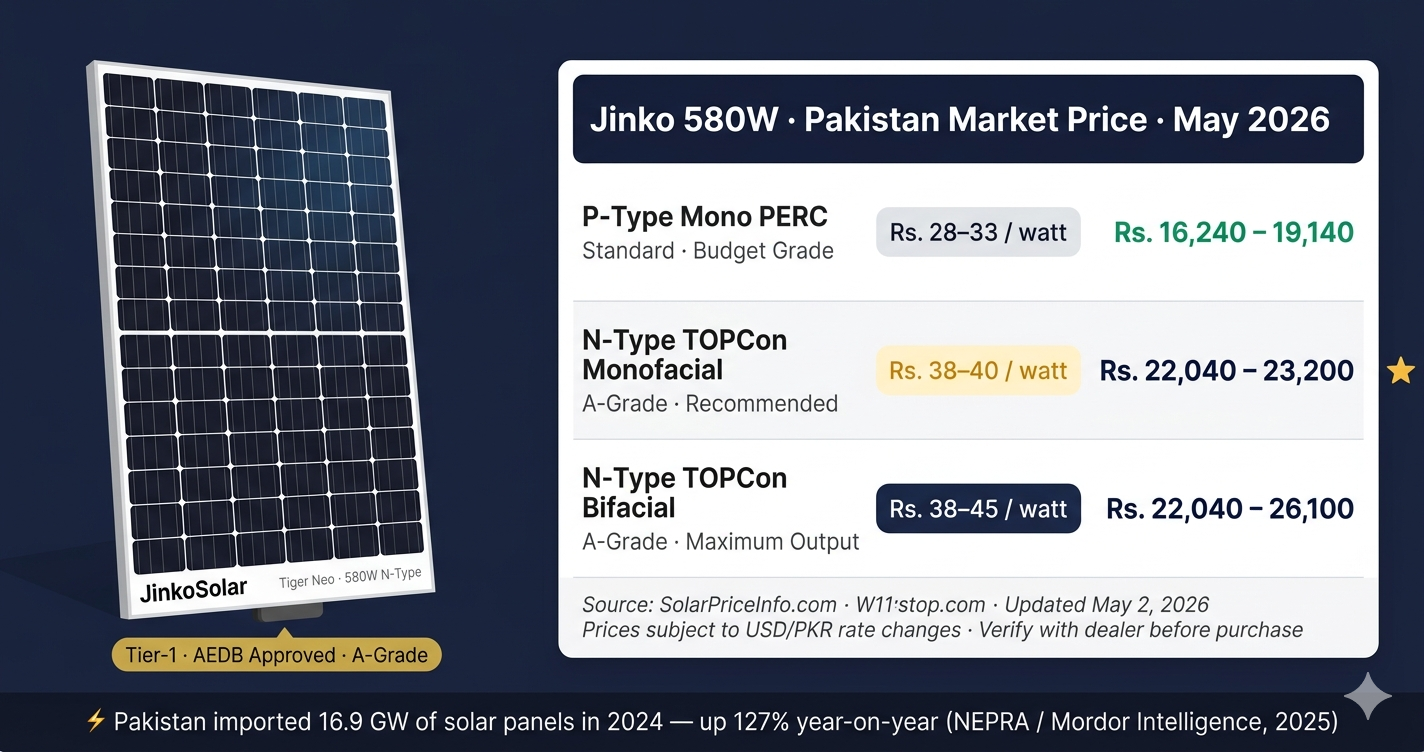
The Jinko Solar Panel 580 Watt price in Pakistan ranges from approximately Rs. 22,040 to Rs. 32,480 per panel depending on the variant N-Type TOPCon or P-Type Mono PERC, monofacial or bifacial, and A-Grade or B-Grade classification.
The per-watt rate as of May 2026 runs between Rs. 38 and Rs. 56/watt for N-Type A-Grade models at authorized dealers. The reason three dealers can quote Rs. 22,000, Rs. 28,750, and Rs. 32,480 for what looks like the same 580W panel is that they’re quoting three genuinely different products: a P-Type monofacial, an N-Type monofacial, and an N-Type bifacial respectively.
Same wattage on the label. Different cell technology, different degradation rate, different lifetime output. Knowing this distinction before you walk into any dealer saves you from either overpaying or under-buying.
The current Jinko 580W price benchmarks as of May 2026:
| Variant | Per Watt Rate (PKR) | Panel Price (PKR) | Best For |
| Jinko 580W P-Type Mono PERC | Rs. 28–33 | Rs. 16,240–19,140 | Budget-first buyers, short-term ROI |
| Jinko 580W N-Type A-Grade Monofacial | Rs. 38–40 | Rs. 22,040–23,200 | Standard residential 5–10kW systems |
| Jinko 580W N-Type A-Grade Bifacial | Rs. 38–45 | Rs. 22,040–26,100 | Rooftops with reflective surfaces or ground mounts |
According to Pakistan’s NEPRA State of Industry Report (2025), net-metered rooftop solar capacity surged from under 1 GW in 2023 to approximately 4.9 GW by March 2025, a growth trajectory that has pushed panel availability up and, in most models, prices down. Buyers in 2026 have more options than ever. That also means more ways to get confused.
N-Type vs P-Type: What the Price Difference Actually Buys You
This is the question that most dealer conversations skip entirely.
What N-Type TOPCon Means for Your Roof
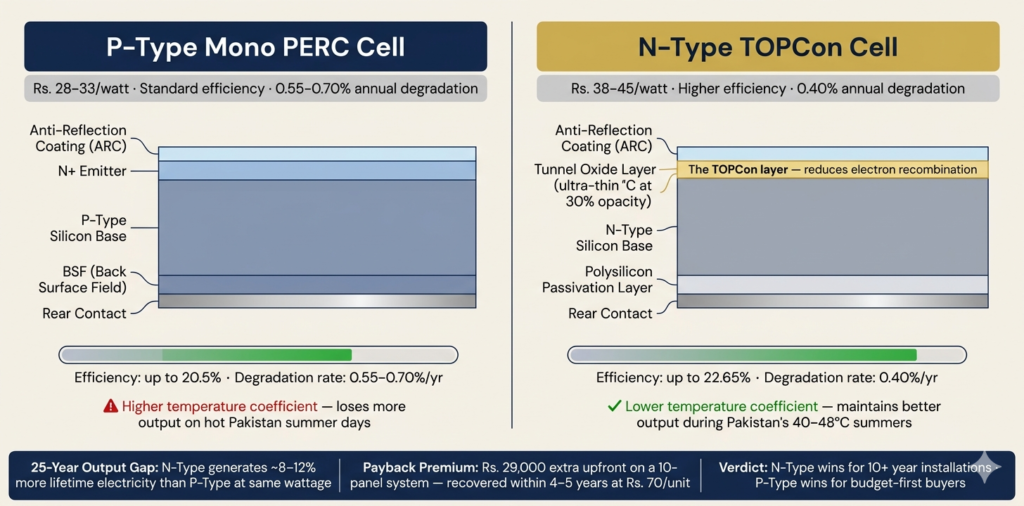
N-Type TOPCon (Tunnel Oxide Passivated Contact) is Jinko’s current flagship cell technology. It achieves efficiency ratings up to 22.65% meaning more watts extracted per square foot of roof and it degrades at approximately 0.40% per year, compared to 0.55–0.70% per year for standard P-Type PERC cells. Over a 25-year system lifespan, that difference compounds into a meaningful output gap.
Here’s the thing: on a 10-panel, 5.8kW system, paying Rs. 5/watt more for N-Type over P-Type adds roughly Rs. 29,000 to the upfront cost. At Pakistan’s current residential electricity rate of Rs. 65–80/unit in peak hours, that extra output over 25 years more than covers the premium — but only if you’re staying in the property long enough to realize it.
Quick note: if you’re installing for a rental property or plan to sell within 5 years, the P-Type A-Grade delivers better short-term payback math.
What A-Grade vs B-Grade Actually Means
This is the distinction that catches most first-time buyers off guard.
An A-Grade panel meets the manufacturer’s full performance specifications efficiency, wattage output, and cosmetic standards. A B-Grade panel is a manufacturing reject: it performs within acceptable tolerances but may have micro-cracks, cosmetic blemishes, or slightly lower-than-rated output. B-Grade Jinko panels are not counterfeit they’re genuine Jinko cells but they’re sold at a discount because they didn’t pass A-Grade quality control.
The price gap between an A-Grade and B-Grade 580W panel can be Rs. 3,000–6,000 per panel. That sounds attractive. But on a 10-panel system, B-Grade panels can produce 3–8% less power than rated, which over 25 years at Rs. 70/unit translates to a significant cumulative loss.
Quick Comparison: N-Type vs P-Type for Pakistan Buyers
N-Type TOPCon is better suited for long-term residential installations in Pakistan because it tolerates high temperatures more efficiently and degrades slower in the subcontinent’s intense summer irradiance. P-Type Mono PERC works better when upfront cost is the primary constraint and the system will be used under 5–7 years. The key difference is the annual degradation rate: 0.40% (N-Type) vs 0.55–0.70% (P-Type).
Where to Buy Jinko 580W Panels in Pakistan: Authorized Channels
Look if you’re comparing online prices to what a local dealer is quoting, here’s what actually works: use online prices as your negotiating floor, not as your purchase price.
Purewave lists the Jinko 580W N-Type Mono PERC at Rs. 28,750 with cash-on-delivery available nationwide in Karachi, Lahore, Islamabad, Multan, and Peshawar. This is a verified authorized dealer. The price is fixed; negotiation isn’t really their model. What you get in exchange is guaranteed A-Grade stock and documented provenance.
SolarPrice Info functions as a daily-updated price aggregator, not a seller. Their May 2026 listings show Jinko N-Type 580W A-Grade at Rs. 38–40/watt (Rs. 22,040–23,200 per panel) for monofacial and Rs. 38–45/watt (Rs. 22,040–26,100) for bifacial. These are dealer-level reference prices your local market may run Rs. 1,000–2,500 higher per panel depending on city and stock.
Powerhouse Express (powerhouseexpress.com.pk) lists the bifacial N-Type variant at Rs. 31,900 and the monofacial at Rs. 32,480. These prices include nationwide delivery and full warranty documentation.
The highest-risk purchase channel in Pakistan for solar panels remains OLX and unverified Daraz listings not because the products are always bad, but because the serial number verification step is nearly impossible to complete before money changes hands.
| Purchase Channel | Panel Type Available | Listed Price (PKR) | Verification |
| Purewave pk | N-Type 580W Mono PERC | Rs. 28,750 | Authorized distributor |
| Powerhouse Express | N-Type 580W Monofacial & Bifacial | Rs. 31,900–32,480 | Authorized, nationwide delivery |
| Solar Price Info | All variants (reference pricing) | Rs. 22,040–26,100 | Aggregator — not a seller |
| Local dealers (Lahore/Karachi market) | P-Type and N-Type | Rs. 19,000–28,000 | Verify grade before purchase |
| OLX / Daraz unverified | B-Grade, used, or grey market likely | Rs. 15,000–22,000 | High risk — serial verify mandatory |
Some solar consultants argue that buying from local market dealers in Lahore’s Hall Road or Karachi’s Saddar is always cheaper than buying online. That’s valid for buyers who know how to identify A-Grade panels by inspection and serial number.
But if you’re new to solar procurement, the Rs. 2,000–3,000 premium for a verified online channel is cheap insurance against a Rs. 15,000–20,000 mistake per panel.
How to Verify a Jinko Panel Before You Buy in Pakistan
Counterfeits exist. That’s the uncomfortable reality of Pakistan’s solar market, and it’s one neither Jinko Solar nor SolarPrice Info addresses in their price listings.
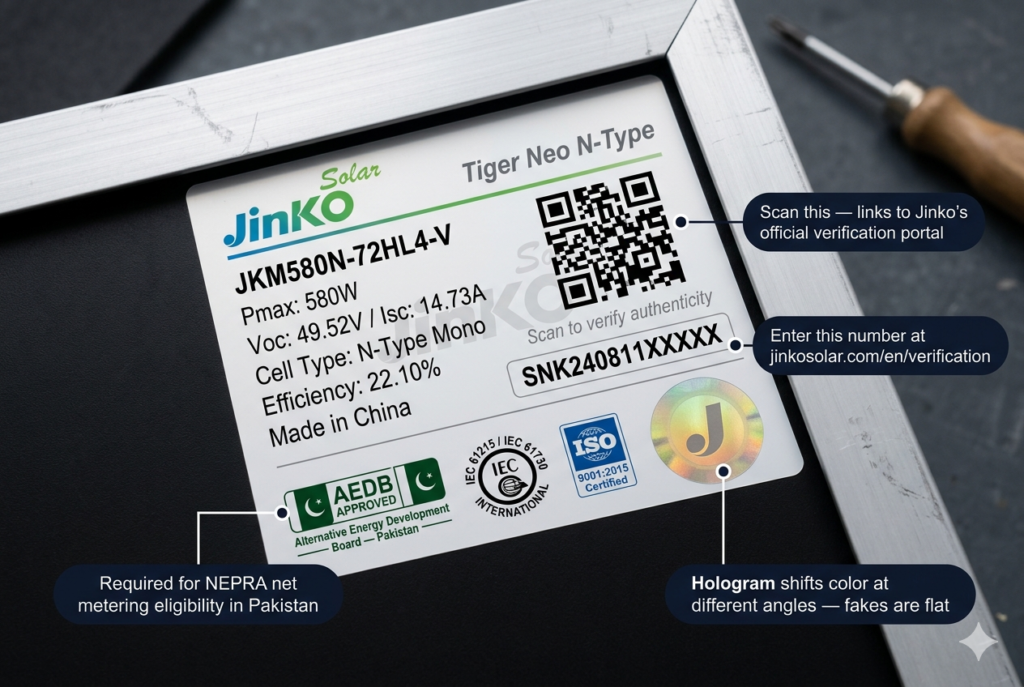
To verify a Jinko 580W panel before purchasing, follow these steps:
- Locate the serial number label on the panel’s back frame.
- Visit Jinko Solar’s official verification portal at jinkosolar.com/en/verification
- Enter the serial number a genuine panel returns full spec confirmation within seconds.
- Check for the AEDB (Alternative Energy Development Board) compliance stamp on the label.
- Confirm the dealer is listed as an authorized Jinko distributor on the same portal.
Buyers who skip this step and buy from unverified sources on Daraz or OLX frequently report receiving B-Grade or grey-market panels sold as A-Grade with no recourse after purchase.
The NEPRA 2026 Buyback Cut: What It Changes About Your Panel Choice
This is the section most price guides in Pakistan are completely ignoring right now.
In February 2026, NEPRA issued its Prosumer Regulations 2026, cutting the net metering buyback rate from approximately Rs. 27/unit to Rs. 10/unit for new installations. That’s a more than 60% reduction in what you’ll earn by exporting surplus solar power back to the grid.
Or maybe I should say it this way: the 3–5 year payback period that made Pakistani rooftop solar so compelling in 2023 and 2024 has now stretched to roughly 5–8 years for new buyers depending on system size, household consumption, and which panel variant they choose.
This directly affects which 580W variant is worth the premium. Here’s why: under the old Rs. 27/unit export rate, a higher-output N-Type bifacial panel that generates surplus was extremely valuable — you were paid well for every unit you exported. Under the new Rs. 10/unit rate, the financial return on surplus generation drops sharply, shifting the math toward right-sizing your system rather than maximizing panel output.
I’ve seen conflicting estimates from solar consultants on the updated payback period some say 6 years, others say 8, depending on assumptions about tariff escalation. My read is that 6–7 years is realistic for a well-sized N-Type 5–8 kW system at current prices, assuming electricity tariffs continue rising (which NEPRA’s own trajectory suggests they will).
Note: The NEPRA Prosumer Regulations 2026 primarily affect new installations. Existing net-metering users registered before February 2026 are grandfathered under the old terms — confirm your registration date with your DISCO.
Voice Search FAQs
What’s the best Jinko 580 watt panel to buy in Pakistan in 2026?
The Jinko N-Type 580W A-Grade Monofacial is the best balance of price and performance for most Pakistani residential buyers available at Rs. 22,040 to 28,750 from authorized dealers with AEDB compliance and full warranty documentation.
How do I know if my Jinko panel is genuine in Pakistan?
Scan or enter the serial number on the panel’s back label at Jinko Solar’s official verification portal at jinkosolar.com. Genuine A-Grade panels return full spec confirmation instantly. Always check before payment.
Why does the same 580 watt Jinko panel have different prices at different dealers?
Because “580 watt” covers multiple variants P-Type Mono PERC, N-Type Monofacial, and N-Type Bifacial with different cell technologies, degradation rates, and grade classifications. Always ask for the exact model name and A-Grade or B-Grade designation.
Should I buy N-Type or P-Type Jinko panels for my home in Pakistan?
N-Type TOPCon if you’re building a system you’ll keep for 10+ years better heat tolerance and slower degradation justify the Rs. 5–8/watt premium. P-Type Mono PERC if upfront cost or a short-term installation horizon is the priority.
When should I use bifacial over monofacial Jinko 580W panels?
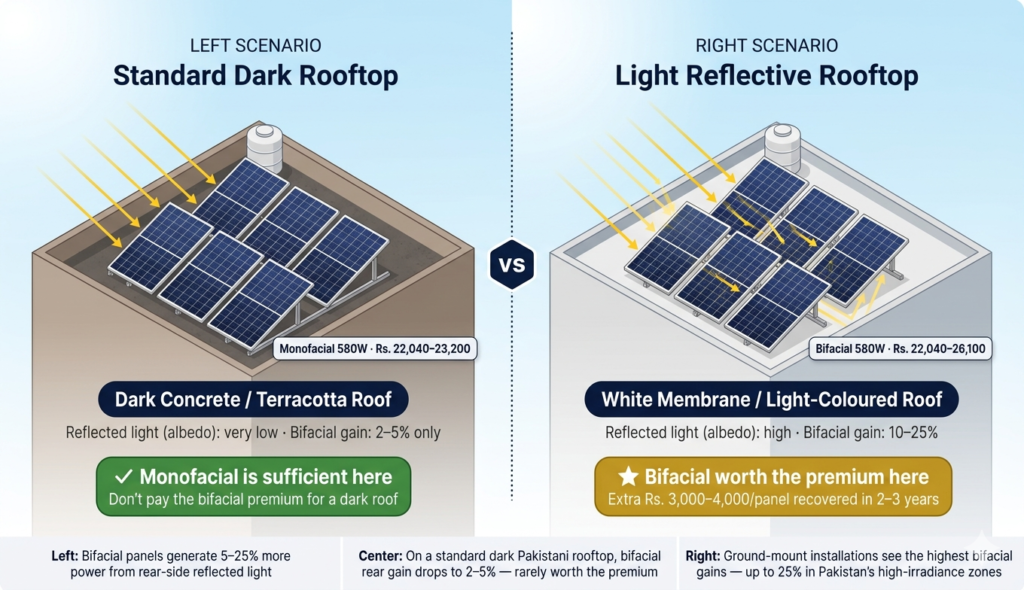
Use bifacial panels if your roof has a light-coloured or reflective surface, or if you’re doing a ground-mount installation they can generate 5–25% more power from reflected light. On a standard dark Pakistani rooftop, the bifacial premium rarely pays back.
Conclusion
For consumers looking to invest in superior solar energy solutions in Pakistan, the Jinko Solar Panel 580 Watt is a great option. The long-term advantages of lower electricity bills and more energy independence make it a smart investment, even though the initial cost may seem high. Now is an excellent moment to think about switching to solar power because of the market’s competitiveness and the government’s increased support.