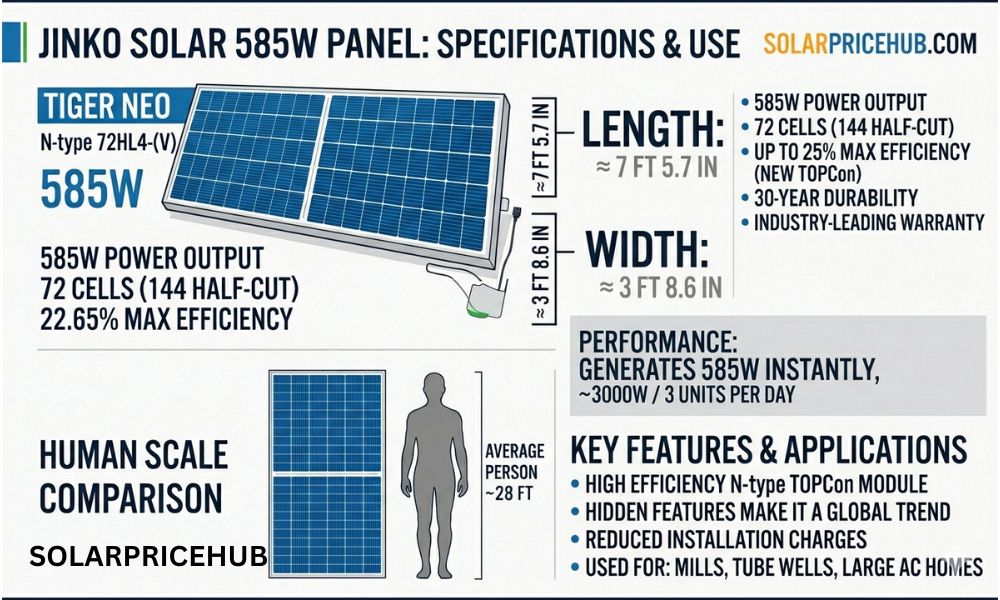
I physically measure the size of the Jinko 585-watt Solar Panel that is “7.5 feet in length by 3.7 feet in width” nowadays. I visited many shops in Lahore and Faisalabad to measure the sizes and latest prices.
It is very informative that an A Jinko 585-watt solar panel has a size of about 7 ft 5.7 in × 3 ft 8.6 in (≈ 7.47 ft × 3.72 ft) with a surface area of about 28 square feet, making it one of the largest solar panels in the world.
It is a high-efficiency N-type TOPCon module with 25% that delivers outstanding power density, long-term durability of 30 years, and one of the best performance warranties in the industry.
Jinko 585-watt Solar Panel can generate 585 watts of electricity at a time and 3000 watts in a day, which is equal to 3 units. Jinko solar panels are the most trending in the world because of their hidden features.
Jinko 585-watt Solar Panels are used to run heavy loads, mostly in the mills, tube wells, and big family homes with ACs as well. These large solar panels reduce installation charges.
Jinko 585-Watt Solar Panel Size in Feet
The Jinko 585W solar panel (model JKM585N-72HL4-V, part of the Tiger Neo series) has the following dimensions, and we will discuss the Jinko 585-Watt Solar Panel Size in Feet.
| Dimension | Millimeters (mm) | Feet & Inches |
|---|---|---|
| Length | 2,278 mm | 7 ft 5.7 in (≈ 7.47 ft) |
| Width | 1,134 mm | 3 ft 8.6 in (≈ 3.72 ft) |
| Thickness | 30–35 mm | 1.18–1.38 inches |
| Surface Area | ~2.58 m² | ≈ 27.8 sq ft |
Quick Answer: The Jinko 585W solar panel measures approximately 7 feet 5.7 inches long by 3 feet 8.6 inches wide, with a surface area of about 28 square feet.
It’s worth noting that the thickness varies slightly between variants. The standard mono-facial version (JKM585N-72HL4-V) comes with a 35mm frame, while the bifacial variant (JKM585N-72HL4-BDV) is available in both 30mm and 35mm frame versions. Neither variation affects the length or width.
Why Solar Panel Size Matters for Your Solar Project
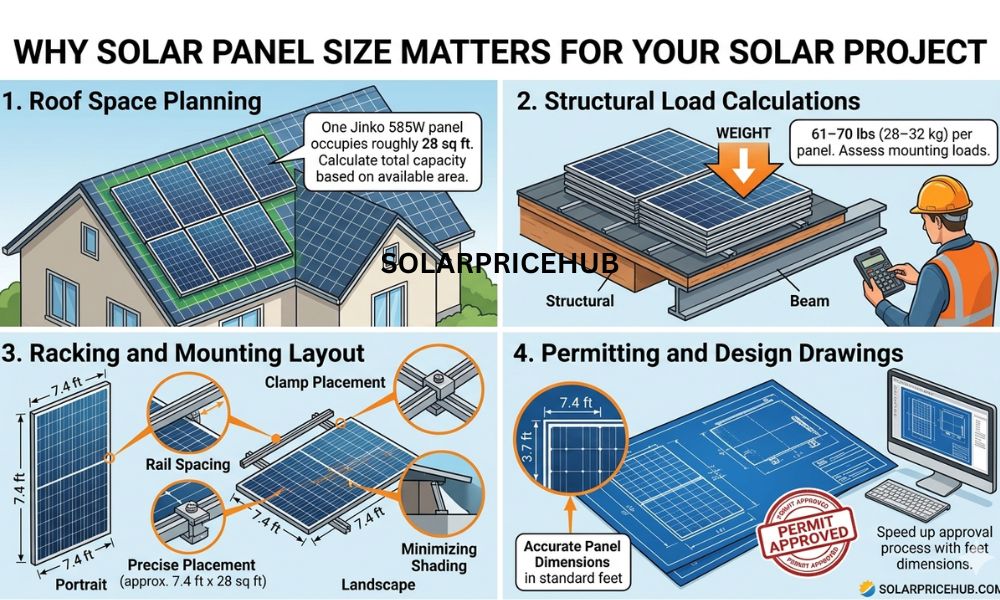
There, we will also discuss completely”Why Solar Panel Size Matters for Your Solar Project” one by one as follows.
Roof Space Planning: Every rooftop has a limited usable area. Knowing that one Jinko 585W panel occupies roughly 28 square feet allows you to calculate exactly how many panels fit on your roof and what total capacity you can achieve.
Structural Load Calculations: At approximately 28–32 kg (61–70 lbs) per panel, your roof structure needs to handle the combined weight. Engineers use both size and weight to assess mounting loads.
Racking and Mounting Layout: Whether you’re using portrait or landscape orientation, the exact dimensions in feet determine rail spacing, clamp placement, and row-to-row setback distances for minimizing shading.
Permitting and Design Drawings: Most permitting authorities require accurate panel dimensions in your system design drawings. Having the size in feet — the standard unit in the US — speeds up the approval process.
Full Technical Specifications of the Jinko 585W Solar Panel
There, we will also discuss “Full Technical Specifications of the Jinko 585W Solar Panel” in an easy table as follows.
Electrical Specifications (Standard Test Conditions)
| Parameter | Value |
|---|---|
| Rated Power (Pmax) | 585 Wp |
| Power Tolerance | 0 to +3% |
| Module Efficiency | ≈ 22.65% |
| Open Circuit Voltage (Voc) | 51.16 – 52.7 V |
| Max Power Voltage (Vmpp) | 42.52 – 44.02 V |
| Short Circuit Current (Isc) | 14.01 – 14.55 A |
| Max Power Current (Impp) | 13.29 – 13.76 A |
| Max System Voltage | 1000 / 1500 VDC |
| Series Fuse Rating | 25–30 A |
Temperature Coefficients
| Parameter | Value |
|---|---|
| Pmax Temp. Coefficient | −0.29% to −0.30% / °C |
| Voc Temp. Coefficient | −0.25% / °C |
| Isc Temp. Coefficient | +0.045% / °C |
| NOCT | 45 ± 2°C |
Mechanical Specifications
| Parameter | Value |
|---|---|
| Cell Type | N-Type Monocrystalline TOPCon |
| Cell Configuration | 144 cells (6 × 24 arrangement) |
| Frame Material | Anodized Aluminum Alloy |
| Glass | Anti-reflection tempered glass |
| Connector Type | JK03M or MC4 |
| Output Cable Length | 1,400 mm (12 AWG) |
| Wind Load Resistance | 2,400 Pa |
| Snow Load Resistance | 5,400 Pa |
| Operating Temperature | −40°C to +85°C |
Warranty
| Coverage | Term |
|---|---|
| Product (Workmanship) Warranty | 12 years |
| Linear Performance Warranty | 30 years |
| Annual Degradation Rate | ≈ 0.40% |
Jinko 585W Panel Size Comparison: How Does It Stack Up?
It helps to compare the Jinko 585W against other commonly used solar panel sizes to understand how it fits in the market. Here is a table to easily understand as follows.
| Panel | Wattage | Length | Width | Area (sq ft) |
|---|---|---|---|---|
| Standard Residential (60-cell) | 300–350W | ~5.4 ft | ~3.25 ft | ~17.5 |
| Standard Commercial (72-cell) | 400–450W | ~6.6 ft | ~3.3 ft | ~21.8 |
| Jinko Tiger Neo 585W | 585W | 7.47 ft | 3.72 ft | ~27.8 |
| Large-Format 700W+ | 700W+ | ~8.2 ft | ~3.9 ft | ~32 |
The Jinko 585W falls in the large-format commercial and utility range. Compared to a standard residential 350W panel, it produces roughly 67% more power while only being about 38% larger in area — a clear advantage in terms of watts per square foot (power density).
How Many Jinko 585W Panels Do You Need?
Now that you know the size, here’s a practical way to estimate how many panels your project requires.
Step 1: Calculate your energy needs. For example, a household consuming 1,200 kWh per month needs roughly a 10–12 kW system (assuming 4–5 peak sun hours daily).
Step 2: Divide by panel wattage. A 10,000W (10 kW) system divided by 585W per panel = approximately 17 panels.
Step 3: Calculate total roof area required. 17 panels × 27.8 sq ft = approximately 472 square feet of usable roof space (plus spacing between rows).
For a 20 kW commercial system, you’d need roughly 35 panels occupying about 970 square feet before accounting for row clearance.
Portrait vs. Landscape: Mounting Orientation
The Jinko 585W panel is most commonly installed in portrait orientation (tall/vertical) on residential rooftops, and landscape orientation (wide/horizontal) in utility ground mounts or commercial flat-roof systems.
Portrait (7.47 ft tall × 3.72 ft wide): Better for sloped residential rooftops. Allows more rows to fit vertically on a pitched roof. Most residential racking systems are designed around this orientation.
Landscape (3.72 ft tall × 7.47 ft wide): Common on ground mounts and flat commercial roofs. Lower profile makes wind loading calculations more favorable. Often used with tracker systems on utility farms.
In both cases, the panel’s 28 sq ft footprint remains the same — only the mounting geometry changes.
What Makes the Jinko 585W Tiger Neo Stand Out?
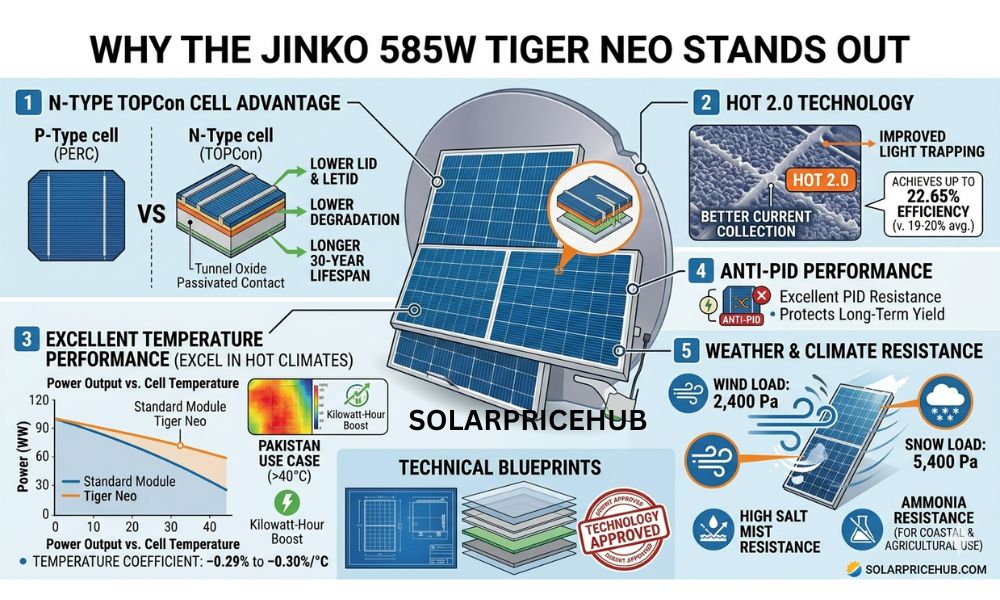
The Jinko 585W isn’t just popular because of its size-to-power ratio. Several advanced technologies set it apart.
N-Type TOPCon Cell Technology: Unlike older P-type panels that use PERC technology, the Tiger Neo uses N-type Tunnel Oxide Passivated Contact (TOPCon) cells. This results in lower light-induced degradation (LID) and light and elevated temperature-induced degradation (LETID), meaning the panel holds its efficiency longer over its 30-year lifespan.
HOT 2.0 Technology: Jinko’s proprietary Hot 2.0 process improves light trapping and current collection within each cell. This is why the 585W achieves up to 22.65% efficiency — significantly above the 19–20% average for many commercial panels.
Excellent Temperature Performance: With a temperature coefficient of −0.29% to −0.30%/°C, this panel loses less power in hot weather compared to many competing modules. In a country like Pakistan, where summer temperatures frequently exceed 40°C, this characteristic translates directly into more kilowatt-hours generated annually.
Anti-PID Performance: Potential Induced Degradation (PID) can silently rob panels of efficiency over the years. The Tiger Neo’s N-type architecture provides excellent anti-PID performance, protecting long-term yield.
Weather Resistance: With a wind load tolerance of 2,400 Pa and snow load tolerance of 5,400 Pa, the panel is engineered for extreme climates. It also carries high salt mist and ammonia resistance ratings, making it suitable for coastal and agricultural environments.
Jinko 585W Solar Panel Variants: Bifacial vs. Mono-Facial
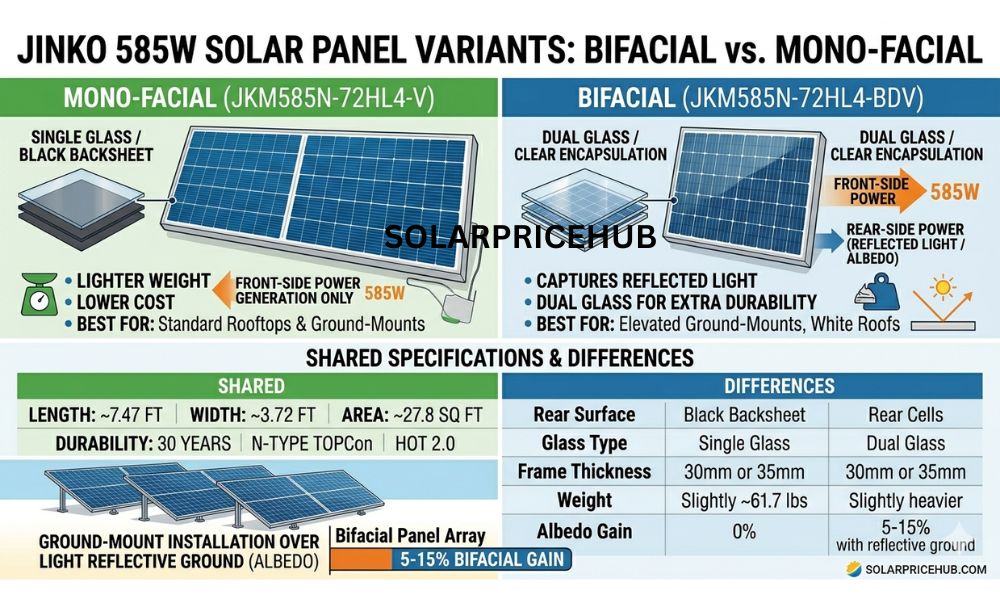
The 585W Tiger Neo is available in two main configurations, and here, we will also discuss them in detail as follows.
Mono-Facial (JKM585N-72HL4-V): Generates power from the front surface only. Slightly lighter and lower cost. Best for most standard rooftop and ground-mount applications.
Bifacial (JKM585N-72HL4-BDV): Generates power from both the front and rear surfaces. The rear side can capture reflected light (albedo) from ground surfaces below. On a white or light-colored ground, bifacial gain can add 5–15% additional energy yield. Best for ground-mount systems, elevated flat roofs, or installations over reflective surfaces.
Both variants share the same length, width, and core electrical specs. The key differences are the rear glass type, frame thickness options (30mm or 35mm), and slight weight variation.
Certifications and Quality Standards
The Jinko 585W Tiger Neo holds a comprehensive set of international certifications, confirming its reliability for professional solar installations:
- IEC 61215 – Design Qualification and Type Approval
- IEC 61730 – Safety Qualification
- UL 61730 – North American safety standard
- ISO 9001:2015 – Quality Management Systems
- ISO 14001:2015 – Environmental Management
- ISO 45001:2018 – Occupational Health and Safety
- CE Marking – European Conformity
These certifications make the panel eligible for use in virtually every major solar market worldwide, including the US, Europe, the Middle East, and South Asia.
Installation Tips for the Jinko 585W Solar Panels
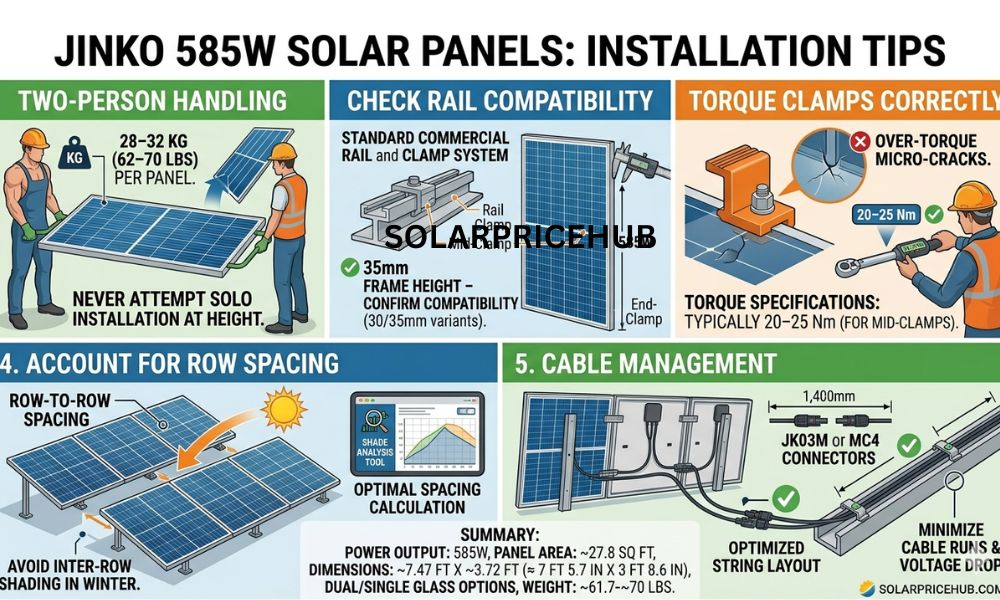
Given its size of approximately 7.5 ft × 3.7 ft, here are a few practical tips for installers that will help them to set it properly.
Two-Person Handling: At 28–32 kg (62–70 lbs), this panel requires two people to safely lift and position on a roof or rack. Never attempt a solo installation at height.
Check Rail Compatibility: The 35mm frame height is standard across most commercial racking systems, but always confirm your rail and clamp specifications before ordering hardware.
Torque Clamps Correctly: Over-torquing aluminum clamps can micro-crack the glass near the frame. Follow the racking manufacturer’s torque specifications, typically 20–25 Nm for mid-clamps.
Account for Row Spacing: On ground mounts, row-to-row spacing must account for the panel’s height and your installation latitude to avoid inter-row shading during winter months. Use a shade analysis tool to determine the optimal spacing.
Cable Management: The 1,400mm output cables with JK03M or MC4 connectors provide good flexibility for stringing. Plan your string layout before installation to minimize cable runs and voltage drop.
Final Thoughts
The Jinko 585-watt solar panel measures 7 ft 5.7 in × 3 ft 8.6 in (≈ 7.47 ft × 3.72 ft) with a surface area of about 28 square feet.
It’s a large-format, high-efficiency N-type TOPCon module that delivers outstanding power density, long-term durability, and one of the best performance warranties in the industry.