
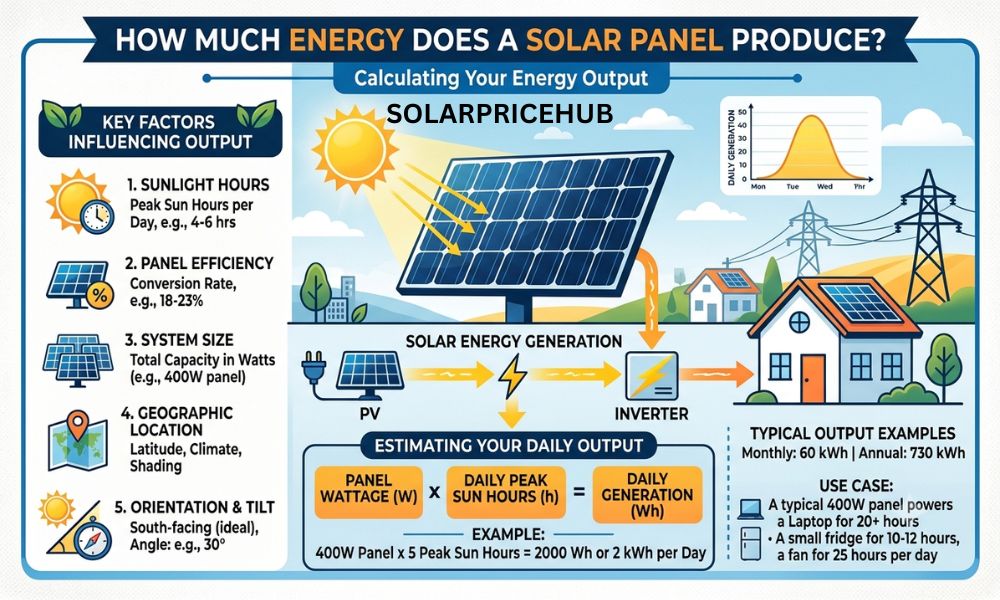
Energy Does a solar panel produces depends on the solar panel size as well as the wattage or quality of solar panels. It also depends on the weather conditions, like a sunny day helps solar panels to generate maximum power. Clean solar panels generate full amounts of power.
It also depends on the technology of solar panels, like N-Type Bifacial solar panels generate more electricity than P-Type Mono Facial nowadays. The latest solar panels are more capable than old solar panels because of their high efficiency rate.
In the summer season, solar panels get maximum sunlight and generate maximum solar power because of getting clear sunlight for many hours, such as 5 to 6 hours. On the other hand, in the winter season, they get less sunlight for fewer sunny hours, like 3 to 4 hours or sometimes less.
A 540W N-Type Bifacial solar panel generates 500 watts of power on sunny summer days and about 300 watts in the winter season. A 540W P-Type Monofacial solar panel generates 400 watts of power on sunny summer days and about 200 watts in the winter season.
The Simple Answer: How Much Energy Does a Solar Panel Produce?
A normal solar panel used in homes today makes between 300 watts and 600 watts of power when the sun is shining directly on it.
| Panel Wattage (Rated) | Daily Energy (kWh) @ 4 Peak Sun Hours | Daily Energy (kWh) @ 5 Peak Sun Hours |
| 350W | ~1.05 kWh | ~1.31 kWh |
| 400W | ~1.20 kWh | ~1.50 kWh |
| 450W | ~1.35 kWh | ~1.69 kWh |
| 500W+ (Commercial) | ~1.50 kWh | ~1.88 kWh |
My personal experience: The most common panels people install in Pakistan right now are around 545 watts, 580 watts, or 620 watts per panel.
How Many Units Does One Solar Panel Make in a Day?
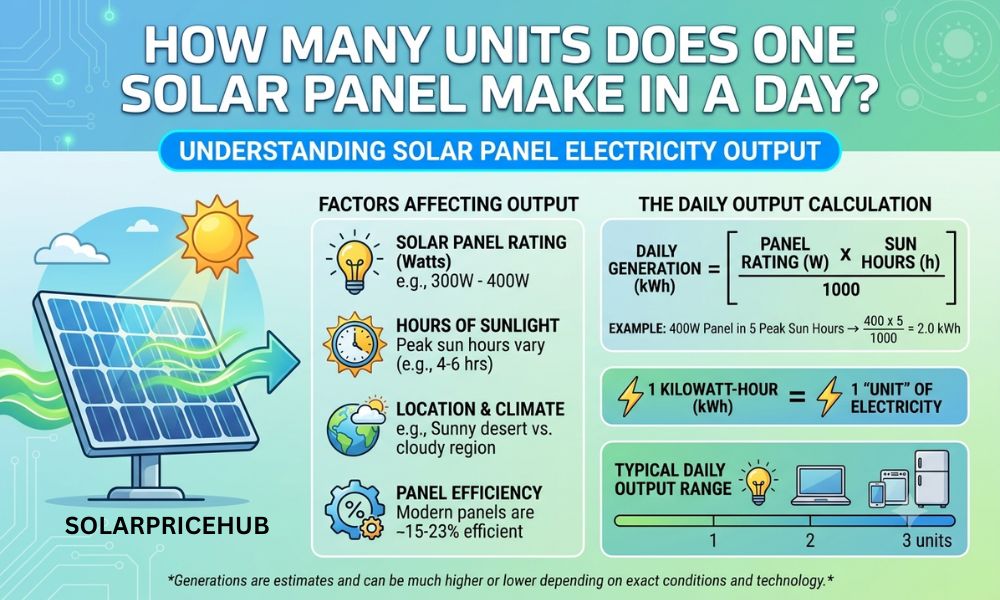
This depends on three simple things:
- The size (wattage) of the panel
- How many hours of strong sunlight does your area get
- How clean and well-placed the panel is
My personal experience: In most cities of Pakistan, we get around 5 to 6 hours of strong, usable sunlight per day on average across the year. Some months, like June and July, give more, and winter months like December and January give less.
| Solar Panel Wattage | @ 3 Peak Sun Hours | @ 5 Peak Sun Hours | @ 7 Peak Sun Hours |
| 300W | 0.72 kWh | 1.20 kWh | 1.68 kWh |
| 400W | 0.96 kWh | 1.60 kWh | 2.24 kWh |
| 500W | 1.20 kWh | 2.00 kWh | 2.80 kWh |
| 600W | 1.44 kWh | 2.40 kWh | 3.36 kWh |
How to Calculate the Energy Generation Of A Solar Panel?
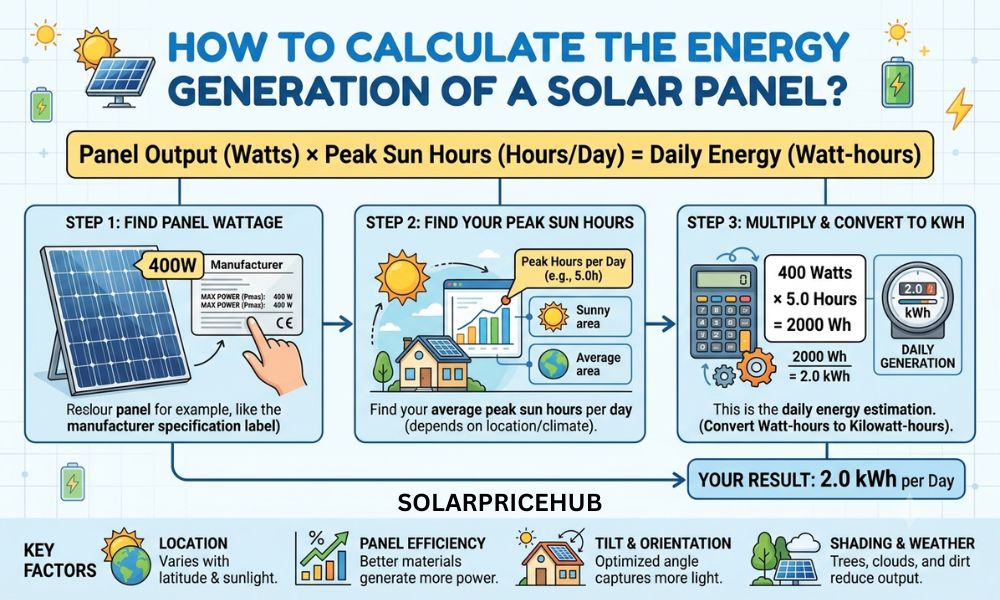
Here is a simple way to calculate it:
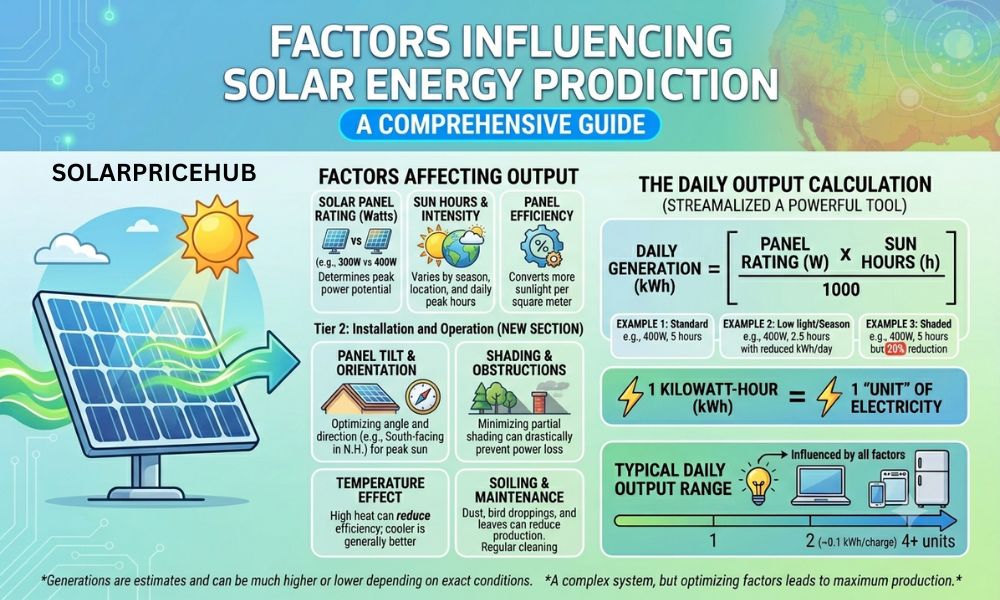
- Panel Wattage ÷ 1000 × Sunlight Hours = Units Produced in a Day
- Let’s try it with a real example.
- If you have a 550-watt solar panel, and your area gets 5.5 hours of strong sunlight on average:
- 550 ÷ 1000 = 0.55
- 0.55 × 5.5 = around 3 units per day
- So one 550W panel gives you roughly 3 units a day, which adds up to about 90 units in a month.
My pro tip: I always tell people to remember this number loosely: a good quality panel gives you about 1.5 to 2 units per day for every 300 watts of its size, depending on your city and the season.
How Many Units Does One Solar Panel Make in a Month in 2026?
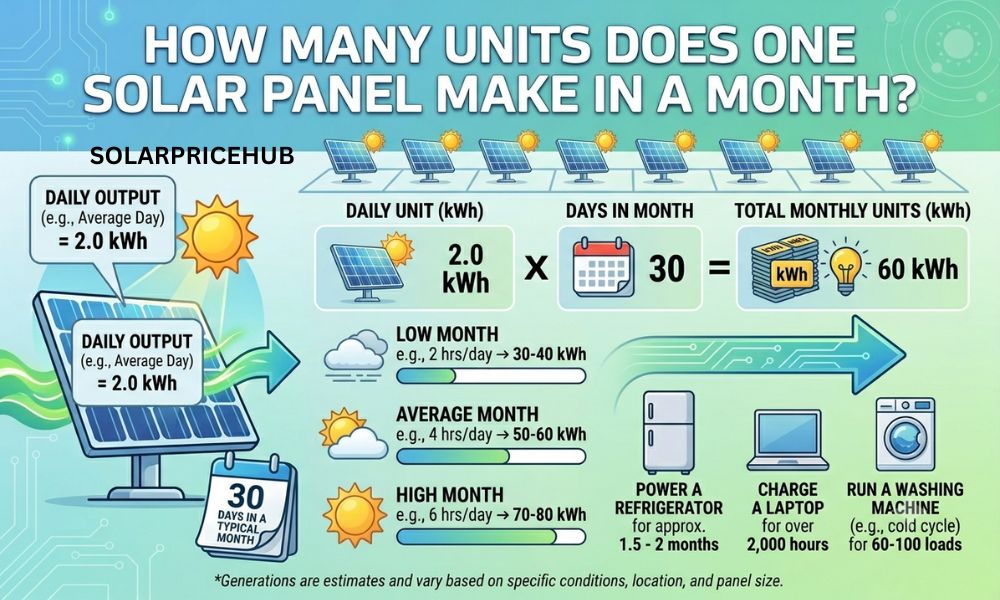
There, we will completely discuss a 400W solar panel energy generation in a month in winter as well as summer.
| Daily Peak Sun Hours | Daily Output (Units/kWh) | Monthly Output (30 Days) |
| 2 Hours (Winter/Cloudy) | 0.8 kWh | 24 kWh |
| 4 Hours (Average) | 1.6 kWh | 48 kWh |
| 5 Hours (Good/Sunny) | 2.0 kWh | 60 kWh |
| 6 Hours (Excellent/Summer) | 2.4 kWh | 72 kW |
How Many Units Does One Solar Panel Make in a Year in 2026?
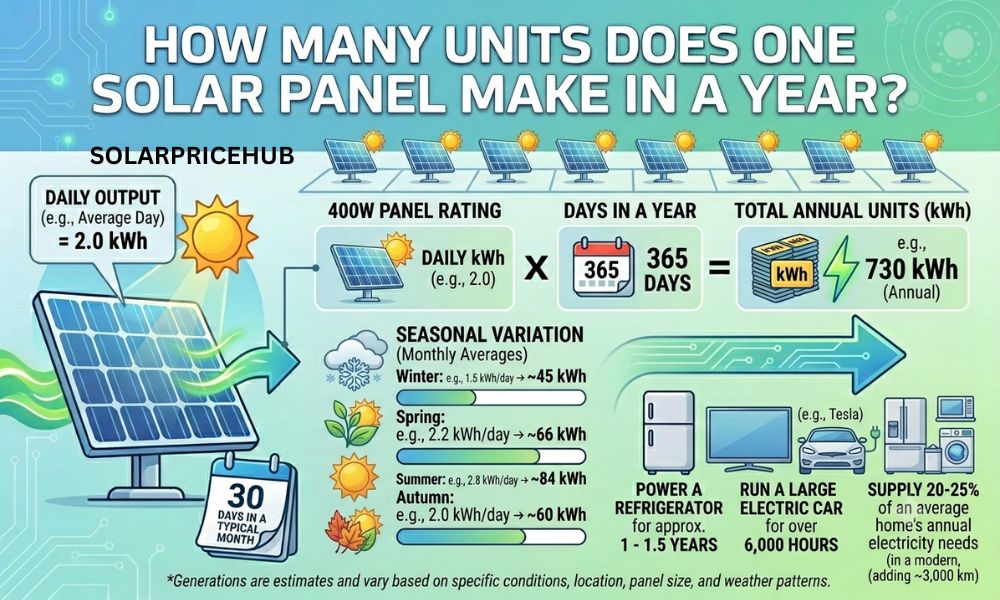
There, we will completely discuss a 400W solar panel energy generation in a month in winter as well as summer.
| Average Daily Peak Sun Hours | Daily Output (kWh) | Annual Output (365 Days) |
| 3 Hours (Low sunlight/Cloudy) | 1.2 kWh | ~438 kWh |
| 4 Hours (Moderate) | 1.6 kWh | ~584 kWh |
| 5 Hours (Good/Average) | 2.0 kWh | ~730 kWh |
| 6 Hours (Excellent/Sunny) | 2.4 kWh | ~876 kWh |
A Quick Table for Easy Understanding
Here is a simple table showing roughly how much energy different panel sizes can produce in a day and in a month, assuming average sunlight of around 5.5 hours.
| Panel Size | Units Per Day (Approx) | Units Per Month (Approx) |
|---|---|---|
| 100 Watt | 0.5 to 0.6 units | 15 to 18 units |
| 300 Watt | 1.5 to 1.8 units | 45 to 54 units |
| 400 Watt | 2.0 to 2.4 units | 60 to 72 units |
| 550 Watt | 2.8 to 3.2 units | 84 to 96 units |
| 580 Watt | 3.0 to 3.4 units | 90 to 102 units |
| 620 Watt | 3.2 to 3.6 units | 96 to 108 units |
Please remember, these numbers are not exact for every single day. Some days will be cloudy, some days will be extra sunny. Think of this table as a fair average, not a guarantee.
Solar Production Estimates (400W Solar Panel)
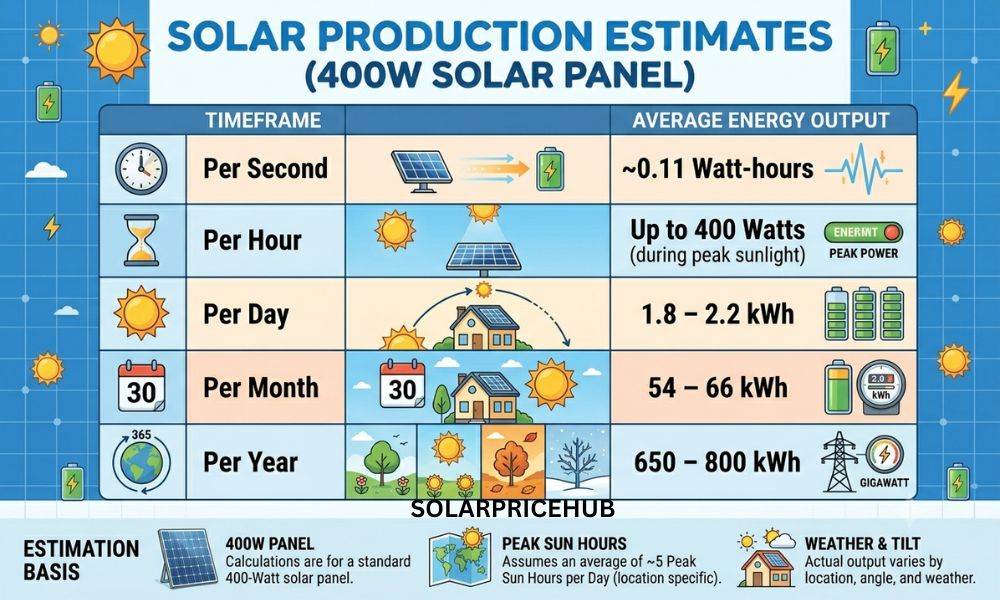
| Timeframe | Average Energy Output |
| Per Second | ~0.11 Watt-hours |
| Per Hour | Up to 400 Watts (during peak sunlight) |
| Per Day | 1.8 – 2.2 kWh |
| Per Month | 54 – 66 kWh |
| Per Year | 650 – 800 kWh |
My Own Experience With This
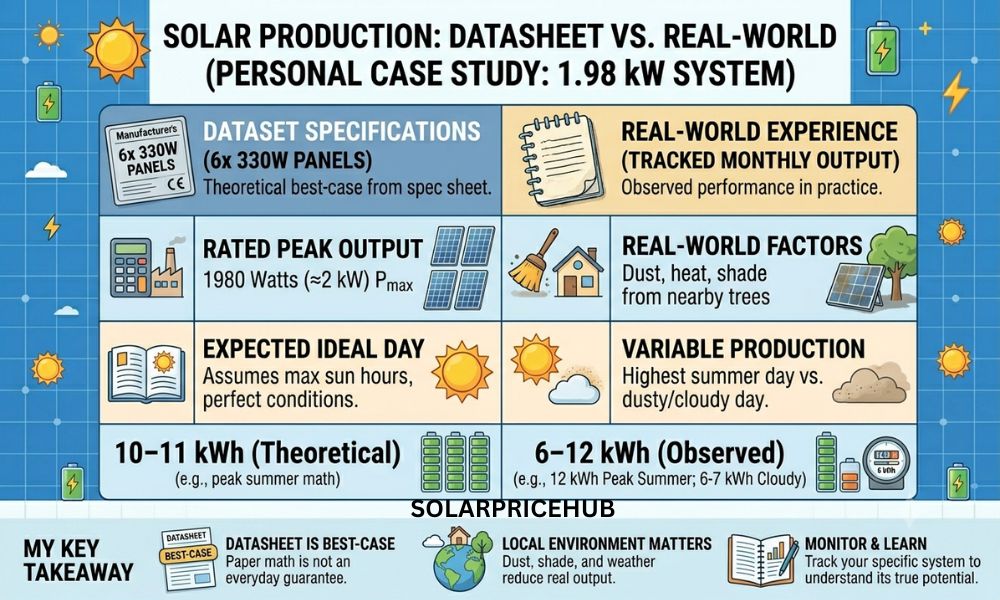
I remember the first time I actually sat down and tracked a solar system’s output for a full month, just out of curiosity. I had access to a small system with six panels, each rated at 330 watts, so a total of about 1980 watts (close to 2 kilowatts).
On paper, simple math suggested this system should make around 10 to 11 units a day. But in real life, during the peak of summer, it actually touched 12 units on the brightest days, and dropped to 6 or 7 units on cloudy or dusty days.
That difference taught me something important: the numbers on a datasheet are the best-case scenario, not the everyday guarantee. Real homes deal with dust, heat, shade from nearby buildings, and cloudy weather, all of which slightly lower the output.
Why Does Energy Output Change Throughout the Year?
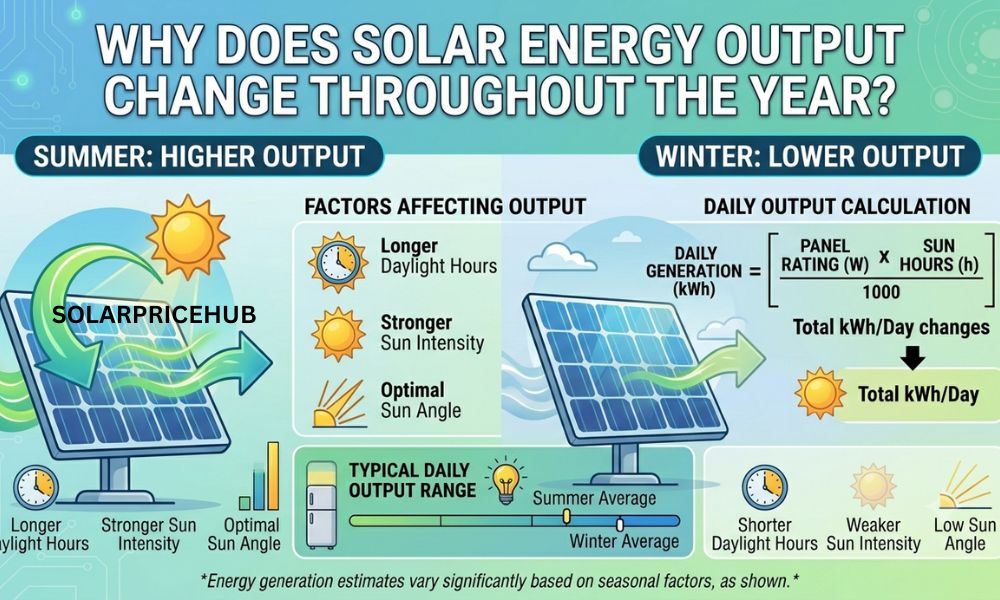
This is something a lot of beginners do not expect. Solar panels do not make the same amount of energy every single day of the year. Summer months are not always the best, and winter is not always the worst, surprisingly.
Here is why:
Summer (May to August): Days are longer, and sunlight is strong, but extreme heat can actually slightly reduce a panel’s efficiency. Yes, panels do not love being too hot, just like people do not enjoy standing outside at 45°C for too long.
Spring and Autumn (March, April, September, October): This is often the sweet spot. Good sunlight, not too much extreme heat, and clear skies in many cities.
Winter (November to February): Days are shorter, and the sun sits lower in the sky, so total sunlight hours are reduced. Output usually drops noticeably during these months, especially in foggy areas like parts of Punjab in December and January.
So when people plan their solar system size, I always suggest using winter as your safety guide, not summer. If your system gives you enough power even in weak winter sun, summer will always feel like a bonus.
What Affects How Much Energy a Solar Panel Produces?
1. Sunlight Hours in Your City
It is very informative news that Cities like Multan, Bahawalpur, and parts of Sindh generally get strong, long hours of sunlight almost all year. Cities like Lahore, Islamabad, and northern areas can have more cloud cover and fog, especially in winter, which slightly reduces output.
2. Angle and Direction of the Panel
It is very informative news that A solar panel facing south (in Pakistan) and tilted at the right angle will always perform better than one lying flat or facing the wrong direction. I always tell people, even a small mistake in angle can quietly cost you units every single day without you noticing.
3. Dust and Dirt
This is the most underestimated factor. Pakistan has a lot of dust, especially before the monsoon season. A dusty panel can lose 10 to 25 percent of its output, sometimes even more if it has not been cleaned in a long time.
My personal tip: clean your panels gently with plain water and a soft cloth or soft brush every couple of weeks, especially in dusty months.
Important notice: Avoid using strong chemicals or rough brushes, since scratching the glass surface can permanently reduce performance.
4. Shade
It is very informative news that even a small shadow from a tree branch, a wall, or a water tank falling on just one corner of a panel can reduce the output of the whole panel, not just that shaded part.
This surprises a lot of people. Solar panels are sensitive to partial shading because of how their internal cells are connected.
5. Temperature
It is very informative news that Solar panels actually work best in bright but cool conditions, not extremely hot conditions. This is why a clear spring day can sometimes outperform a scorching July afternoon, even though July feels hotter and sunnier.
6. Panel Quality and Age
It is very informative news that A-grade panels from trusted brands tend to perform closer to their rated output and lose efficiency more slowly over the years.
My personal experience: Lower quality panels may produce less from day one, and their output can drop faster as years pass.
How Much Energy Does a Full Solar System Produce?
Most homes do not just install one single panel. They install a system made of many panels together. So let’s look at full system examples too, since this is usually what readers actually want to know before buying.
| System Size | Approx Panels Needed (550W each) | Units Per Day (Approx) | Units Per Month (Approx) |
|---|---|---|---|
| 3 kW System | 5 to 6 panels | 15 to 18 units | 450 to 540 units |
| 5 kW System | 9 to 10 panels | 25 to 30 units | 750 to 900 units |
| 10 kW System | 18 to 19 panels | 50 to 60 units | 1500 to 1800 units |
My pro tip: These numbers assume average sunlight conditions and a clean, well-placed system. A home using around 600 to 700 units a month would usually be comfortable with a 5kW system, while bigger homes or homes running ACs heavily often go for 8kW, 10kW, or more.
A Simple Way to Estimate Your Own Need At Home 2026
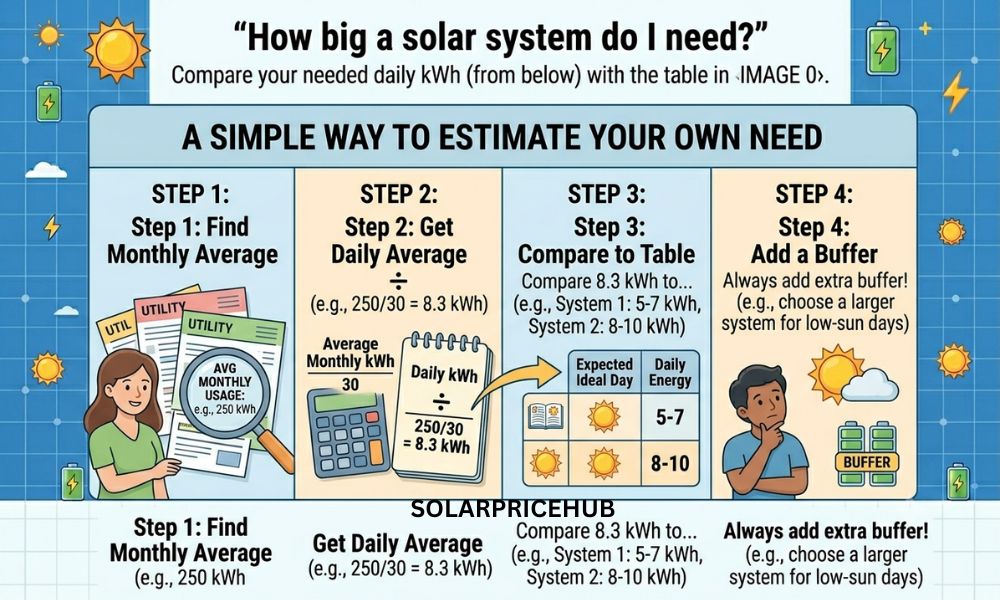
Whenever someone asks me how big a solar system they need, I tell them to follow these easy steps:
Step 1: Look at your last few electricity bills and find your average monthly units used.
Step 2: Divide that number by 30 to get your daily average usage.
Step 3: Compare that daily number to the system sizes in the table above.
Step 4: Always add a little extra buffer, because real-life output is usually slightly lower than perfect lab numbers, especially in winter.
My personal experience: This simple method has helped a lot of people avoid both mistakes — buying a system too small (and still getting high bills) or buying a system too big (and spending extra money for nothing).
(FAQs)
Q: Does a solar panel produce energy on a cloudy day?
Yes, but much less. On a cloudy day, a panel might only produce 10 to 25 percent of what it makes on a clear sunny day. It is not zero, but it is a noticeable drop.
Q: Does a solar panel work at night?
No. Solar panels need light from the sun to produce energy. At night, they produce nothing, which is why most solar systems are paired with batteries or stay connected to the regular electricity grid for nighttime use.
Q: Why is my solar panel not producing as much energy as advertised?
This is usually because of dust, shading, wrong angle, ageing, or simply because the rated wattage on the box is the maximum possible output under perfect lab conditions, not everyday real conditions.
Q: How long do solar panels keep producing energy well?
Good quality panels usually keep working well for 20 to 25 years or more, though their output very slowly reduces year by year. This slow reduction is completely normal and is even mentioned in most manufacturer warranties.
Q: Does panel color or design affect energy output?
Not really by much. What matters far more is the actual technology inside the panel (like the type of solar cells used), the brand quality, and how well it is installed, rather than its color or outer look.
Q: Can dust really make that much difference?
Yes, surprisingly, dust is one of the biggest silent reasons for low output in many homes. A few weeks of neglect can quietly cost a noticeable number of units every single month.
How much energy does a solar panel produce per day?
A standard 400W panel produces around 1.6 to 2 units (kWh) per day in Pakistan, depending on sunlight hours and panel placement.
How much energy does a solar panel produce per year?
A 400W solar panel can produce roughly 580 to 700 units (kWh) per year, depending on weather, location, and dust on the panel.
How much energy does a solar panel produce per month?
A 400W panel usually produces between 48 and 60 units (kWh) per month, depending on sunlight and season.
How much energy do 12 solar panels produce per day?
12 panels of 400W each (4.8kW total) can produce around 19 to 24 units (kWh) per day under good sunlight.
How much energy does a solar panel produce per kWh?
This is usually asking the reverse — a 1kW solar system produces about 4 to 5 units (kWh) per day in Pakistan on average.
How much energy does a solar panel produce per hour?
A 400W panel produces close to 0.3 to 0.4 units (kWh) per hour during peak sunlight hours (around 10 AM to 3 PM).
How much energy does a solar panel produce per second?
At peak output, a 400W panel produces about 400 joules per second (400 watts), which is too tiny a unit to matter in daily use.
How much power does a solar panel produce per m²?
On average, solar panels produce around 150 to 200 watts per square meter under full sunlight, depending on panel efficiency.
My Honest Personal Tips Before You Decide 2026
After going through datasheets, talking to many installers, and watching real systems work month after month, here are a few honest tips I always share with people:
- Do not just trust the wattage number on the box. Ask the installer what real daily output you should expect in your specific city, not a generic number copied from a brochure.
- Always clean your panels regularly, especially before and after dusty seasons. This single habit alone can protect a good chunk of your expected output.
- Plan your system size based on winter performance, not summer. This way, you are never caught off guard during shorter, weaker sunlight months.
- Choose a good, clear south-facing angle wherever possible, since even a small mistake here adds up to real losses over a full year.
- Be patient in your first year. Real-world output often becomes more predictable and easier to understand once you have lived through one full year with your system, from summer to winter and back again.
Final Thoughts
Energy Does a solar panel produces depends on the solar panel size as well as the wattage or quality of solar panels.
It also depends on the weather conditions, like a sunny day helps solar panels to generate maximum power. Clean solar panels generate full amounts of power.
It also depends on the technology of solar panels, like N-Type Bifacial solar panels generate more electricity than P-Type Mono Facial nowadays.
The latest solar panels are more capable than old solar panels because of their high efficiency rate.
In the summer season, solar panels get maximum sunlight and generate maximum solar power because of getting clear sunlight for many hours, such as 5 to 6 hours.
On the other hand, in the winter season, they get less sunlight for fewer sunny hours, like 3 to 4 hours or sometimes less.

I am Muhammad SHAHID, and my education is a Master’s in IT at GCUF. Muhammad Shahid is a passionate solar energy researcher, writer, and renewable energy enthusiast with years of experience in the solar industry.