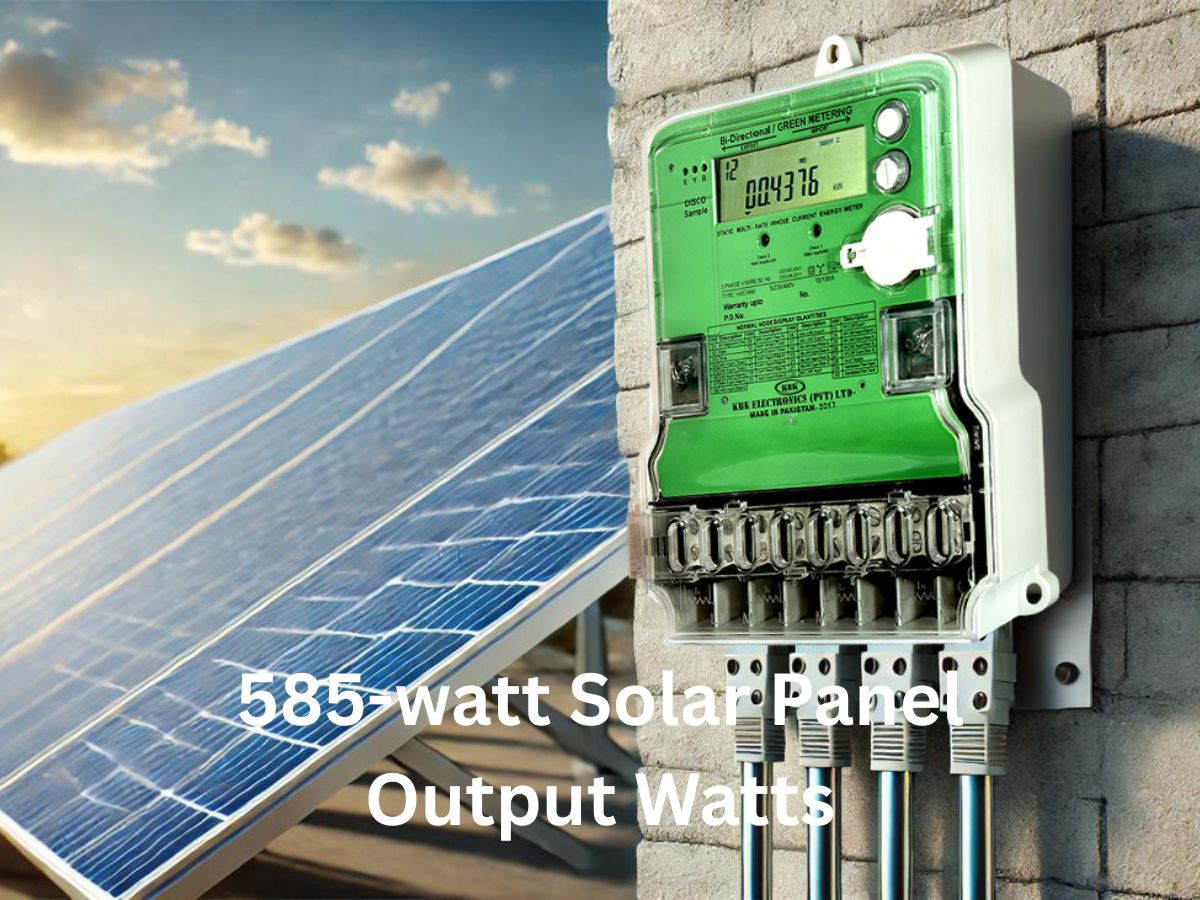
I have verified physically that A 585-watt Solar Panel Output is about 585 watts at a time and 3000 watts or 3 units of electricity on a sunny day like summer in the world. It is the most trending solar panel that can power many appliances, such as fans, lights, an air-water cooler, mobile chargers, and laptops.
Winter Season: It is very important to note that it will generate less solar power in the winter season due to the availability of less sunlight. In the winter season, it can generate only 1500 watts in a day and about 250 watts at a time. Always install the best solar panels to generate more electricity for 25 years.
But on foggy or rainy days, it will generate very little electricity because solar panels work better only when sunlight is abundant. So my recommendation is to generate more electricity and install it on hot summer days.
A 585-watt Solar Panel Output in a month is about 90,000 watts or 90 units, which means it can save us 100 rupees daily and 3000 rupees monthly in Pakistan. A 585-watt Solar Panel is used to generate large amounts of solar power to run heavy appliances like solar tube well, ACs, and solar atta chakki in Pakistan.
My neighbour installed this solar panel at home last year, and he said that it generates a huge amount of electricity and it can only run a small home with its appliances.
What is a 585-Watt Solar Panel?
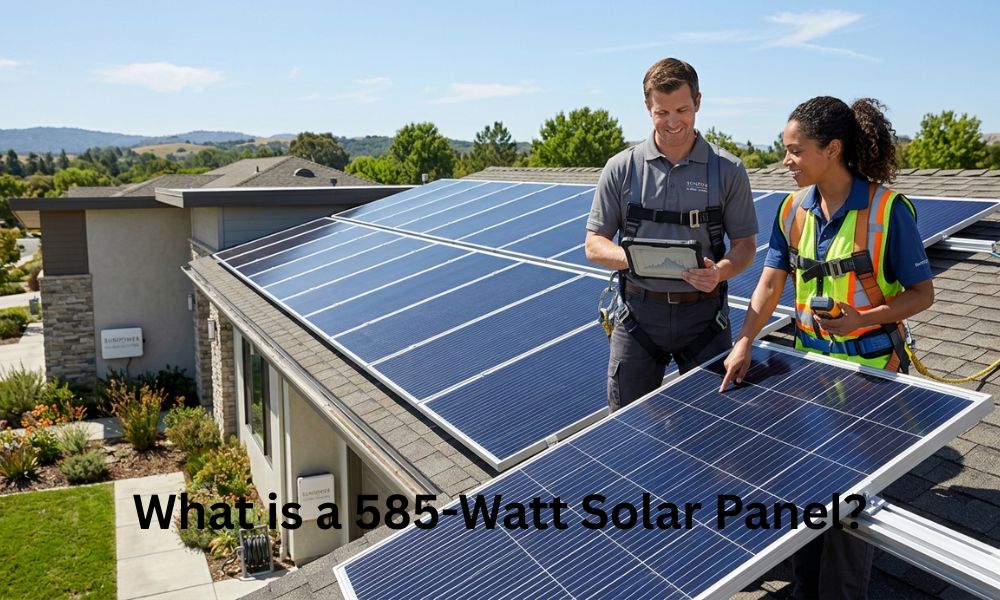
It is very informative news that A 585-watt solar panel is a photovoltaic (PV) module rated to produce 585 watts of electrical power under Standard Test Conditions (STC). It sits at the higher end of the residential and commercial panel market, delivering more power per panel than most systems installed even five years ago.
My personal experience: These solar panels are physically large, typically around 2.3 meters long by 1.13 meters wide, and weigh between 30 and 36 kilograms. Do you want to know full specifications of a 585-watt solar panel?
They use monocrystalline silicon cells, usually built with advanced cell technologies like TOPCon or HJT, which push cell efficiency above 22%.
Understanding the STC Rating of a 585-watt solar panel
The 585W rating is measured under laboratory-controlled Standard Test Conditions, and here we will discuss some secrets as follows.
- Irradiance: 1,000 W/m² (full, direct sunlight)
- Cell temperature: 25°C (77°F)
- Air mass: 1.5 (standardised solar spectrum)
These conditions represent the ideal scenario, something that rarely occurs perfectly in the real world. On a hot summer day, your panel’s surface might reach 55–65°C, which alone can cut output by 15–25%.
How Does 585W Compare to Other Panel Sizes?
| Panel Wattage | Typical Efficiency | Best Suited For |
|---|---|---|
| 400W | ~20% | Standard residential, budget builds |
| 450W | ~21% | Residential, light commercial |
| 500W | ~21.5% | Residential, rooftop commercial |
| 550W | ~22% | Large residential, commercial |
| 585W | ~22.5% | Premium residential, commercial, industrial |
| 620W+ | ~23%+ | Utility-scale, ground-mount projects |
The 585W panel offers a compelling middle ground, high enough output to be genuinely productive, but not so physically large or heavy that it becomes impractical for most residential roofs.
Real-World Output: What to Actually Expect
This is where things get practical. Forget the lab. Let’s talk about what a 585-watt panel will produce on your roof, in your climate, over a full year.
The Core Formula
The simplest way to estimate output is:
Daily Output (kWh) = Panel Wattage (kW) × Peak Sun Hours × System Efficiency
System efficiency accounts for inverter losses, wiring resistance, soiling, and temperature derating — typically around 75–82% for a well-designed system. Using 80% as a reasonable middle estimate:
585W × 0.80 = 468W effective output per peak sun hour
Daily Output by Location
Peak sun hours vary enormously by geography. Here is what you can expect from a single 585W panel in different parts of the world:
| Location | Peak Sun Hours/Day | Daily Output | Annual Output |
|---|---|---|---|
| Northern Europe (UK, Germany) | 2.5–3.5 hrs | 1.2–1.6 kWh | 430–590 kWh |
| US Northeast, Canada | 3.5–4.5 hrs | 1.6–2.1 kWh | 590–770 kWh |
| Central US, Central Europe | 4.5–5.0 hrs | 2.1–2.3 kWh | 770–840 kWh |
| US Southeast, Mediterranean | 5.0–5.5 hrs | 2.3–2.6 kWh | 840–950 kWh |
| Texas, Arizona, Spain, Australia | 5.5–6.5 hrs | 2.6–3.0 kWh | 950–1,100 kWh |
| Middle East, South Asia, North Africa | 6.0–7.0 hrs | 2.8–3.3 kWh | 1,020–1,200 kWh |
These are per-panel figures. A 10-panel system multiplies these numbers by ten, giving you a realistic whole-system production estimate.
Annual Output: The Bigger Picture
Over the course of a full year, accounting for seasonal variation, weather, and system losses, a single 585W panel installed in a good location (5 peak sun hours average) will produce approximately 1,000–1,100 kWh annually.
To put that in context:
- The average US household uses about 10,500 kWh per year
- A 10-panel 585W system (5.85kW) could cover roughly 95–105% of that demand
- A 6-panel system (~3.5kW) would cover around 55–65%
What Can a 585-Watt Panel Power?
It is very informative news that on a good sunny day, producing approximately 2.9 kWh, a single 585W panel can generate enough electricity to:
Household Appliances (Daily Runtime)
- Refrigerator: Run a modern energy-efficient fridge for an entire day (they use 1.0–1.5 kWh/day)
- LED lighting: Power 10 LED bulbs (10W each) for nearly 29 hours
- Washing machine: Run one full wash cycle (uses approximately 0.5–1.0 kWh per cycle)
- Laptop: Fully charge a laptop 8–12 times
- Television: Power a 55-inch LED TV for 8–10 hours of viewing
- Ceiling fan: Run continuously for nearly three full days
Bigger Energy Uses (Partial Coverage)
- Electric vehicle charging: Deliver approximately 10–15 km of EV range per day
- Air conditioning: Cover about 1.5–2 hours of a mid-size split AC unit (1.5 kW)
- Water heater: Contribute meaningfully to solar water heating when paired with a diverter
Of course, in a real system with multiple panels, these numbers scale proportionally. A 10-panel 585W array producing 29 kWh on a sunny day can comfortably power an entire medium-sized home.
Factors That Reduce the Output of 585-watt solar panels
There are also many Factors That Reduce the Output of 585-watt solar panels, and here we will discuss them one by one.
Temperature Coefficient
Every solar panel has a temperature coefficient, usually expressed as a percentage per degree Celsius above 25°C. For most 585W panels, this figure sits around -0.30% to -0.35%/°C.
If your panel surface reaches 60°C on a hot day (35°C above the STC reference), you lose approximately:
35 × 0.32% = 11.2% of rated output
585W × (1 – 0.112) = ~519W actual output
This is why panels in cooler, cloudier climates sometimes outperform sun-belt installations on a per-watt basis — less temperature derating.
Shading and Soiling
Shading is the silent killer of solar production. Even a small shadow from a chimney, vent pipe, or overhanging tree branch can drastically cut output — not just from the shaded cells, but potentially from the entire string of panels if the system uses a traditional string inverter.
Soiling — dust, pollen, bird droppings, and pollution, quietly erodes 3–8% of annual production if panels are not cleaned regularly. In dry or dusty climates (like much of South Asia, the Middle East, and parts of Australia), this can climb to 10–15% without periodic washing.
Roof Orientation and Tilt Angle
It is very important to note that Roof direction has a significant impact on annual yield, and here we will explain it in a table
| Roof Orientation (Northern Hemisphere) | Approximate Yield vs. Optimal |
|---|---|
| South-facing, optimal tilt | 100% (baseline) |
| Southeast or Southwest | 95–97% |
| East or West | 80–85% |
| North-facing | 65–75% |
Tilt angle matters too. The ideal angle is roughly equal to your latitude. Panels installed flat on a low-pitch roof lose some performance, though they also self-clean better in rainy climates.
Inverter Efficiency
Your inverter converts DC electricity from the panels into AC electricity that your home or the grid can use. This conversion is not lossless:
- String inverters: 95–97% efficient (most common, lowest cost)
- Microinverters: 95–96% efficient per panel, but handle shading far better
- Hybrid/battery inverters: Slightly lower efficiency (93–96%) due to added conversion stages
Solar Panel Degradation Over Time
Quality 585W panels degrade at approximately 0.4–0.5% per year, meaning:
- After 10 years: ~95% of the original output
- After 20 years: ~90% of the original output
- After 25 years: ~87.5% of original output
Most reputable manufacturers guarantee at least 80% of rated power after 25–30 years. That’s a long, productive lifespan.
The Secret Technology Inside a 585-Watt Solar Panel 2026
There we will also discuss completely The Secret Technology Inside a 585-Watt Solar Panel one by one as follows.
Monocrystalline Silicon: The Foundation
All 585W panels on the market today use monocrystalline silicon cells — single-crystal silicon grown in a controlled process that produces highly uniform, efficient cells. Compared to older polycrystalline technology, monocrystalline delivers higher efficiency in the same footprint.
TOPCon Technology: The Current Standard
Most 585W panels use TOPCon (Tunnel Oxide Passivated Contact) cell architecture. This technology adds an ultra-thin layer of tunnel oxide and polysilicon on the rear of each cell, dramatically reducing electron recombination losses and pushing module efficiencies above 22.5%.
TOPCon panels also perform better in low-light conditions and have a lower degradation rate compared to older PERC-based panels.
HJT: The Premium Alternative
Some 585W panels use HJT (Heterojunction Technology), which sandwiches a thin amorphous silicon layer between crystalline silicon cells. HJT panels deliver efficiencies up to 23.5% and have an exceptionally low temperature coefficient (often -0.26%/°C or better), making them particularly well-suited to hot climates.
HJT panels are typically more expensive but offer measurable long-term performance advantages.
Half-Cut Cell Design
Nearly all modern 585W panels use half-cut cells — standard cells that are laser-cut in two. This reduces resistive losses, improves shade tolerance, and lowers the panel’s operating temperature. It is now essentially standard practice in panels of this wattage class.
Bifacial Configuration
Many 585W panels are bifacial, meaning both the front and rear surfaces generate electricity. The rear side captures reflected light (albedo) from the ground or rooftop surface beneath the panel, typically adding 5–15% additional yield depending on the surface reflectivity and panel mounting height.
Ground-mounted bifacial panels on a light-colored or white surface can achieve even higher rear-side gains.
How Many 585-Watt Panels Do You Need?
Here we will also discuss completely How Many 585-Watt Panels Do You Need?
Sizing for a Typical Home
To size a system for your home, start with your annual electricity consumption from your utility bills. Then:
- Find your location’s average peak sun hours per day
- Estimate system efficiency at ~80%
- Divide your daily kWh need by the effective output per panel
Example: A household in Texas using 1,400 kWh/month (46.7 kWh/day), with 6 peak sun hours:
- Effective output per 585W panel: 585 × 0.80 × 6 = 2.81 kWh/day
- Panels needed: 46.7 ÷ 2.81 = ~17 panels
- System size: 17 × 585W = ~9.9 kW
Typical System Sizes by Application
| Application | Recommended System Size | Approximate Panel Count (585W) |
|---|---|---|
| Small apartment or studio | 1.5–2.5 kW | 3–5 panels |
| Small home (2 bed) | 3–4 kW | 6–7 panels |
| Medium home (3–4 bed) | 5–8 kW | 9–14 panels |
| Large home with EV | 10–15 kW | 17–26 panels |
| Small commercial | 20–50 kW | 34–86 panels |
| Large commercial/industrial | 100kW+ | 170+ panels |
Pros and Cons of 585-Watt Solar Panels
There are a lot of Pros and Cons of 585-Watt Solar Panels, and here we will discuss them completely.
Advantages
High power density. You get more watts per panel, which means fewer panels needed and less roof penetration, wiring, and labour — especially valuable on roofs with limited usable area.
Lower balance-of-system costs. Fewer panels mean fewer mounting brackets, fewer connectors, and less cable. On large commercial projects, this can add up to meaningful savings.
Future-proof sizing. Installing a higher-wattage panel today means your system can meet growing energy needs (an EV, a heat pump, a pool) without adding more panels later.
Strong warranty profile. Leading manufacturers offer 25–30 year linear power warranties and 10–15 year product warranties on panels in this class.
Disadvantages
Physical size and weight. At 30–36 kg per panel, these are heavy. Not every roof structure can accommodate them without reinforcement. Handling and installation require experienced crews.
Higher upfront cost per panel. The cost-per-watt is competitive, but the absolute price per panel is higher, which affects financing terms and cash flow for some buyers.
Not ideal for small roofs with complex shapes. Large panels are less flexible to work around dormers, skylights, vents, and hips. Smaller panels sometimes tile better in awkward spaces.
Overkill for minimal energy users. If your electricity usage is genuinely low, a 585W array may be larger than you need, extending payback periods unnecessarily.
What to Look for When Buying a 585-Watt Panel
Check the Temperature Coefficient
Look for a temperature coefficient better (lower in absolute value) than -0.35%/°C. Panels with TOPCon or HJT technology typically come in at -0.30% or better. In hot climates, this is a financially significant number.
Verify the Warranty Terms
- Product warranty (covers manufacturing defects): Minimum 12 years, ideally 15+
- Linear power warranty (covers output degradation): 25–30 years, guaranteeing at least 80–87.5% of rated power at the end of the term
- Degradation rate guarantee: Look for panels warranting no more than 0.5% annual degradation
Research Manufacturer Bankability
Solar panels are a 25–30-year investment. The manufacturer needs to still exist in 15 years to honour warranty claims. Stick with established manufacturers that have been producing panels for at least a decade and have a documented track record.
Compare Cost Per Watt, Not Cost Per Panel
A 585W panel at $200 costs $0.34/W. A 550W panel at $180 costs $0.33/W. The per-watt cost is what matters for comparing value — not the panel price in isolation.
585-Watt Panels and Battery Storage
Pairing 585W panels with battery storage is increasingly common as battery prices fall. A well-sized 585W array can:
- Charge a home battery system (10–20 kWh) during the day for evening use
- Provide backup power during grid outages
- Enable true energy independence in off-grid applications
- Participate in time-of-use arbitrage, charging the battery when generation is high and selling or consuming when grid prices peak
For homes with a 10-panel 585W system (5.85 kW), a 10–15 kWh battery (like two Tesla Powerwalls or equivalent) typically provides enough stored energy to cover overnight demand in a moderately efficient household.
Environmental Impact
Carbon Offset Per Panel
Over its 25-year lifespan, a single 585W panel installed in an average location (5 peak sun hours) will produce approximately 25,000–27,500 kWh of clean electricity. Displacing grid electricity at an average carbon intensity of 0.4 kg CO₂/kWh (global average), that is roughly:
10,000–11,000 kg of CO₂ avoided per panel — the equivalent of taking a car off the road for 4–5 years.
Energy Payback Period
Modern monocrystalline panels have an energy payback period of approximately 1.0–1.5 years — meaning the panel generates back the energy used to manufacture it within the first 12–18 months of operation. With a 25-year lifespan, that represents an energy return on investment of roughly 15–20×.
Final words
I have verified physically that A 585-watt Solar Panel Output is about 585 watts at a time and 3000 watts or 3 units of electricity on a sunny day like summer in the world. It is the most trending solar panel that can run many appliances like fans, lights, an air water cooler, and mobile chargers, as well as laptops.
Winter Season: It is very important to note that it will generate less solar power in the winter season due to the availability of less sunlight. In the winter season, it can generate only 1500 watts in a day and about 250 watts at a time.
But on foggy or rainy days, it will generate very little electricity because solar panels work better only when sunlight is abundant. So my recommendation is to generate more electricity and install it on hot summer days.