I have noticed and verified that checking solar panel quality is not difficult if you know what to look for. By verifying the manufacturer, inspecting the solar panel’s construction, reviewing certifications, testing its performance, and checking the warranty.
My personal experience: Buying solar panels is one of the biggest decisions a family can make. You spend a lot of money, and you want the solar panels to work well for 25 years or more. But how do you know if a solar panel is good or bad before you buy it?
My pro tip is that always buy and install the best quality A-Grade solar panels, also known as Tier 1, that has huge ability to generate electricity for 25 years. These best solar panels can save thousands of rupees monthly and millions of rupees yearly by installing a big solar system at home.
Always install or buy the best quality solar panels from a trusted and old solar panel retailer. Always check their documentation, like the bar code, serial number, and physically check.
What Is Solar Panel Quality and Why Does It Matter?
It is very important to note that Solar panel quality refers to how well a solar panel is made and how long it will continue producing electricity. A high-quality solar panel gives you more power, lasts longer, like 25 years, and saves you more money from a few hundred to a thousand dollars.
My personal experience: A low-quality solar panel might look the same on the outside, but it is not good.
- But inside, it has weak materials.
- It breaks faster. It produces less electricity.
- And it costs you more money in repairs.
Think of it like shoes. Two pairs might look the same. But one pair falls apart in two months, while the other lasts five years. Solar panels are the same way.
Why Poor Quality Panels Are a Big Problem
It is also very important to note that Bad solar panels cause real problems for families, and here we will discuss some problems as follows.
- You get less electricity than you expected
- Your electricity bill does not go down as much
- The solar panels break and need expensive repairs
- The warranty company might not exist anymore when you need help
- You have to buy new panels sooner than planned.
My personal experience: When I first talked to my neighbor about his solar system, he was upset. He bought cheap solar panels from an unknown brand.
Important Note: After three years, four out of twelve solar panels stopped working. He lost 33% of his electricity production. That was a very painful lesson.
The 10 Best Ways to Check Solar Panel Quality Free Of Cost
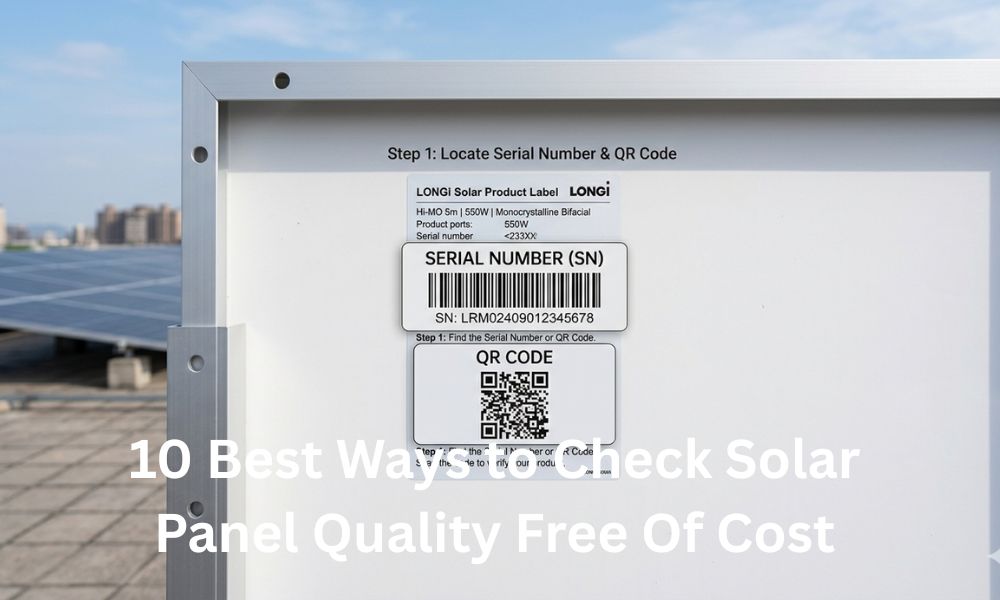
There, we will discuss the 10 Best Ways to Check Solar Panel Quality Free Of Cost one by one in detail for complete understanding.
1. Check the Solar Panel Efficiency Rating
It is very important to note that Efficiency tells you how much sunlight a panel turns into electricity. A higher efficiency rate, like 25%, means more solar power from the same-sized solar panel.
| Efficiency Level | Percentage | What It Means |
|---|---|---|
| Excellent | 20% to 23% | Top-tier panels, best technology |
| Good | 17% to 20% | Reliable everyday panels |
| Average | 15% to 17% | Budget panels, okay for large spaces |
| Poor | Below 15% | Low quality, avoid if possible |
My personal tip: I always look for panels with at least 20% efficiency. My own solar panels are 25.1% efficient, and I am very happy with their performance.
How to check: The efficiency number is printed right on the solar panel’s datasheet or product page. If a seller cannot give you this number, walk away.
2. Read the Temperature Coefficient
It is also important that all Solar panels get hot in the sun. When they get hot, they produce less electricity. The temperature coefficient tells you how much power the panel loses for every degree it gets hotter.
| Temperature Coefficient | Quality Level |
|---|---|
| -0.26% per °C or better | Excellent |
| -0.30% to -0.35% per °C | Good |
| -0.40% to -0.45% per °C | Average |
| Worse than -0.45% per °C | Poor |
Important note: If you live in a hot place like Pakistan, India, or the Middle East, this number is very important. A panel with a bad temperature coefficient will produce much less power on hot summer days.
My experience: My area gets very hot in summer, above 45°C. I specifically chose solar panels with a -0.29% temperature coefficient. For a hot summer, N-Type solar panels are best because I personally installed them at my home, and I am satisfied.
My neighbor bought cheaper solar panels with -0.44%. In summer, my panels produce noticeably more electricity than his, even though they are the same size.
3. Look at the Degradation Rate
It is also important to note that every solar panel slowly loses power over time. This is called degradation. A good solar panel loses very little power each year.
A bad solar panel loses a lot.
| Degradation Type | Rate | Quality |
|---|---|---|
| First-year degradation | Less than 2% | Good |
| First-year degradation | More than 3% | Poor |
| Annual degradation after year 1 | Less than 0.5% per year | Excellent |
| Annual degradation after year 1 | 0.5% to 0.7% per year | Good |
| Annual degradation after year 1 | More than 0.7% per year | Poor |
I personally noticed and verified that after 25 years, a good panel should still produce at least 80% of its original power.
My personal experience: Most quality manufacturers guarantee this in their product warranty.
4. Check the Warranty — Both Parts of It
It is also important to note that A solar panel warranty has two separate parts. Many people do not know this. Both parts are important.
Part 1: Product Warranty (also called Equipment Warranty)
This covers manufacturing defects, things that go wrong because the solar panel was made badly. A good product warranty lasts 10 to 25 years.
If the solar panel cracks, breaks, or stops working because of a manufacturing problem, the company must replace it for free.
Part 2: Performance Warranty (also called Power Warranty)
This guarantees how much electricity the panel will produce. A good performance warranty says the panel will produce at least 80% of its original power after 25 years.
| Warranty Type | Good | Acceptable | Poor |
|---|---|---|---|
| Product Warranty | 25 years | 15-24 years | Less than 10 years |
| Performance Warranty | 25 years at 80%+ | 20 years at 80% | Less than 20 years |
My warning from personal experience: Always check if the company will actually be around to honor that warranty. I found one brand offering a 30-year warranty, but the company was only 2 years old.
Important Note: A warranty means nothing if the company disappears. Choose brands that have been around for at least 10 years.
5. Look for Certifications and Safety Marks
It is also important that many Certifications are official stamps of approval from trusted testing organizations. They prove that the solar panel was tested and passed safety and quality standards for installation.
| Certification | What It Means | Importance |
|---|---|---|
| IEC 61215 | Passed international quality and durability tests | Very High |
| IEC 61730 | Passed international safety tests | Very High |
| UL 1703 or UL 61730 | Passed US safety standards | High (required in USA) |
| MCS | UK certification standard | High (required in UK) |
| ISO 9001 | The factory has a quality management system | Medium |
| PID Resistance Certified | Panels resist potential-induced degradation | Medium |
My personal tip: If a solar panel does not have IEC 61215 and IEC 61730, do not buy it. These are the two most important certifications.
6. Inspect the Physical Build Quality
It is also very important to note that you can learn a lot just by looking at and touching a solar panel. Here is what to check:
The Frame
A good solar panel has an aluminum frame that is:
- Thick and sturdy — at least 35mm deep
- Evenly welded at all four corners
- Perfectly straight with no bends or dents
- Anodized (coated to prevent rust)
My pro tip: A bad frame will be thin, poorly welded, and might have sharp edges or gaps at the corners.
The Glass
Quality solar panels use tempered safety glass that is:
- At least 3.2mm thick (some premium panels use 4mm)
- Anti-reflective coated (looks slightly blue or tinted)
- Smooth with no bubbles, scratches, or cloudiness
My hands-on test: When I was choosing solar panels, I gently tapped the glass on different brands.
- Good solar panels sound solid and firm.
- Bad panels sound hollow or thin.
- It is a small test, but it tells you a lot about the glass quality.
The Back Sheet or Back Glass
It is also important to note that the back of the solar panel protects it from moisture and heat. Check that it is:
- Smooth with no bubbles or wrinkles
- White or black (depending on brand) with no yellowing
- Firmly bonded — not peeling at the edges
My pro tip: Yellowing on the back sheet is a sign of low quality or old, deteriorated material.
The Junction Box
The junction box is the plastic box on the back of the solar panel where the wires come out. It should be:
- Firmly attached with no gaps
- Rated IP67 or IP68 (waterproof ratings)
- Well-sealed against moisture
My personal tip: A loose or poorly sealed junction box lets in water and causes electrical failures.
7. Understand the Cell Type
It is also important to note that Different solar cell technologies have different quality levels. Here is a simple comparison for easy understanding.
| Cell Type | Efficiency | Cost | Lifespan | Best For |
|---|---|---|---|---|
| Monocrystalline PERC | 18%–23% | Medium-High | 25+ years | Most homes |
| Monocrystalline TOPCon | 21%–24% | High | 30+ years | Premium installs |
| Bifacial Monocrystalline | 20%–24% | High | 25+ years | Open, reflective areas |
| Polycrystalline | 15%–17% | Low | 20–25 years | Large budget installs |
| Thin Film | 10%–13% | Very Low | 15–20 years | Special applications |
My recommendation: For homes, always go with monocrystalline solar panels. They are more efficient, look better, and last longer. The extra cost is worth it.
My pro tip: You can tell a monocrystalline solar panel by its dark, uniform black color. Polycrystalline panels look blue and sparkly like metal flakes.
8. Research the Brand’s Reputation
The brand of the solar panel matters a lot. A well-known brand with a long history is much safer than a new, unknown brand. These are the best brands like Longi, Jinko, Trina, Canadian, and JA in the world.
Top-Tier Brands (Tier 1)
These brands have the best reputations in the industry and high performance as well as longevity.
| Brand | Country | Known For |
|---|---|---|
| LONGi Solar Panel | China | World’s largest, excellent monocrystalline |
| JA Solar Panel | China | Consistent quality and good value |
| Canadian Solar Panel | Canada/China | Reliable performance, good warranty |
| Jinko Solar Panel | China | High efficiency, very popular globally |
| SunPower (Maxeon) | USA | Premium quality, best warranty in industry |
| REC Group Panel | Norway | High efficiency, European quality standards |
| Panasonic Panel | Japan | Excellent temperature performance |
| Q CELLS Panel | Germany/Korea | Strong R&D, certified quality |
How to check a brand’s reputation:
- Search Google for “[Brand Name] solar panel problems” or “[Brand Name] solar panel review”
- Check the Bloomberg Tier 1 Solar Module Manufacturers list
- Read reviews on solar forums from SOLARPRICEHUB.COM
- Ask your local solar installer what brands they trust most
My personal experience: I chose LONGi solar panels for my home. They were not the cheapest option, but my installer told me they have one of the lowest failure rates in the industry. Three years later, I have had zero problems.
9. Verify the Datasheet Numbers
It is also very important to note that every quality solar panel comes with a datasheet, a technical document with exact performance numbers.
Always ask for this document and check these key numbers that we will discuss in a table as follows.
| Datasheet Item | What to Look For |
|---|---|
| Peak Power (Watts) | Should match what the seller claims |
| Open Circuit Voltage (Voc) | Important for inverter compatibility |
| Short Circuit Current (Isc) | Higher is generally better |
| Maximum Power Voltage (Vmp) | Key for system design |
| Power Tolerance | Look for 0/+5W or better, never negative |
Pay special attention to Power Tolerance. This tells you how much the actual power output can vary from the stated number.
- A solar panel labeled 400W with a tolerance of -3%/+3% could actually produce only 388W
- A solar panel labeled 400W with a tolerance of 0/+5W will always produce at least 400W and possibly up to 405W
My personal tip: Never buy a solar panel with a negative power tolerance. It means the panel might produce less than what is printed on the label.
10. Do the Flash Test and EL Imaging Test
These are two professional tests that show you exactly what is happening inside a solar panel, and here we will discuss them one by one as follows.
Flash Test (also called I-V Curve Test)
A flash test machine shines a bright light on the panel and measures exactly how much power it produces. The results should match the datasheet numbers closely. Reputable manufacturers publish flash test results for every single panel they ship.
Ask your supplier: “Can you provide the flash test report for my specific panels?” If they say no, that is a red flag.
EL Imaging Test (Electroluminescence Test)
This is my favorite test. A special camera takes a photo of the panel while electricity runs through it. The photo shows every single crack, broken cell, or manufacturing defect inside the panel — things you cannot see with your eyes.
A good EL image shows:
- Uniform, even glow across all cells
- No dark spots or areas
- No cracks or lines cutting across cells
A bad EL image shows:
- Dark spots (dead cells)
- Cracks (appear as thin dark lines)
- Uneven glow (poor cell connections)
My personal experience: When I bought my panels, I specifically requested EL test images for a sample from my batch.
The seller sent them. All cells were uniform and perfect. That gave me real confidence in my purchase.
Common Solar Panel Defects to Watch Out For
Microcracks
Tiny cracks inside solar cells that are invisible to the naked eye. They develop during manufacturing or shipping. They grow bigger over time and kill cell performance. EL imaging is the only reliable way to see them.
Delamination
When the layers inside a panel start to separate. You can see this as bubbles or cloudy patches inside the panel glass. It lets in moisture and destroys the panel.
Snail Trails
Dark brown or black lines that appear on panel cells over time. They look like snail paths. They are caused by silver paste oxidation reacting with moisture through micro-cracks. They reduce power output significantly.
PID (Potential-Induced Degradation)
A problem where voltage causes chemical changes in the panel that permanently reduce power output. Quality panels are certified as “PID resistant.” Always check for this certification.
Hot Spots
Areas of a panel that get much hotter than the rest. This happens when cells are shaded, cracked, or have defects. Hot spots damage the panel and can even start fires. Bypass diodes in the junction box reduce this risk — make sure your panel has them.
How to Check Solar Panel Quality at Home: A Simple Checklist
It is also important to note that you do not need to be an engineer to do basic quality checks. Here is a checklist you can use yourself at home.
| Check | What to Do | Pass | Fail |
|---|---|---|---|
| Frame | Look at all corners | Tight, even welds | Gaps, cracks, or bent metal |
| Glass | Look closely at surface | Clear, smooth, no scratches | Bubbles, chips, or hazing |
| Back Sheet | Check the entire back surface | Smooth, no yellowing | Bubbles, peeling, or yellow color |
| Junction Box | Push and wiggle it | Firmly attached | Loose or gaps visible |
| Certification Label | Find IEC marks | IEC 61215 and 61730 present | Missing certifications |
| Datasheet | Ask for document | Seller provides full datasheet | Seller refuses or cannot provide |
| Power Tolerance | Read the datasheet | Zero or positive tolerance | Negative tolerance |
| Warranty Cards | Check both warranties | 10+ year product, 25 year performance | Less than 10 years |
Secret Questions to Ask Your Solar Panel Seller
There, we will also discuss some of the best questions that will help us to buy the best solar panels.
- “What is the efficiency rating of this panel?”
- “What are the IEC certifications for this panel?”
- “Can I see the full product datasheet?”
- “What is the power tolerance — positive or negative?”
- “How long has this brand been in business?”
- “Can you provide EL test images or flash test reports?”
- “Who handles warranty claims — you or the manufacturer?”
- “What is the degradation rate guarantee after 25 years?”
- “Is this panel on the Bloomberg Tier 1 list?”
- “Do you have references from other customers who bought these panels?”
My personal tip: If a seller gets annoyed by these questions or cannot answer most of them, that is a very serious warning sign.
A good seller will be happy to answer every question because they are proud of what they sell.
My Personal Experience: What I Got Right and What I Got Wrong
When I started researching solar panels, I made several mistakes. I want to share them so you can avoid the same problems.
What I got wrong first:
I almost bought a very cheap brand because the price was tempting — almost 30% cheaper than well-known brands. The seller showed me nice photos and gave me a long warranty document.
But when I asked for the IEC certification numbers, he could not provide them. When I searched the brand online, I found almost no reviews — just their own marketing website.
I walked away from that deal. I later found out from a solar forum that this brand had a factory fire and went bankrupt. Many customers who bought their panels had no warranty support at all.
What I got right:
I spent three weeks researching before buying. I visited two different suppliers. I asked every question on my list. I requested EL test sample images. I checked the brand on the Bloomberg Tier 1 list.
I ended up spending about 20% more than the cheapest option. But three years later, my panels are performing at 99.4% of their original rated power. They have never needed any repairs. The electricity savings have already paid back a large portion of the installation cost.
The extra money I spent up front was absolutely worth it. Cheap panels cost you more in the long run.
Solar Panel Quality vs. Price: Is Expensive Always Better?
Not always. But extremely cheap solar panels are almost always a warning sign, and here, we will discuss them in a simple table.
| Price Range | What to Expect |
|---|---|
| Very cheap (bottom 20% of market) | Often unbranded, poor certifications, short lifespan |
| Budget range | Tier 2-3 brands, acceptable for non-critical installs |
| Mid-range | Tier 1 brands, good efficiency, reliable warranties |
| Premium range | Best efficiency, longest warranties, top certifications |
| Ultra-premium | Maximum efficiency (SunPower/Maxeon), for space-limited installs |
Final Summary: The 5 Most Important Quality Checks
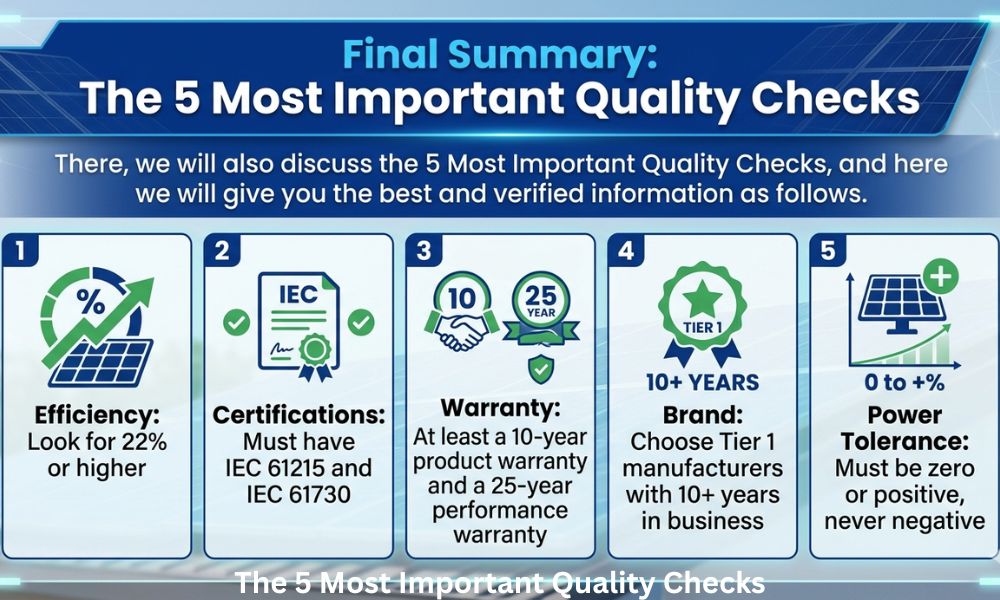
There, we will also discuss the 5 Most Important Quality Checks, and here we will give you the best and verified information as follows.
- Efficiency: Look for 22% or higher
- Certifications: Must have IEC 61215 and IEC 61730
- Warranty: At least a 10-year product warranty and a 25-year performance warranty
- Brand: Choose Tier 1 manufacturers with 10+ years in business
- Power Tolerance: Must be zero or positive, never negative
My personal tip: Check these five things, and you will avoid 95% of the bad solar panels on the market.
Frequently Asked Questions
How long should good solar panels last?
A quality solar panel should last 25 to 30 years. After 25 years, it should still produce at least 80% of its original power.
Can I check solar panel quality without special equipment?
Yes. You can check the frame, glass, back sheet, junction box, certifications, and datasheet by yourself. For deeper testing like EL imaging, you need professional equipment — but you can ask your supplier to provide these reports.
What is the most important number on a solar panel datasheet?
Efficiency and power tolerance are the most important numbers for buyers to understand.
Are Chinese solar panels of bad quality?
No. Many of the world’s best and most reliable solar panels are made in China — including top brands like LONGi, JA Solar, Jinko, and Canadian Solar. The country of manufacture alone does not tell you quality. Certifications, brand reputation, and warranty terms are what matter.
What should I do if my new solar panels seem to be underperforming?
First, check if there is any shading issue on your roof. If not, contact your installer and ask for a production report compared to the expected output. If panels are producing significantly less than the datasheet says, you may have a warranty claim.
Final words:
I have noticed and verified that checking solar panel quality is not difficult if you know what to look for.
By verifying the manufacturer, inspecting the solar panel’s construction, reviewing certifications, testing its performance, and checking the warranty.
My personal experience: Buying solar panels is one of the biggest decisions a family can make. You spend a lot of money, and you want the solar panels to work well for 25 years or more.
But how do you know if a solar panel is good or bad before you buy it?