
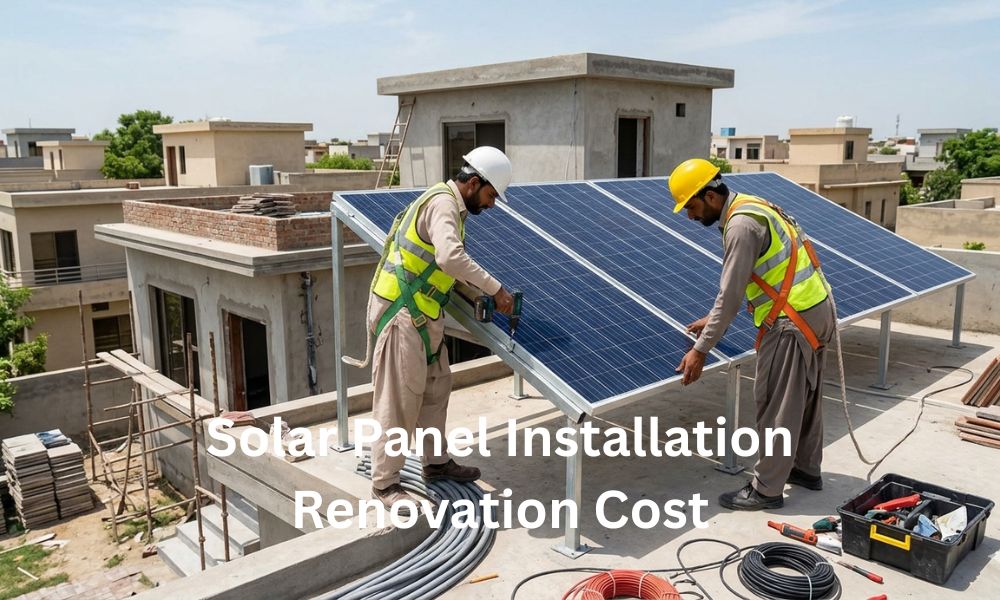
I have verified that the Today 03 Jun 2026 Solar Panel Installation Renovation Cost ranges from 3,50,000 to 15,00,000 rupees, depending on the size and type of the solar system, such as off-grid, on-grid, or hybrid. The renovation cost for a small (3 kW) solar system is very low, but for a big (10 kW) solar system, the cost is also very high in Pakistan in 2026.
I personally verified that, depending on your design, standard flush mounts keep upfront costs minimal, while customized elevated structures (L2/L3 frames) optimize rooftop terrace usability for an additional PKR 10,000 to PKR 15,000 per solar panel in Pakistan.
I have also checked that Budgeting for an “all-in” turnkey system currently ranges from PKR 300,000 for a basic 3kW on-grid setup up to PKR 2.2 million for a premium 10kW hybrid system featuring high-performance Lithium-ion storage batteries in Pakistan.
My personal experience: The Solar Panel Installation Renovation is the best way to generate free electricity from solar panels and get ride from government high electricity bills. We can easily save thousands of rupees every month and millions in a year.
My pro tip: So, always install A-Grade solar panels as well as other necessary appliances like batteries, inverters, wires, frames, pipes, shipping, and labour costs in Pakistan.
Latest Solar Panel Installation Renovation Cost Today 03 Jun 2026 : All Systems
There, we will discuss the latest solar panel installation renovation cost today for all solar systems in a table for easy understanding.
These costs vary from basic fitting to elevated structures, as well as waterproofing solar systems in Pakistan.
| System Capacity & Type | (Equipment + Basic Fitting) | (Elevated Structures, Hidden Conduits, Waterproofing) |
| 3 kW On-Grid (No Battery) | PKR 350,000 – 450,000 | PKR 65,000 – 100,000 |
| 3 kW Hybrid (With Backup) | PKR 550,000 – 650,000 | PKR 65,000 – 100,000 |
| 5 kW On-Grid (No Battery) | PKR 750,000 – 850,000 | PKR 100,000 – 155,000 |
| 5 kW Hybrid (With Backup) | PKR 950,000 – 1,150,000 | PKR 100,000 – 155,000 |
| 6 kW On-Grid (No Battery) | PKR 800,000 – 950,000 | PKR 115,000 – 175,000 |
| 6 kW Hybrid (With Backup) | PKR 950,000 – 1,300,000 | PKR 115,000 – 175,000 |
| 10 kW On-Grid (No Battery) | PKR 1,200,000 – 1,500,000 | PKR 180,000 – 260,000 |
| 10 kW Hybrid (With Backup) | PKR 1,650,000 – 2,200,000 | PKR 180,000 – 260,000 |
What the Renovation Column Includes: It is also important that Applying heavy chemical waterproofing beneath the concrete base blocks, routing hidden 2-inch internal PVC cable pipes inside the walls in Pakistan in 2026.
Top 10 Solar Panel Installation Renovation Ideas 2026
There, we will discuss the Top 10 Solar Panel Installation Renovation Ideas one by one in detail as given below.
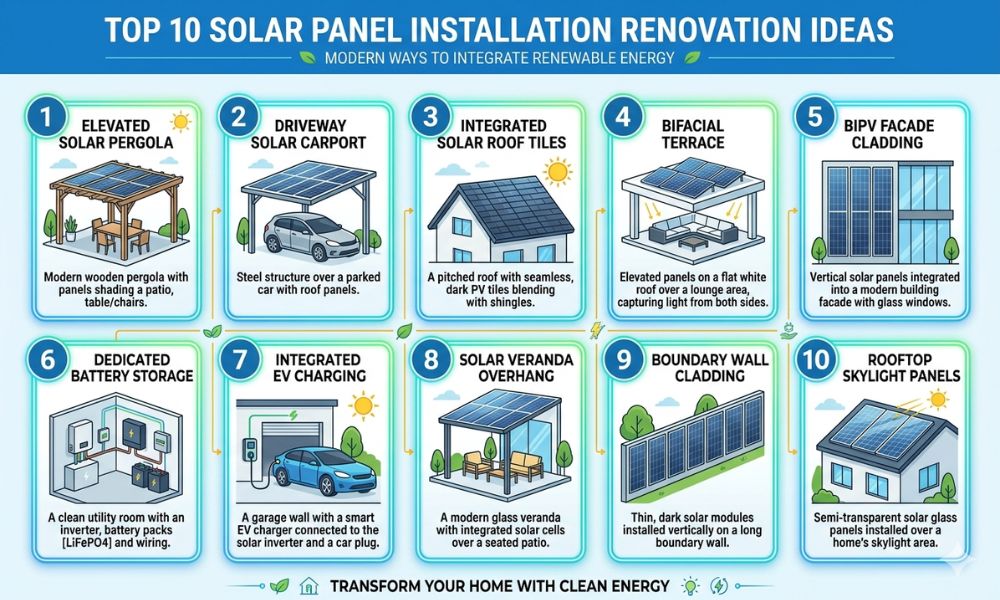
1. Elevated Solar Terrace Pergolas
It is very important to note that always elevating your solar panels on customized steel framing transforms a flat, concrete rooftop into a premium, shaded outdoor pavilion nowadays in 2026.
My personal experience: By elevating the structure, you keep the terrace floor fully open for seating, lounges, or a rooftop garden while harvesting clean energy right above your head from solar panels.
2. Multi-Car Solar Canopies & Carports
It is also important to note that replacing a standard fiberglass or sheet metal parking shed with high-grade solar racking lets you turn an empty driveway into a dedicated power generator.
My pro tip: Always use semi-transparent or bifacial solar panels provides clean architectural lines and essential shade to keep vehicles cool during peak summer months.
3. Sleek “All-Black” Flush-Mount Roof Integration
If you are remodeling a traditional pitched roof, replacing older, silver-framed panels with uniform N-Type All-Back-Contact (ABC) or premium dark TOPCon modules offers a stunning upgrade.
Important Notice: These solar panels eliminate visible front gridlines, creating a seamless obsidian sheet appearance that matches modern minimalist designs.
4. Building-Integrated Photovoltaic (BIPV) Facades
It is also a very informative thing that for high-end structural modernizations, vertical solar cladding can be integrated directly into a building’s south-facing walls.
This cutting-edge architectural approach replaces conventional exterior finishes with active, energy-producing vertical glass surfaces that capture lower winter sun angles perfectly.
5. Dedicated Inverter & Battery Command Rooms
It is also important to note that A complete energy renovation should include a dedicated indoor utility space for the core power electronics. Designing a clean, well-ventilated, and dust-protected enclosure or garage bay for hybrid inverters and lithium storage banks keeps heavy wiring hidden, preserves interior aesthetics, and extends equipment life.
6. Bifacial Glass Terraces with Cool-Roof Coatings
It is very important to note that maximizing energy output on a flat roof renovation can be achieved by mounting double-sided (bifacial) glass-on-glass panels over a freshly applied, highly reflective white cool-roof coating.
My personal experience: The bright floor increases albedo light reflection, allowing the rear side of the panels to capture bouncing rays and boost system generation.
7. Solar-Powered Verandas & Patio Overhangs
Extending your home’s living space with a front or rear veranda constructed out of specialized photovoltaic glass is an excellent structural upgrade.
Important tip: The seamless overhead glass provides weather protection for the patio while allowing filtered natural sunlight to brighten the seating area underneath.
8. Architectural Solar Roof Shingles & Tiles
If your home renovation includes a total roof replacement, solar tiles can be laid down in place of traditional slate, ceramic, or asphalt shingles.
These durable photovoltaic tiles interlock smoothly with surrounding conventional tiles, delivering full clean energy generation without altering the home’s classic profile.
9. Smart EV Charging Carport Hubs
It is also a very important thing that upgrading a garage or entrance driveway can involve a solar panel canopy paired with an integrated Level 2 EV charging station.
Pre-wiring the vehicle charger directly to your hybrid solar inverter’s smart load output ensures that your car can be fueled entirely by direct, real-time sunlight without drawing from the main electrical grid.
10. Exterior Solar Boundary Wall Cladding
When rooftop real estate is restricted by shading or space, a long, unshaded boundary wall facing the sun can be converted into a power asset.
Mounting slim, low-profile, weather-resistant solar modules flush against boundary walls offers a highly stable, hidden installation that generates passive daily power safely out of sight.
Why Pakistan’s Solar Moment Is Right Now 2026
It is very informative news that Pakistan’s average electricity tariff in 2026 sits at approximately Rs. 33–48 per unit for residential consumers, and heavy users on the highest slab pay up to Rs. 47.69/unit.
Important note: If we compare that to 2015, when the national tariff was roughly Rs. 9/kWh. That’s nearly a 5× increase in just a decade in Pakistan.
It is also very amazing that, at the same time, solar panel prices have moved in the opposite direction in Pakistan. There are N-type bifacial panels that cost Rs. 80–90 per watt in 2023, now cost Rs. 38–45 per watt, a drop of over 50% in under three years.
This price collapse, driven by a global manufacturing glut (led by Chinese suppliers), has made solar the single most cost-effective energy decision most Pakistani households can make.
I have verified and checked that Pakistan now holds the title of the world’s largest solar panel importer, importing 17 GW of capacity in 2024 alone, double the previous year.
It is also amazing news that Solar power now accounts for over 25% of Pakistan’s total electricity production, making it the country’s single largest electricity source as of 2025.
Understanding the Two Types of Solar System Costs
There are mainly Two Types of Solar System Costs, and here we will discuss each one by one as follows.
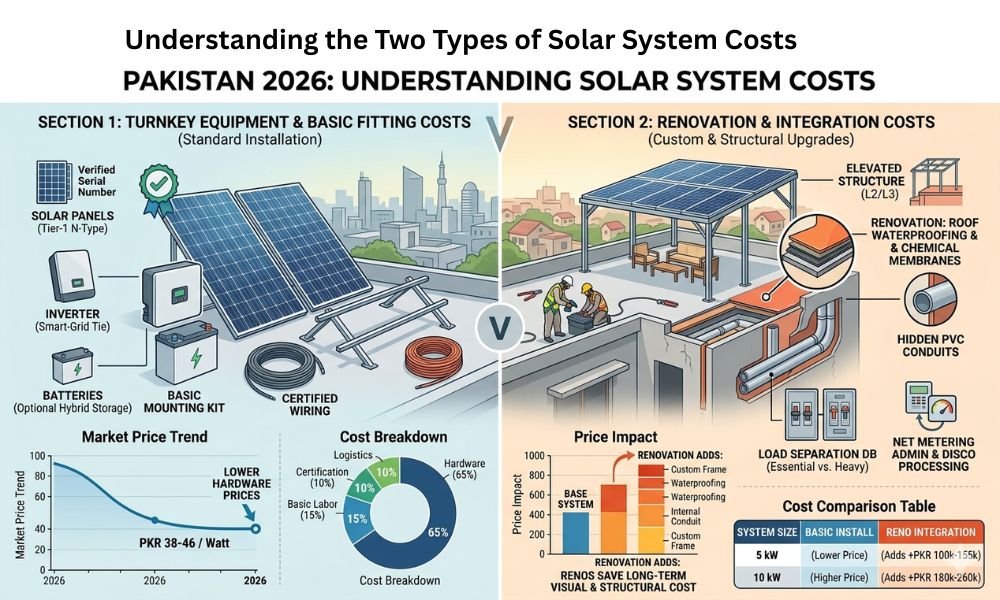
- New Installation Cost: It is very important to note that A fresh solar system installed on your rooftop, and for the first time, the total cost is much higher in Pakistan.
- Renovation / Upgrade Cost: It is also very informative news that expanding or modifying an existing system (adding panels, replacing an inverter, adding batteries, etc.).
My personal experience: The pricing principles overlap significantly, but renovation costs have unique considerations, especially given Pakistan’s recently updated net metering rules.
Latest Solar Panel Prices in Pakistan
There, we will also discuss the latest solar panel prices in Pakistan, per-watt, in a table for easy understanding.
Per Watt Rate by Panel Type
| Panel Technology | Price Per Watt (PKR) | Efficiency | Best For |
|---|---|---|---|
| N-Type Bifacial (Premium) | Rs. 41–45 | 22–23% | Homes, rooftop installs |
| N-Type Monofacial | Rs. 38–42 | 21–22% | Standard residential |
| P-Type Monofacial | Rs. 30–35 | 18–20% | Budget installs, agriculture |
| TOPCon Bifacial | Rs. 40–43 | 22%+ | Commercial, high-output |
My pro tio: These are wholesale/pallet rates ex-Lahore. Loose panels (single or small lots) typically cost Rs. 0.25–0.50 extra per watt. City-to-city transport adds marginal cost.
Top Brands & Their 2026 Price Ranges
Longi Solar (Most Popular in Pakistan) The Hi-Mo 7 N-Type series is the go-to panel for new residential installations in 2026. Longi offers 22%+ efficiency with a 25-year linear power output warranty. Price range: Rs. 40–46 per watt.
Jinko Solar (World’s Largest Manufacturer) Jinko’s N-Type Tiger Neo series is a certified Tier-1 panel with full documentation and strong dealer support across Pakistan. Price range: Rs. 42–45 per watt.
Canadian Solar’s TOPCon bifacial panels are popular in commercial setups. Canadian Solar commands a slight premium due to its origin, but the quality is respected. Price range: Rs. 42 per watt (approximate).
My personal experience: JA Solar, Trina Solar, Aiko Solar, and TCL Solar are all credible Tier-1 manufacturers with active distribution in Pakistan. Pricing generally falls in the Rs. 38–43/watt range for N-type models.
Complete Solar System Costs by Size (2026)
Below are all-inclusive installed prices — panels, inverter, mounting structure, DC/AC wiring, breakers, and labor.
On-Grid Systems (No Battery)
| System Size | Avg. Monthly Units Generated | Installed Cost (Approx.) |
|---|---|---|
| 3 kW | 400–420 units | Rs. 3,50,000 – Rs. 5,00,000 |
| 5 kW | 580–700 units | Rs. 5,50,000 – Rs. 7,50,000 |
| 6 kW | 700–840 units | Rs. 7,00,000 – Rs. 9,50,000 |
| 10 kW | 1,150–1,400 units | Rs. 12,00,000 – Rs. 15,00,000 |
| 12 kW | 1,400–1,680 units | Rs. 13,50,000 – Rs. 17,00,000 |
Hybrid Systems (With Battery Backup)
My personal experience: Hybrid systems include a battery bank for uninterrupted power during grid failures, a major advantage in load-shedding-prone areas like Okara, Multan, and parts of Sindh.
| System Size | Battery Capacity | Installed Cost (Approx.) |
|---|---|---|
| 3 kW Hybrid | 5–10 kWh (Lithium) | Rs. 6,50,000 – Rs. 9,00,000 |
| 5 kW Hybrid | 10 kWh | Rs. 9,50,000 – Rs. 13,00,000 |
| 10 kW Hybrid | 15–20 kWh | Rs. 18,00,000 – Rs. 25,00,000 |
Lithium vs. Lead-Acid Batteries: Lithium-ion batteries (brands: Pylontech, Dyness, BYD, Pytes) cost more upfront but last 8–12 years with minimal maintenance in Pakistan.
It is important news that Lead-acid batteries are cheaper initially but require replacement every 3–4 years and have higher long-term costs.
Component-by-Component Breakdown 03 Jun 2026
Understanding what you’re paying for is critical before signing a contract. Here’s how the budget typically splits across components:
1. Solar Panels (40–50% of total cost)
The panels themselves. For a 5 kW system with quality N-type panels at Rs. 42/watt, you’re looking at approximately Rs. 2,10,000 just for the modules.
2. Inverter (20–25% of total cost)
The inverter converts DC power from your panels to usable AC power. Top inverter brands in Pakistan include:
- Growatt (China, widely available, budget-friendly)
- SolarEdge (premium, module-level optimization)
- Huawei FusionSolar (smart features, strong warranty)
- GoodWe, Sofar, Solis (mid-range, popular for residential)
A quality 5 kW hybrid inverter costs approximately Rs. 80,000–Rs. 1,50,000 depending on brand and features.
3. Mounting Structure (8–12% of total cost)
Standard L2 flush-mount or ground-mount structures are typically included in quotes. If your rooftop is flat concrete and requires an elevated structure (H-beam + C-channel for optimal angle), expect an additional Rs. 7.000 per solar panel.
4. Wiring & Electrical Components (8–12%)
This includes DC cables (tin-copper), AC cables, distribution boxes, breakers (Chint, Schneider, Tomzn), surge protectors, and grounding. Never compromise on cable quality — undersized or low-grade cabling is a fire risk.
5. Labor & Installation (5–10%)
Installation labor in Pakistan ranges from Rs. 20,000 to Rs. 50,000 for a standard residential system, depending on system size, city, and roof complexity.
I have noticed that in major cities like Lahore, Karachi, and Islamabad, labor costs tend to be at the higher end almost 20k to 50k for small solar systems.
6. Net Metering Application (Rs. 1,000–Rs. 5,000)
The one-time NEPRA license fee is now Rs. 1,000 per kW for new net billing applications. For a 5 kW system, that’s Rs. 5,000.
Renovation & Upgrade Costs: What to Know
If you already have a solar system and want to expand or upgrade it, several key cost factors apply:
Scenario 1: Adding More Panels to an Existing System
Adding panels costs less than a full new installation since the inverter and structural framework may already be in place. Expect to pay Rs. 24,000–Rs. 35,000 per additional panel (hardware) plus Rs. 5,000–Rs. 10,000 per panel for wiring and labor.
Important: Under NEPRA’s Solar Regulations 2026 (effective February 9, 2026), consumers who expand their systems under new net billing rules may lose the preferential tariff rates that were available under old net metering agreements.
Good news: Existing valid contracts remain protected, but upgrades to those systems can trigger reclassification. Always consult your DISCO before expanding your solar system in Pakistan.
Scenario 2: Replacing a Failed Inverter
It is also very important that Inverter replacement is one of the most common renovation scenarios. A new quality hybrid inverter (5–10 kW) costs Rs. 80,000–Rs. 2,00,000 installed, depending on brand.
My pro tip: Inverter warranties typically run 5–10 years, so a replacement before 5 years may indicate a quality issue with the original unit.
Scenario 3: Adding Battery Backup to an On-Grid System
Many homeowners originally installed on-grid (no battery) systems and now want to add storage. This requires either:
- An existing hybrid inverter (check compatibility first), or
- Replacing the on-grid inverter with a hybrid unit
Battery-only add-on cost: Rs. 1,50,000–Rs. 4,00,000 for a 5–10 kWh lithium battery system. Inverter swap + battery: Rs. 2,50,000–Rs. 5,00,000 for a mid-range residential setup.
Scenario 4: Cleaning, Maintenance & Panel Replacement
Annual maintenance is often overlooked. Dust accumulation on panels in cities like Lahore, Multan, and Quetta can reduce output by 10–25%. Professional cleaning costs Rs. 500–1,500 per panel. A failed or degraded panel replacement costs Rs. 25,000–Rs. 38,000 per unit installed.
City-by-City Price Variation
Solar panel prices in Pakistan vary by city due to logistics, dealer margins, and local demand:
| City | Approx. Panel Rate (per watt) | Notes |
|---|---|---|
| Lahore | Rs. 40–43 | Strong installer network (LESCO area) |
| Karachi | Rs. 41–44 | Higher logistics from northern suppliers |
| Islamabad/Rawalpindi | Rs. 41–43 | Well-developed market |
| Faisalabad | Rs. 39–42 | Competitive pricing |
| Multan | Rs. 40–43 | High demand, good supply |
| Okara/Sahiwal | Rs. 40–43 | Near Lahore supply chain |
| Peshawar | Rs. 42–45 | Transport premium applies |
| Quetta | Rs. 44–47 | Remote logistics add cost |
CM Punjab Solar Panel Scheme (Roshan Gharana Program)
Under Chief Minister Maryam Nawaz Sharif, Punjab launched one of its most ambitious renewable energy programs — the CM Punjab Free Solar Panel Scheme. Relaunched and expanded in 2026, it provides free or heavily subsidized 1–3 kW systems to low-income households.
Eligibility Criteria:
- Permanent resident of Punjab
- Monthly consumption between 50,300 units
- Valid CNIC and electricity bill
- No history of electricity theft or default
Eligible households can receive: solar panels, a certified inverter, battery backup, professional installation, wiring, and net metering eligibility (where applicable) — all at zero or minimal cost.
NEPRA Net Billing / Net Metering
Pakistan’s current distributed generation framework, updated via NEPRA Solar Regulations 2026 (effective February 9, 2026), has shifted from unit-for-unit net metering to a net billing system for new applicants. Key points:
- Existing net metering consumers retain their original contracts and favorable buyback rates until expiry.
- New applicants operate under net billing terms, which may offer lower buyback rates for excess generation.
- NEPRA has abolished the requirement for a separate generation license for small solar users, reducing bureaucracy.
- One-time license fee: Rs. 1,000 per kW.
Despite reduced export incentives for new consumers, solar self-consumption remains highly lucrative; you save at the full Rs. 33–48/unit tariff rate for every unit you use from your own panels.
ROI & Payback Period: What the Numbers Say
The average payback period for a residential solar system in Pakistan is currently 3 to 5 years — one of the best in the world for any energy investment.
Example Calculation: 5 kW On-Grid System
| Item | Value |
|---|---|
| Total System Cost | Rs. 6,50,000 |
| Monthly Units Generated | ~650 units |
| Monthly Bill Savings | Rs. 27,000–Rs. 31,000 |
| Annual Savings | Rs. 3,24,000–Rs. 3,72,000 |
| Payback Period | ~21–24 months |
| 25-Year Projected Savings | Rs. 75–90 Lakh+ |
With electricity tariffs expected to continue rising, those savings compound over time. Solar panels carry a 25-year linear performance warranty from Tier-1 manufacturers, meaning your asset outlasts its payback period by two decades.
How to Avoid Getting Ripped Off: 7 Must-Know Rules
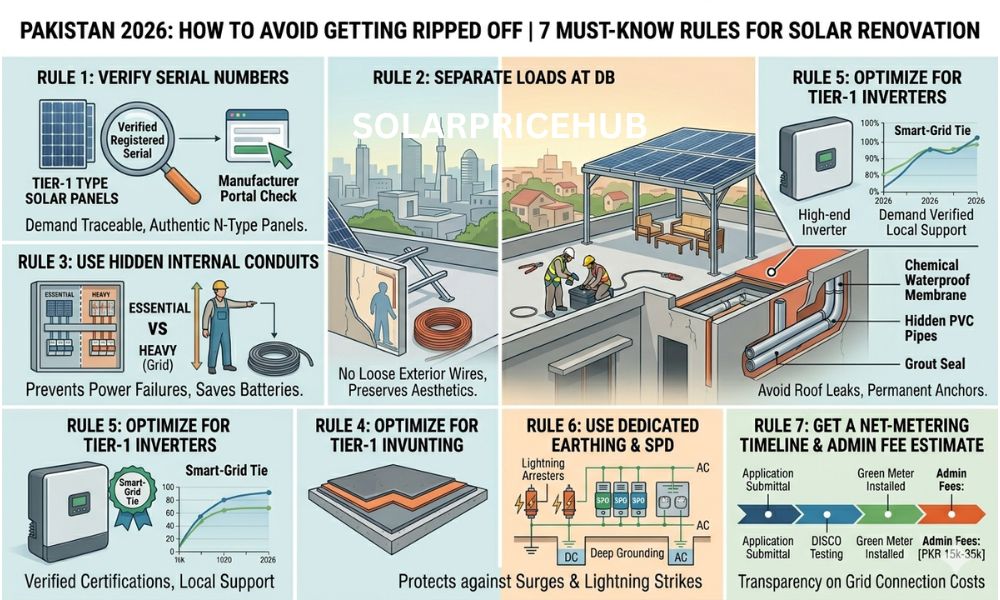
- Demand Tier-1 panels with full documentation. A “Grade A panel” claim means nothing without the manufacturer’s datasheet and serial numbers. Verified Tier-1 brands: Longi, Jinko, Canadian Solar, JA Solar, Trina.
- Get at least three written quotes. Prices vary significantly between vendors. Compare watt-for-watt, not system-to-system, since panel wattages differ.
- Check the inverter brand and warranty. A cheap, no-name inverter is the single biggest risk in a solar installation. Insist on a named brand with a minimum 5-year warranty.
- Clarify what the mounting structure includes. Standard flush mounts are cheap; elevated structures for flat roofs cost extra. Confirm in writing.
- Verify cable specifications. An undersized DC cable (should be a minimum OF 4mm² for most residential runs) is a fire and efficiency hazard.
- Ask about the workmanship warranty. Reputable companies offer a minimum 2-year workmanship warranty. If they don’t, walk away.
- Don’t sign off on the net metering application without understanding the current NEPRA rules. The shift from net metering to net billing means the economics are different for new applicants. Get clarity before sizing your system.
Is It Worth Installing Solar in Pakistan Right Now?
The honest answer: Yes — but with nuance.
For most households consuming 300+ units/month, solar is an exceptional investment with payback periods now under 3 years in many cases. Pakistan’s abundant sunshine (5.5–6 peak sun hours daily across most of the country), the dramatic fall in panel prices, and the continuing rise in grid tariffs have created a uniquely favorable window.
The shift away from generous net metering buyback rates for new consumers slightly reduces the benefit for those who hoped to profit heavily from exporting excess power. However, for systems sized correctly to your actual consumption (not oversized for export), the math remains excellent.
My personal experience: For homeowners in Punjab specifically, checking eligibility for the CM Punjab Solar Scheme before spending a rupee out of pocket is a no-brainer.
Quick Reference: Who Should Buy What
| Your Situation | Recommended System |
|---|---|
| 200–350 units/month | 3 kW On-Grid |
| 400–600 units/month | 5 kW On-Grid or Hybrid |
| Frequent load-shedding area | Any size, Hybrid with battery |
| Commercial/shop | 5–20 kW On-Grid |
| Agriculture/tubewell | 7.5–25 kW (dedicated solar pump or on-grid) |
| Low income (Punjab) | Apply for the CM Punjab Solar Scheme first |
Final Word
I have verified that the Today Solar Panel Installation Renovation Cost ranges from 3,50,000 to 15,00,000 rupees, depending on the size and type of the solar system, such as off-grid, on-grid, or hybrid.
A small solar system (3kw) renovation cost is very low or cheap, but for a big (10kw) solar system, the cost is also very high in Pakistan in 2026.
I personally verified that, depending on your design, standard flush mounts keep upfront costs minimal, while customized elevated structures (L2/L3 frames) optimize rooftop terrace usability for an additional PKR 10,000 to PKR 15,000 per solar panel in Pakistan.

I am Muhammad SHAHID, and my education is a Master’s in IT at GCUF. Muhammad Shahid is a passionate solar energy researcher, writer, and renewable energy enthusiast with years of experience in the solar industry.