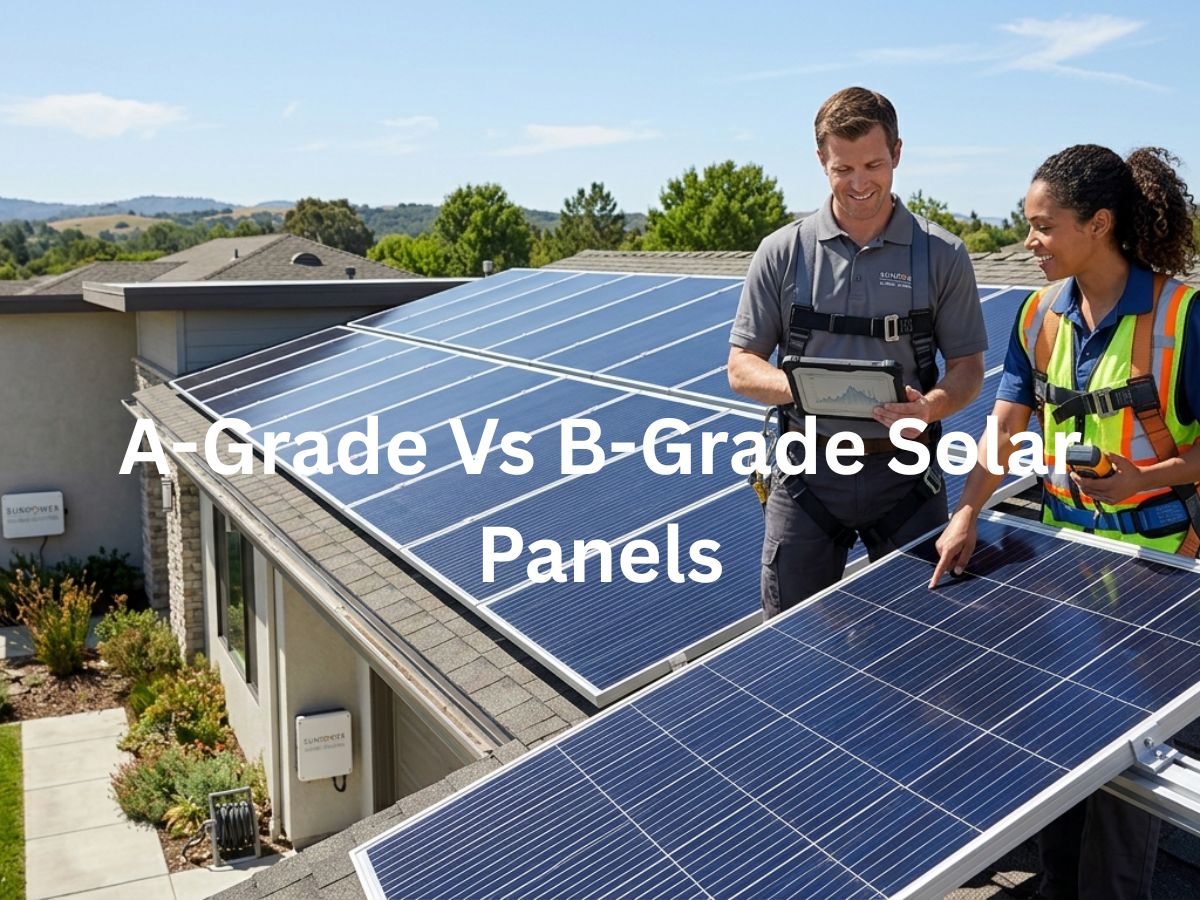
I have visited many shops in different cities to understand A-Grade Vs B-Grade Solar Panels in Pakistan and found that every solar panel retailer sells old or B-Grade. There is no huge difference in price for A- grade solar panels, but a huge difference in performance as well as life span.
Important Note: It is informative news that buying solar panels in Pakistan without knowing the difference between A-Grade and B-Grade can cost you 200,000 PKR. There is only an 8k to 10k rupees difference between original or A-Garde and fake or B-Grade per solar panel.
My personal experience: There are a lot of new Dealers often sell B-Grade panels with fake A-Grade stickers, and most buyers can’t tell until their system drops power after 2 years.
A-Grade costs 8-12 PKR/watt more but gives you 15 more years of performance and 25% more output.
Tried and Tested Experience: For a 5kW system, that’s 40,000 PKR extra upfront vs 250,000 PKR lost over 25 years if you buy B-Grade. I recommended that you always buy Tier 1 or Best solar panels for huge electricity generation for a lifetime of at least 25 years.
What Exactly Is an A-Grade Solar Panel?
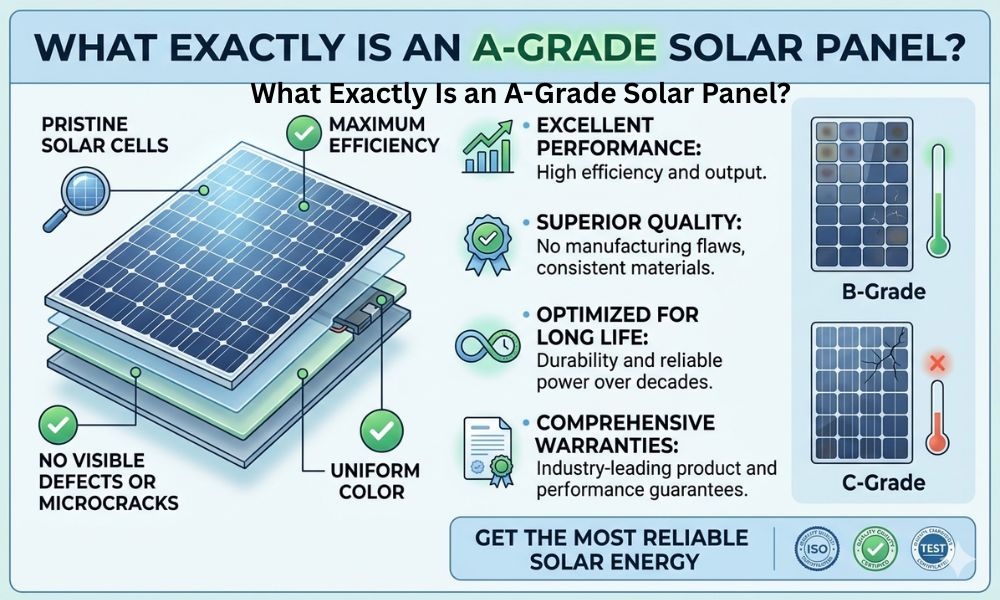
It is very important to note that An A-Grade solar panel is built using cells that passed every quality checkpoint during manufacturing.
Consistent Efficiency:
It is informative news that every cell in an A-Grade solar panel is matched for output. When cells in a solar panel are mismatched, even slightly, the weakest cell limits the performance of the entire string, the way a weak link weakens a chain.
My personal experience: In A-Grade solar panels, this mismatch is minimized, which means the solar panel performs closer to its rated wattage in real-world conditions.
No Micro-Cracks:
It is also important to note that there are many Micro-cracks are, tiny fractures in the silicon wafer. They are invisible to the naked eye, but they grow over time, especially under thermal cycling. The daily expansion and contraction that happens as solar panels heat up during the day and cool at night.
My personal experience: A-Grade solar cells are free of these cracks at the time of manufacture. B-Grade cells may already have them. How to Check Solar Panel Quality 2026: 5 Simple Steps
Uniform Appearance:
It is also informative news that A-Grade solar panels look clean and consistent. The cells are the same color, and the surface is free of blotches, dark spots, or irregular patterns.
This matters beyond aesthetics; visible anomalies often indicate structural or chemical inconsistencies in the cell.
Manufacturer Warranty:
A-Grade solar panels from reputable brands come with a product warranty (typically 10–12 years) and a linear power output warranty (typically 25–30 years).
My personal experience: These warranties are backed by companies with service infrastructure and financial standing. Do you want to know the original and fake solar panels?
Certified Testing:
It is also informative news that Legitimate A-Grade solar panels carry international certifications, IEC 61215, IEC 61730, and in many cases, additional certifications for specific environmental conditions.
My personal experience: These are not stickers you print yourself; they require independent lab testing.
What Exactly Is a B-Grade Solar Panel?
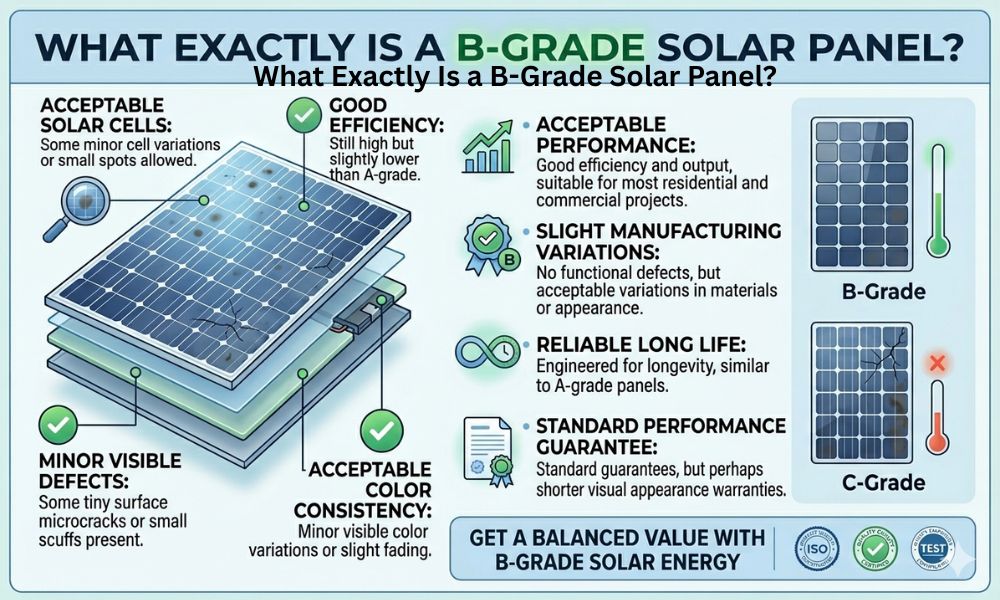
B-Grade panels are manufactured using cells that did not pass the top-tier quality sorting in the world, and here we will discuss them one by one as follows.
Cosmetic Defects
B-Grade cells may have minor color variations, faint marks, or surface imperfections. These do not always affect initial performance but can indicate variations in the cell’s material consistency.
Pre-Existing Micro-Cracks
This is the most serious issue. Many B-Grade cells already have micro-cracks when they are assembled into panels. In moderate climates, this might not matter much for a year or two.
But in Pakistan’s climate, where rooftop temperatures can exceed 70°C in summer and thermal stress is extreme,micro-cracks propagate faster.
A crack that is small today becomes a fracture that isolates a section of the cell within a few years, reducing output permanently.
Efficiency Variance
The cells in a B-Grade panel are often not matched as carefully. Some cells may output slightly more than others. This mismatch can reduce the panel’s effective output by several percentage points compared to its label rating.
Shorter Real-World Lifespan
Because B-Grade panels start with structural compromises, their degradation rate tends to be steeper. Instead of the standard 0.5–0.7% annual efficiency loss you see in quality A-Grade panels, B-Grade panels may degrade at 1.5–3% per year or more, depending on environmental stress.
Absent or Questionable Warranties
Many B-Grade panels are sold with either no warranty or a warranty from a local dealer who has no formal relationship with the manufacturer. If the dealer closes shop, which happens in Pakistan’s volatile retail market, your warranty is worth nothing.
The Price Gap: Why It Exists and What It Actually Means
In Pakistan’s current market, A-Grade solar panels from reputable brands, JA Solar, Longi, Jinko, and Canadian Solar, typically cost between PKR 28 and PKR 38 per watt, depending on technology (monocrystalline vs polycrystalline) and panel capacity.
I personally checked and verified that B-Grade solar panels can be found for PKR 15 to PKR 22 per watt, sometimes even less in Pakistan nowadays.
For example, for a 10kW system, this translates to a difference of roughly PKR 80,000 to PKR 100,000 in upfront solar panel cost in Pakistan.
My pro tip: If an A-Grade solar panel produces 98% of its rated output in year one and degrades at 0.55% per year, after 10 years, it is still producing around 93% of its original output.
My pro tip: A B-Grade solar panel that starts at 92% of rated output and degrades at 2% per year is down to roughly 72% of rated output after 10 years in the world.
| Metric / Parameter | Impact of B-Grade Panels | The Bottom Line |
| Capacity Loss (Gap) | ~2 kW | You only get the output of an 8kW system. |
| Annual Generation Loss | 2,500 – 3,000 kWh (Units) | Wasted energy that you have to buy from the grid. |
| Annual Financial Loss | PKR 50,000 – PKR 75,000 | Money out of your pocket every single year. |
| Payback/Breakeven Period | 2 – 3 Years | Initial upfront savings on cheaper panels vanish. |
| Long-Term Outlook | Lifetime Financial Penalty | Every year after year 3 is a pure net loss compared to A-grade panels. |
Pakistani Conditions: Why Grade Matters More Here Than Almost Anywhere
This is the part of the conversation that is rarely discussed. Pakistan is not Germany or the UK, where panels sit in cool, overcast conditions.
Pakistani rooftops are brutal environments for solar panels, and this brutality exposes the weaknesses of B-Grade panels faster and more severely.
Heat
In cities like Multan, Sukkur, Jacobabad, and Rahim Yar Khan, ambient temperatures regularly hit 48–50°C in summer. Solar Panel surface temperatures can reach 70–75°C.
Every degree above 25°C reduces solar panel output; this is called the temperature coefficient, but it also accelerates every form of degradation. Micro-cracks grow.
Encapsulant layers (the material that seals cells inside the panel) yellow and delaminate. Solder joints fatigue.
Dust
Pakistani dust is not just an aesthetic problem. The fine particulate matter that settles on panels in Punjab, Sindh, and Balochistan is abrasive.
If panels are cleaned frequently (which is necessary), the cleaning process itself can stress panels that already have micro-cracks. If panels are not cleaned, soiling losses can reduce output by 15–30%.
Monsoon and Humidity
Post-monsoon humidity, combined with heat, creates ideal conditions for moisture ingress in panels with compromised encapsulation. Once moisture gets inside a panel, it causes corrosion of the cell contacts and accelerated degradation. A-Grade panels with better manufacturing quality generally have superior encapsulation integrity.
Rooftop Thermal Cycling
Pakistani days are extremely hot; nights are significantly cooler. This daily temperature swing creates constant mechanical stress inside the panel.
The cells expand when hot and contract when cool. For cells that already have micro-cracks, this cycling is the mechanism by which small cracks become large ones.
How to Tell the Difference When You Are Standing in a Showroom
Ask for the Datasheet: Every legitimate panel has a published datasheet from the manufacturer. It lists the exact model number, wattage, efficiency, temperature coefficients, and certifications.
My personal tip: If a dealer cannot produce one, or produces something that looks like it was designed in Microsoft Word, be very cautious.
Check the Model Number Against the Manufacturer’s Website: This is the single most powerful check you can do. Take the model number off the panel label or datasheet and search it on the manufacturer’s official website.
My personal tip: If the model exists there, it is a real product. If it does not appear, or if the specifications differ, something is wrong.
Look at the Certification Marks: IEC 61215 and IEC 61730 are the key ones. The certification body’s name should also appear (TÜV, Bureau Veritas, UL, etc.).
My personal tip: Fake certification marks do exist in the market, so combine this with the model number check.
Visually Inspect the Cells: Look through the glass at the cells. They should be uniform in color, consistently dark blue or black for monocrystalline, and more varied blue for polycrystalline.
My personal tip: Any large blotches, dark patches, or obvious color variations within individual cells are warning signs.
Ask About the Warranty Process Specifically: Do not just ask “Is there a warranty?” Ask: “If this panel’s output drops below 90% of rated wattage in year five,
- What is the exact process for making a claim?
- Who do I contact? How long does it take?
- Who bears the transport cost?”
My personal tip: The quality of the answer tells you a great deal about whether the warranty is real.
Request a Flash Test Report: High-quality dealers will have a flash test certificate for each panel or pallet of panels. This shows the actual measured output of the panel at Standard Test Conditions.
My personal tip: A panel labeled 550W that flash-tests at 538W is already below spec before you install it.
Common Deceptive Practices in Pakistan’s Solar Market
There are also many Common Deceptive Practices in Pakistan’s Solar Market, and here we will discuss them one by one as follows.
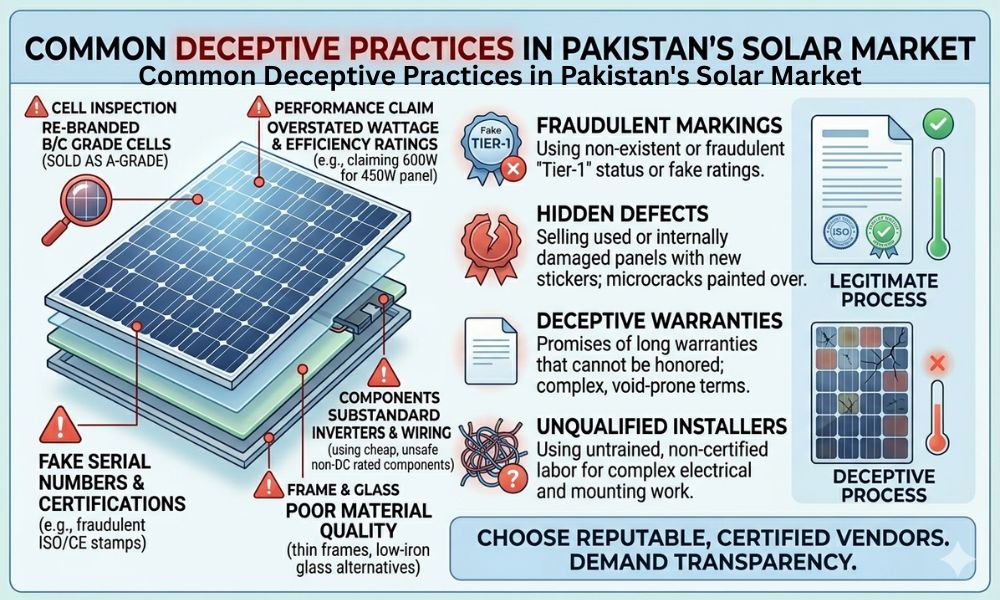
Rebranded B-Grade Panels: Some importers buy B-Grade panels from Chinese factories and rebrand them under a local or obscure international name with inflated wattage labels. The panel looks professional. The brochure looks glossy. But the product is substandard.
My personal tip: Always verify the manufacturer independently.
Grade Mixing: A dealer may show you genuine A-Grade samples but fulfill your order with B-Grade panels from the same-looking box.
My personal tip: Insist on inspecting the actual panels before installation, not just the samples.
Old Stock Sold as New: Solar panels degrade even in storage if stored improperly, in hot, humid conditions without proper racking. A panel that sat in a Karachi warehouse for two years before reaching you has already experienced some degradation.
My personal tip: Ask for manufacturing dates on the panel labels.
Manipulated Watt Ratings: Some panels in the market have their wattage ratings inflated by 5–10%. A “600W” panel that flash-tests at 560W is a 560W panel with a misleading label.
My personal tip: This directly affects your system’s output and your payback calculation.
Which Should You Buy: A-Grade Vs B-Grade Solar Panels?
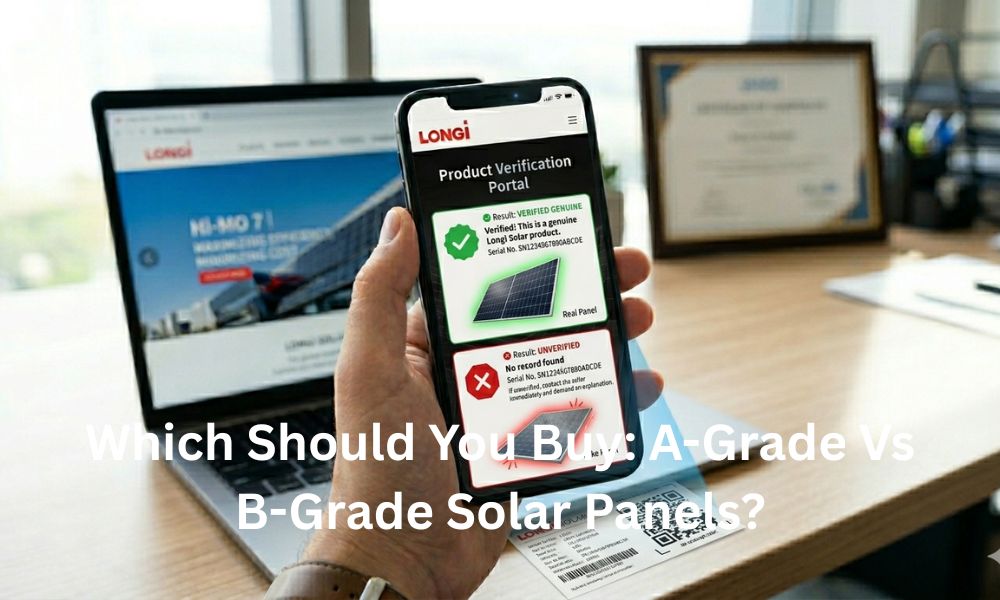
It is also important to note that for most Pakistani households and businesses, installing solar with any serious long-term intent, A-Grade panels from a reputable manufacturer are the right choice.
The upfront cost difference is real but recoverable within two to three years of operation, after which the superior performance pays you back every year for the remaining life of the system.
B-Grade panels are not worthless. For very short-term applications, a temporary installation, a demonstration setup, or an off-grid system in a low-stress environment, they may serve their purpose. But for a rooftop system intended to offset electricity bills for 20–25 years, they are a false economy.
The solar market in Pakistan is still maturing. Regulation is improving, but inconsistent enforcement remains a challenge. Until third-party quality verification is widely available and mandatory, the burden of due diligence falls on the buyer.
My personal experience: Ask hard questions, verify independently, and do not let the lower price tag decide for you.
Quick Comparison Between A-Grade Vs B-Grade Solar Panels
Here, we will discuss A Quick Comparison Between A-Grade Vs B-Grade Solar Panels in Pakistan in a simple table as follows.
| Feature | A-Grade | B-Grade |
|---|---|---|
| Cell Quality | Top-bin, fully tested | Rejected from top tier |
| Micro-Cracks | None at manufacture | Often present |
| Efficiency | Matches or exceeds label | Often below label |
| Annual Degradation | 0.4–0.7% | 1.5–3%+ |
| Warranty | Full manufacturer warranty | Limited or dealer-only |
| Certifications | IEC, TÜV verified | Often absent or unverified |
| Price per Watt (PKR) | 28–38 | 15–22 |
| Suitability for Pakistan Climate | High | Low to moderate |
| Long-term Value | Excellent | Poor |
Final Thoughts
I have visited many shops in different cities to understand A-Grade Vs B-Grade Solar Panels in Pakistan and found that every solar panel retailer sells old or B-Grade.
There is no huge difference in price for A- grade solar panels, but a huge difference in performance as well as life span.
Important Note: It is informative news that buying solar panels in Pakistan without knowing the difference between A-Grade and B-Grade can cost you 200,000 PKR.
There is only an 8k to 10k rupees difference between original or A-Garde and fake or B-Grade per solar panel.
My personal experience: There are a lot of new Dealers often sell B-Grade panels with fake A-Grade stickers, and most buyers can’t tell until their system drops power after 2 years.
A-Grade costs 8-12 PKR/watt more but gives you 15 more years of performance and 25% more output.
FAQs
A grade vs B grade solar panel Pakistan price 2026
A grade vs B grade solar panel Pakistan price ranges from just 18 to 25 rupees per watt for B grade solar panels and 10k to 14k rupees per solar plate in 2026.
On the other hand, a grade solar panel prices are high due to their performance and longer life. A Grade solar price per watt is 35 to 40 rupees nowadays in Pakistan, and the price per solar plate is 18k to 26k rupees for 540W solar panels.
B-Grade Solar Panel Price in Pakistan 2026 (Per Watt & Plate)
| Brand / Category | Average Price Per Watt (PKR) | Estimated Price Per Plate (550W–585W) (PKR) |
| Jinko Solar (B-Grade) | PKR 21 – PKR 24 | PKR 12,000 – PKR 14,000 |
| Longi Solar (B-Grade) | PKR 20 – PKR 23 | PKR 11,500 – PKR 13,500 |
| Canadian Solar (B-Grade) | PKR 22 – PKR 25 | PKR 12,500 – PKR 14,500 |
| JA Solar (B-Grade) | PKR 19 – PKR 22 | PKR 11,000 – PKR 12,800 |
| Local / Unbranded Mono Crystalline | PKR 18 – PKR 20 | PKR 10,000 – PKR 11,500 |
Buyer’s Warning: Unlike Tier-1 A-grade panels that carry a solid 25-year performance warranty,
B-grade panels are often sold with limited shop-level checking warranties (or completely “as-is” without official manufacturer support).
Always inspect the front busbars and backsheet closely for physical micro-cracks before buying.