
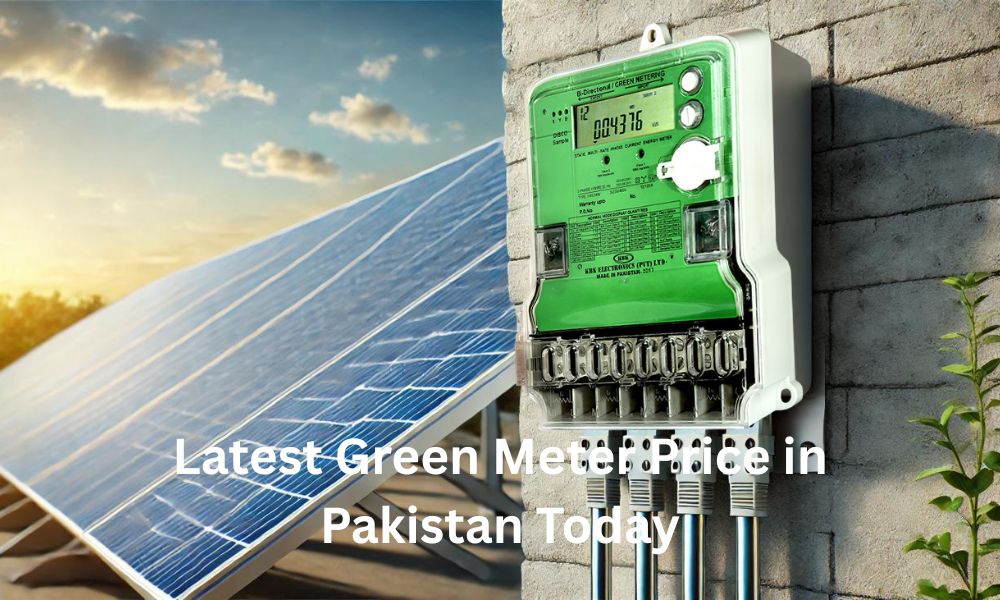
It is very informative news that Green Meter is also known as a Bi-Directional Net Meter, which is used for both purposes, like getting electricity from the grid as well as giving to the grid station. The main purpose of Green Meter is to sell extra solar power to the government and gain more money.
I have checked and verified from online shops or physical shops and found that the Green Meter Price ranges between just 40k to 55k rupees, depending on the quality, brand, area, and availability in Pakistan in 2026. This does not include a complete process for activation of the green meter in your home or installation place.
It is very important to note that Keep in mind that getting your net metering completely set up isn’t free in Pakistan. To get huge solar power to sell, we need to install the best quality solar panels at home.
It is also informative that, between installation, inspection, and processing fees, the total cost usually lands somewhere between Rs. 75,000 and Rs. 150,000 in Pakistan in 2026.
Major Hardware Costs (Meter Only)
It is also important to note that the base cost of the hardware depends on the manufacturer, the phase configuration, and whether you opt for standard digital equipment or an Advanced Metering Infrastructure (AMI) smart meter in Pakistan.
- Standard 3-Phase Bi-Directional Meter: Rs. 26,000 – Rs. 33,000 (Commonly supplied by trusted brands like Microstar, PEL, or Syed Bhais)
- Smart AMI “Green” Meter: Rs. 45,000 – Rs. 55,000 (Features advanced telemetry for real-time, remote data tracking)
Complete Net Metering Installation Package
My personal tip: If you prefer a hassle-free experience, most premium solar vendors offer an end-to-end service package. This completely offloads the physical setup, file processing, regulatory licensing, and NEPRA/DISCO approvals to their team in Pakistan.
- Total Project Estimate: Rs. 75,000 – Rs. 150,000+
- The Cost Split: Bureaucratic documentation, processing, and official fees generally account for Rs. 20,000 to Rs. 40,000, while physical wiring, specialised switchgear, and labour make up the remaining balance.
Essential Prerequisites & Compliance
Mandatory 3-Phase Infrastructure: Net metering applications in Pakistan are exclusively approved for 3-phase connections. If your property is currently operating on a single-phase line,
You must initiate a load extension and line upgrade with your local power distribution company before starting the net metering process.
AEDB Certification is Non-Negotiable: To avoid administrative delays or rejected applications, always partner with an AEDB (Alternative Energy Development Board) certified solar vendor.
My personal experience: They have streamlined, compliant channels to fast-track approvals with regional utilities like LESCO, IESCO, or K-Electric in Pakistan.
What Is a Green Meter & Its Working?
It is very informative news that Green Meter is also known as a Bi-Directional Net Meter, which is used for both purposes, like getting electricity from the grid as well as giving to the grid station.
How a Green Meter Works
A green meter, in simple words, is a two-way electricity meter to gain or give electricity in Pakistan to earn more money by selling extra energy.
A regular meter only measures how much electricity you take from the national grid. A green meter does two jobs at once:
- It measures the electricity you consume from WAPDA’s grid.
- It measures the electricity your solar panels export back to the grid.
The Net Metering System in Pakistan
It is also very informative news that Net metering is the billing mechanism built around the green meter in Pakistan, and for that purpose, we need to install a huge energy-generating system, such as a 10kw solar system.
It is officially approved and regulated by NEPRA (National Electric Power Regulatory Authority) and supported by WAPDA and all DISCOs (Distribution Companies) across Pakistan, including LESCO, MEPCO, IESCO, HESCO, PESCO, QESCO, and K-Electric.
My pro tip: your electricity bill is based on the net difference between what you consume and what you export. If you export more than you consume in a month, your bill drops dramatically — sometimes to almost zero.
Latest Green Meter Price in Pakistan 2026
This is the question on everyone’s mind: how much does it actually cost? The honest answer is that the green meter itself is not the biggest expense.
The total cost includes the physical meter, official government fees, documentation, and installation charges in Pakistan,
Green Meter Device Price (Meter Hardware)
The physical green meter device that is installed at your home costs approximately:
| Item | Price (PKR) |
|---|---|
| Green Meter Hardware (Bi-Directional Meter) | Rs. 30,000 – Rs. 40,000 |
This price has come down slightly in 2026 compared to previous years, largely due to increased local availability and competition among suppliers.
Official NEPRA and DISCO Fees in Pakistan for Green Meter.
These are the official government charges paid through a bank challan (Demand Note) to your relevant DISCO like LESCO, FESCO and K Electric in Pakistan.
| Fee Type | Approximate Amount (PKR) |
|---|---|
| Application Processing Fee | Rs. 3,000 – Rs. 5,000 |
| NEPRA / DISCO Official Charges | Rs. 3,000 – Rs. 5,000 |
| Total Official Government Fee | Rs. 6,000 – Rs. 10,000 |
These charges are the same regardless of which DISCO you are connected to — LESCO, MEPCO, IESCO, or others.
Complete Green Meter Installation Package (Market Rate)
Here is where things get real. Solar companies do not charge you separately for each step. They offer a complete package that includes the meter, documentation, application processing, inspection coordination, and installation labour. In some cases, “speed money” for faster processing is also factored in.
In 2026, the complete green meter installation package in Pakistan ranges from:
PKR 100,000 to PKR 150,000
This is the market reality. The official costs are low, but the complete process — when handled end-to-end by a solar company — costs between one and one and a half lakh rupees. On average, most people pay around Rs. 135,000 for the complete process.
Why Does the Package Cost So Much More Than the Meter?
My personal experience. The answer is that the net metering process in Pakistan involves several steps, visits, inspections, and paperwork. When a solar company handles everything for you, you are paying for:
- Their time and expertise
- Multiple follow-up visits with your DISCO
- Application preparation and submission
- Meter procurement from an approved vendor
- Physical installation and wiring
- Coordination until your first green meter bill arrives
If you have the time and knowledge to do much of this yourself, you can reduce the cost, but most households prefer the convenience of a full-service package.
Green Meter Unit Rate in Pakistan 2026: The Rate Drop
This is the other major topic that has everyone talking in Pakistan. The rate at which WAPDA buys your exported electricity has changed significantly.
Current NEPRA Export Tariff Rate
NEPRA has set the official rate for exported electricity at Rs. 19.32 per kWh for net metering consumers. This is the rate that all DISCOs across Pakistan are bound to apply when crediting your exported units.
Previously, the rate was around Rs. 21 per unit for many consumers. In some discussions, the rate is even reported as having dropped to Rs. 11 per unit for new applicants under revised billing arrangements. This is part of a broader policy shift happening in 2026.
Import Rates: Peak and Off-Peak
If your solar system is not producing enough power and you need to draw electricity from the grid, you pay different rates depending on the time of day:
| Time Period | Rate Per Unit (PKR) |
|---|---|
| Off-Peak Hours (12 hours daily) | Rs. 14 per unit |
| Peak Hours (6 PM – 10 PM) | Rs. 24.33 per unit |
Understanding this difference matters because it affects how much you save. If you use heavy appliances during peak hours at night when solar is not generating, your savings will be lower.
Big Policy Change in 2026: From Net Metering to Net Billing
This is something every potential green meter applicant must know before investing money.
What Changed Under Prosumer Regulations 2026?
Pakistan’s power regulator NEPRA introduced the Prosumer Regulations 2026, which brought a fundamental shift. Under the old system, the 1:1 unit exchange was available — meaning one unit you exported was offset against one unit you consumed, regardless of when.
Under the new framework, traditional 1:1 unit exchange is no longer available for new applicants. Your exported solar units are now treated more like a commercial sale — you sell at a lower rate and buy at a higher rate, which reduces the financial return compared to the old net metering model.
What This Means for You
- Existing net metering consumers remain protected under their current agreements and are not immediately affected.
- New applicants will be processed under the updated billing model.
- Net metering is still active and officially approved in Pakistan as of May 2026. It has not been cancelled or replaced by gross metering yet, though discussions continue.
The bottom line: the system is still worth it, but the financial returns are somewhat lower for new applicants compared to those who installed two or three years ago.
Who Can Apply for a Green Meter in Pakistan in 2026?
Not every solar system qualifies for net metering. NEPRA and WAPDA have specific requirements.
Eligibility Requirements
Solar System Size Requirement
- Net metering is only allowed on solar systems of 5kW or higher with a 3-phase connection.
- For residential single-phase connections, the minimum is typically a 3kW to 5kW system, depending on your DISCO.
Inverter Requirement
- You must use a certified On-Grid or Hybrid inverter that is approved by NEPRA.
- Off-grid or basic inverters do not qualify.
- The inverter must be capable of synchronising with the national grid frequency.
Connection Type
- Your WAPDA connection must be active and in good standing (no dues or legal issues).
- Both residential and commercial consumers can apply.
Meter Compatibility
- Your existing meter must be replaced with the approved bi-directional green meter.
- The meter must be purchased from an NEPRA-approved vendor.
How to Get a Green Meter in Pakistan: Step-by-Step Process
There are some best steps to getting a green meter in Pakistan, and here we will discuss them one by one as follows. I personally got this green meter by following these best and easy steps to get a green meter in Pakistan.
Step 1: Install Your Solar System
It is a necessary step that, before applying for net metering, you must first have your solar system installed with an approved inverter. The system must be fully functional and ready to connect to the grid.
Step 2: Submit Your Application
It is also important that you submit your net metering application to your relevant DISCO. The application requires:
- Copy of your CNIC
- Copy of your existing electricity bill
- Solar system technical details (inverter make, model, system capacity)
- Signed agreement from a licensed solar installer
- Single-line diagram of the solar system
My personal tip: In Punjab, applications also go through the Punjab Energy Department for review and to schedule inspections.
Step 3: DISCO Inspection
It is also very important that after your application is submitted, DISCO officials visit your premises to inspect the solar system, verify the inverter, and assess the installation quality.
My personal tip: This step can take anywhere from two weeks to a couple of months, depending on your area and DISCO’s workload in Pakistan.
Step 4: Demand Note (Challan) Issuance
It is also a very necessary step that once the inspection is approved, DISCO issues a Demand Note, also known as a demand notice, basically a payment slip for the official charges.
My personal tip: You pay this at a designated bank in your area or city, in all banks, especially BOP, HBL, MCB, and Faisal Bank in Pakistan.
Step 5: Green Meter Installation
It is also very important that after payment is confirmed, DISCO arranges for the green meter to be installed at your property, where solar panels are installed, or electricity is generated.
My personal experience: The old meter will be removed and replaced, and a new green meter will be placed in its place of oled meter.
Step 6: First Net Metering Bill
It is the final and beneficial step. Within one to two billing cycles, your first net metering bill arrives, and this is when you finally see the reward for your investment in a solar system at home in Pakistan.
My pro tip: Always install the best quality solar panels to generate extra electricity to sell to the government or grid station like LESCO, HESCO, FESCO, and K Electric.
How Long Does the Whole Process Take?
I PERSONALLY EXPERIENCED THAT the complete net metering process in Pakistan takes 1 to 4 months, depending on how responsive your DISCO is and whether all your documents are in order.
My pro tip: Working with an experienced solar company can significantly speed things up to get a green meter immediately in Pakistan. You can also contact us to get a green meter within a few weeks.
Secret Benefits of the Green Meter in Pakistan
There are also many Secret Benefits of the Green Meter in Pakistan, and here we will discuss them one by one in some detail.
Near-Zero Electricity Bills
The most obvious benefit is the dramatic reduction in monthly electricity bills. Many families report bills dropping by 70% to 90% after getting net metering.
In summer months, when solar production is highest, and you need the air conditioner most, the savings are especially significant.
Selling Electricity Back to WAPDA
Any excess electricity your system produces is exported to the national grid. WAPDA credits these units against your future consumption at the NEPRA-approved rate.
This effectively means your solar system is working even when you are not using electricity at home.
Protection Against Future Tariff Hikes
Pakistan’s electricity tariffs have been rising steadily for years. By generating your own solar electricity, you reduce your dependence on the grid and protect yourself from future price increases.
My personal experience: Whatever WAPDA charges per unit in the future matters less if you are buying fewer units from them. Nowadays, the WAPDA will give you 10 rupees per unit, and the old rate was 21 rupees.
Increase in Property Value
A home with a working solar system and active net metering is worth more in the property market. Buyers see it as a built-in utility saving that will continue for years.
Environmental Contribution
Every unit of solar electricity you generate and use — or export — means one less unit that needs to be produced by burning expensive imported fuel.
Pakistan depends heavily on imported gas and oil for electricity generation. Solar reduces this dependency and helps lower carbon emissions.
Helping Reduce Load Shedding
With over 20,000 households already connected to net metering in Pakistan, the distributed solar generation is adding clean electricity to the national grid during peak daylight hours — the same hours when grid demand is highest.
Green Meter Prices by DISCO: Is There a Difference?
The green meter hardware price is essentially the same across Pakistan since it is procured from central approved vendors. However, the processing time and package rates offered by solar companies can vary by region and DISCO.
LESCO (Lahore)
LESCO serves Lahore and the surrounding areas. It is generally considered one of the more organised DISCOs for net metering processing.
My personal experience: Complete packages in the LESCO area typically cost Rs. 100,000 to Rs. 130,000 in Pakistan.
MEPCO (Multan/South Punjab)
MEPCO serves a large area of South Punjab, including Multan, Bahawalpur, and Okara. The process is similar, and package costs are in the Rs. 110,000 to Rs. 140,000 range.
IESCO (Islamabad/Rawalpindi)
IESCO is often cited as having one of the smoother net metering processes. The package costs here are Rs. 100,000 to Rs. 130,000.
HESCO and PESCO
In Sindh and KPK, the process can be slower due to administrative delays. Complete packages may cost Rs. 120,000 to Rs. 150,000, depending on location and installer.
K-Electric (Karachi)
K-Electric has its own net metering process separate from WAPDA. Rates and processing timelines are managed directly by K-Electric.
Is a Green Meter Worth It in 2026?
Given the policy changes and the shift to net billing for new applicants, many people are asking whether the investment is still worthwhile. The honest answer is: yes, but with realistic expectations.
The Math Still Works
Even at Rs. 9.80 per kWh export rate, and even with the revised billing rules, a well-designed solar system will pay for itself within 3 to 5 years and then generate free electricity for another 15 to 20 years.
The investment makes financial sense for most Pakistani households.
Timing Matters
Those who applied for net metering in 2023 or 2024 got the best deal under the 1:1 offset system in Pakistan. Now, the new rates are only 9.80 rupees per unit in Pakistan.
It is also informative news that New applicants in 2026 will still benefit, just slightly less per exported unit. The sooner you apply, the better, as future policy changes may further reduce the export rate.
Choose a Reliable Solar Company
The most important decision after deciding to go solar is choosing a trustworthy installer. Look for AEDB-licensed companies with verified track records. Ask for references, check reviews, and confirm that the inverter brand they offer is on NEPRA’s approved list.
Frequently Asked Questions
Can I apply for a green meter without a solar system?
No. The green meter is only for solar system owners. You must have a solar system installed and operational before applying.
Is the net metering process free?
No. There are official government charges (around Rs. 6,000 to 10,000) plus the cost of the green meter hardware and installation. The complete package costs Rs. 100,000 to Rs. 150,000.
Can I upgrade my solar system after getting a green meter?
Yes, you can upgrade your solar panels or inverter. However, you must inform your DISCO before making changes to avoid any issues with your net metering agreement.
What if my area has no net metering service?
Currently, all major DISCOs in Pakistan offer net metering. However, processing times and service quality vary by area. A local solar installer can confirm whether net metering is actively processed in your specific location.
Has net metering been cancelled in Pakistan?
No. As of May 2026, net metering is still active, and new applications are being accepted. There have been discussions about transitioning to gross metering, but no final cancellation has been announced.
What is the minimum solar system size for net metering?
For a 3-phase connection, the minimum is typically a 5kW solar system at home. For single-phase residential connections, requirements may vary by DISCO.
My pro tip: Check with your local DISCO or solar installer for the exact threshold in your area.
Latest Green Meter Prices at a Glance (2026)
There, we will also discuss the Latest Green Meter Prices at a Glance in a table to ease understanding.
| Item | Rate/Cost |
|---|---|
| Green Meter Hardware | Rs. 30,000 – Rs. 40,000 |
| Official DISCO/NEPRA Fees | Rs. 6,000 – Rs. 10,000 |
| Complete Package (Market Rate) | Rs. 100,000 – Rs. 150,000 |
| Average Total Cost | ~Rs. 135,000 |
| NEPRA Export Rate | Rs. 19.32 per kWh |
| Grid Import (Off-Peak) | Rs. 14 per unit |
| Grid Import (Peak Hours) | Rs. 24.33 per unit |
Final Thoughts
I have checked and verified from online shops or physical shops and found that the Green Meter Price ranges between just 40k to 55k rupees, depending on the quality, brand, area, and availability in Pakistan in 2026. This does not include a complete process for activation of the green meter in your home or installation place.
It is very important to note that Keep in mind that getting your net metering completely set up isn’t free in Pakistan. It is also informative that, between installation, inspection, and processing fees, the total cost usually lands somewhere between Rs. 75,000 and Rs. 150,000 in Pakistan in 2026.

I am Muhammad SHAHID, and my education is a Master’s in IT at GCUF. Muhammad Shahid is a passionate solar energy researcher, writer, and renewable energy enthusiast with years of experience in the solar industry.