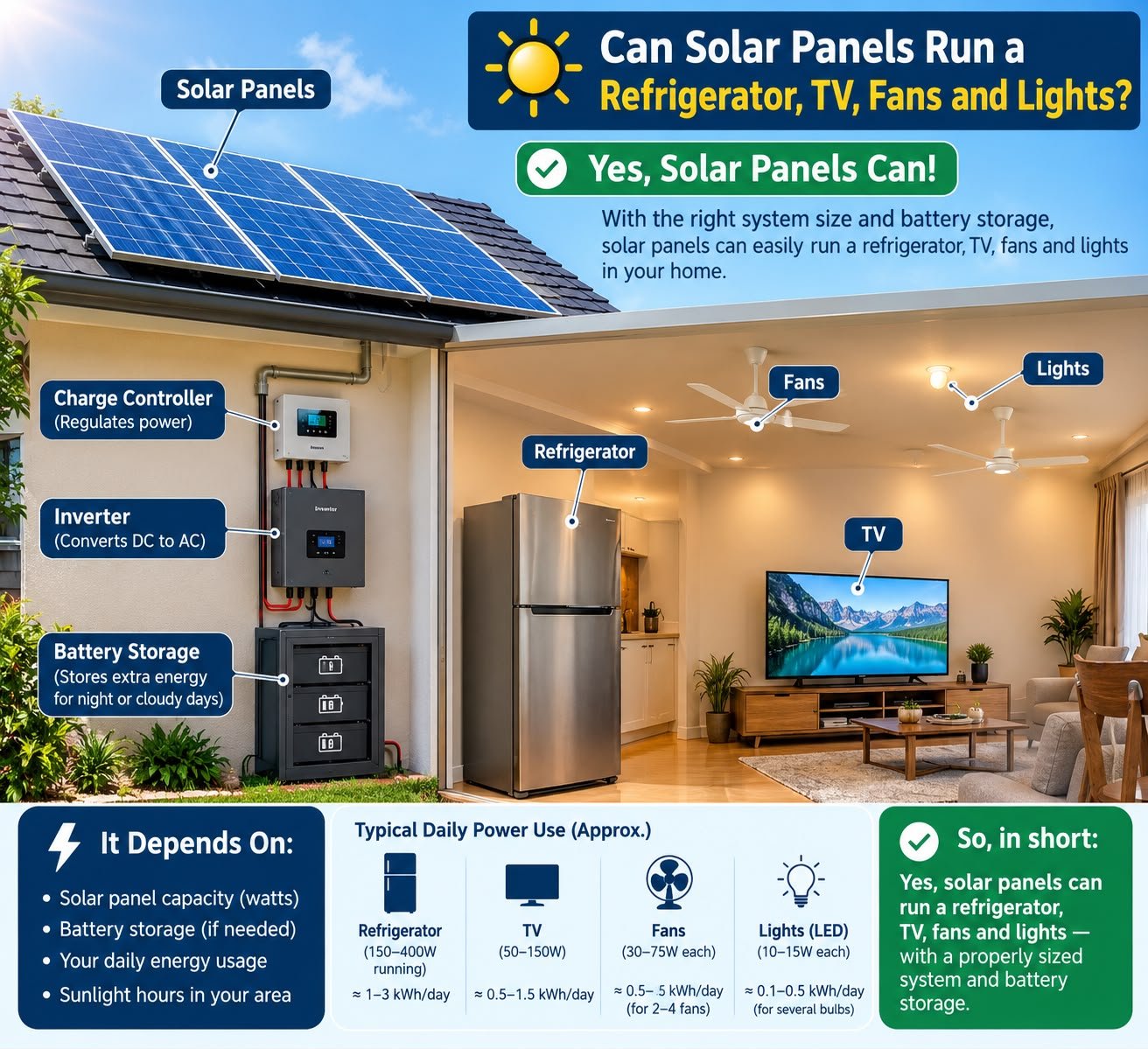
Best Solar Panels Run a Refrigerator, TV, Fans and Lights 2026
Solar panels are gaining increasing popularity among the homeowners who want to minimize the electricity needs and the dependency on the grid. However, when thinking about the installation, people usually ask themselves ‘can solar panels run a refrigerator, TV, fans and lights?’ The answer is yes, if the system is properly sized according to the needs. However, several aspects need to be taken into account when determining the system size, including the loads’ wattage, hours of use, solar irradiation, and battery storage.https://solarpricepakistan.com.pk/1kw-vs-2kw-vs-3kw-solar-system-pakistan-2026/
Unlike a single light bulb, homes have several loads, and the easiest way to determine the system size is to calculate the total consumption of the home. Fortunately, calculating the needs is not difficult, and one can do that by determining the individual loads, hours of use, and the wattage.https://solarpricehub.com/wp-admin/post.php?post=9119&action=edit
How Much Does a TV, Fans, Lights, and Appliances Consume?
Every device has a rated power, and determining the loads’ consumption is the first step towards calculating the system size. The values below represent the estimated consumption and variation in different appliances Best Solar Panels Run a Refrigerator, TV, Fans and Lights 2026.
Appliance Estimated Consumption (W)
LED light – 5W – 15W
Ceiling fan – 50W – 90W
TV – 50W – 150W
Refrigerator – varies greatly
WiFi router – 5W – 20W
Laptop – 30W – 100W
The refrigerator’s consumption depends on the size, and its value varies greatly. Another thing to note is that most of the devices with a compressor do not consume the rated power constantly, but the specified power is still applicable. As an illustration, a 100W television will consume 500Wh when used for 5 hours.
Another important aspect is that the air conditioner, geyser, and other appliances consume significantly more electricity than the lights, fans, and television, and their use can put a bigger demand on the PV system.
Can Solar Panels Run a Refrigerator, TV, Fans and Lights?
As mentioned above, the PV system’s capability to run all the appliances depends on the load, and a refrigerator is one of them. Solar panels can run the fridge, but one should note that it has a compressor, and the starting current can be several times higher than the rated value.
Therefore, the inverter size has to be adequate to run the refrigerator, TV, fans, lights, and other devices in the house. Fortunately, modern devices are more energy-efficient, and a small inverter can run several thousand watts without problems. Besides, the battery storage is another essential aspect when considering the use of a refrigerator as the devices need to be cooled down during the night and days without sun. Solar panels generate the electricity during the day, but the fridge needs to be cooled constantly.
Can Solar Panels Run a Television?
Solar panels can run a TV because it does not consume much electricity. As mentioned above, the device’s power consumption varies between 50 and 150W, and the actual value depends on the size and resolution. Another crucial note is that the television is not usually on for several hours a day as it is a relatively small load. Thus, a TV with 100W will only consume 500Wh when used for 5 hours per day. However, it is vital to specify the exact value, as it will dictate the system size.
Can Solar Panels Run a Fan?
Solar panels can run a fan because a single ceiling fan only consumes between 50 and 90W. A bigger house, however, may require multiple fans, and their combined load will be essential to consider when determining the system size. For illustration purposes, if one has to fans, and each consumes around 70W, then the combined load will be 140W.
Another thing to note is that, nowadays, most of the fans are energy-efficient, and their consumption is lower than the traditional ones. Nevertheless, it is vital to specify the exact model and consumption as their values will determine the PV system size.
Can Solar Panels Run a Light?
Lights consume a relatively small amount of electricity, and most of them are compatible with a small PV system. Traditional bulbs are not energy-efficient, so it is advisable to use the newer versions of LED lights. They have a considerably higher brightness per watt, and their consumption rate is relatively low. For example, if one uses 10W bulbs and has ten of them, then the lighting system will consume 100W in total. However, if one uses them for 5 hours per day, their combined consumption will be 500Wh.
Can Solar Panels Run a Refrigerator, TV, Fans and Lights Simultaneously?
The calculation of the combined value of all the home loads is relatively straightforward, and it is necessary to do that to identify the general consumption. The example below considers several essential appliances that most people use during the day.
Appliance Power (W)
Refrigerator – 150W
TV – 100W
Fans – 2 x 70W
Lights – 5 x 10W
The combined value in the example above sums up to 440 W, and a refrigerator, TV, fans, and lights can be powered by a single inverter. However, it is advisable to use a bigger one as the refrigerator’s starting current will also be higher. On the other hand, the example uses the average values, and the actual system size depends on the appliances’ exact values.
How Many Solar Panels Do I Need?
The number of the panels depends on the total wattage and the panels’ individual wattage, and their value can vary between several hundred watts up to 550W. Below is an illustration of the number of panels and their combined power.
Number of panels Total power (W)
1 – 550
2 – 1,100
4 – 2,200
6 – 3,300
8 – 4,400
10 – 5,500
The values above represent the individual panel power, and the total depends on the number of panels and their combined value.
Is 1kW Solar Enough to Run the Loads?
Solar panels of 1kW or more can be enough, but only for the smaller devices. Although lights, fans, televisions, and other smaller appliances are not that demanding, it is unlikely that their combined load will be enough to power a refrigerator. Another crucial aspect is that the inverter has to be adequate and be able to switch the fridge’s starting current.
Is 3kW Solar Enough to Run the Loads?
A 3kW system should be adequate to power all of the above appliances simultaneously. However, the actual required value will depend on the exact power, and one should calculate the precise consumption rate based on the real power.
Nevertheless, a 3kW system should also be enough to power a couple of other devices, and one can include them in the design to maximize the system’s potential. However, adding an air conditioner, geyser, and other high-power appliances will demand significantly more energy, and their combined load will also be higher.
Do I Need Batteries to Run Appliance Loads?
Batteries are not mandatory, but they are helpful, and their primary purpose is to store the surplus energy. If one has an alternative source of electricity, such as the grid connection, then a small battery bank can be enough. However, if someone wishes for uninterrupted power during the night or days without sun, then a bigger battery will be necessary.
How Many Batteries Do I Need?
Battery size is dependent on the consumption, and an essential aspect is the hours of use. The example below serves to illustrate the calculation.
Battery power (W) Hours of use Total power (Wh)
500W 6hours 3,000Wh
The calculation above serves to illustrate the concept, and one should consider that in practice the loss will be present. Therefore, one should use the value of 3,000Wh as a guide when selecting a battery.
Can Solar Panels Power Lights, Fans, and a TV During Cloudy Days?
Solar panels can produce electricity even on cloudy days, but the output will be lower. During the prolonged cloudy days, the output will be insufficient, and one would need to rely on the battery or grid connection. The PV system size has to be adequate to cover the highest consumption and the periods of absence of sunlight.
How Can I Lower My Electricity Needs?
Although the primary purpose of a PV system is to minimize the electricity needs from the grid, reducing the appliances’ consumption will help. Some of the ways to achieve that are:
- Use energy-efficient devices such as LED lights, and fans
- Choose a more efficient refrigerator model
- Minimize the devices’ use and avoid leaving them on standby
- Turn off the lights when not needed
- Use other energy-efficient home appliances
How Do I Use the Load Calculation to Size a Solar System?
The easiest way to estimate the system size is by calculating the individual consumption of each appliance. It is possible by using the following formula.
Power (kW) x Hours = Energy (kWh)
For example, a television has a power rating of 100W or 0.1kW and is used for 5 hours per day, and its daily consumption will be
0.1kW x 5hours = 0.5kWh
After obtaining the value for each appliance, it is necessary to add up the daily consumption of all the devices, and a solar expert can advise on the system size based on that.
Final Thoughts
Can solar panels run a refrigerator, TV, fans and lights simultaneously? The answer is yes, if the system is sized correctly. When determining the system size, it is vital to consider several aspects, including the loads’ demand, hours of use, battery storage, and inverter size. Most of the devices in a home can be powered by a relatively small PV system. However, the higher the home load, the bigger the system has to be.
Before selecting the inverter and purchasing the equipment, it is essential to calculate the precise consumption and ensure that the appliances’ demand is compatible with the system size. Another crucial aspect is that newer LED lights, fans, and other energy-efficient devices consume less electricity, which reduces the system size. As a result, if one wishes for uninterrupted electricity supply during the night or days without sun, a bigger battery will be required.