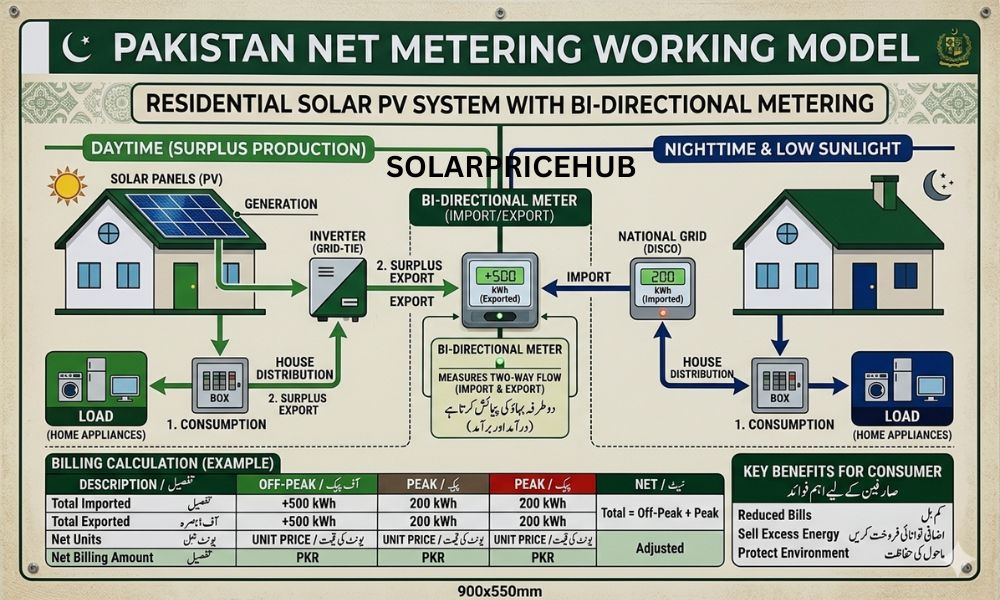
21 Oct 2026 It is very bad news that Net Metering Pakistan 2026 changed in May, and it directly impacts your solar savings by thousands of rupees to millions of rupees. 21 Oct 2026 NEPRA set the new buyback rate at Rs 9.80 per unit for all new net metering applications, down from Rs 19-22, which was the old rate all over Pakistan.
Important note that if you live in Lahore, Karachi, or Islamabad, planning a 5kw or 10kw system, this affects how fast your investment pays back in Pakistan. Under the previous system, solar consumers enjoyed generous buyback rates of Rs. 25–27 per unit on a one-to-one exchange basis. Always install Tier 1 solar panels to get more energy for a long time.
The new net billing prices this to approximately Rs. 9–11 per unit, while grid electricity continues to be charged at Rs. 37–55 per unit. This policy shift, driven by Rs. 101 billion in utility losses and grid stability concerns, fundamentally changes the economics of rooftop solar investment across Pakistan.
In this guide, we break down the updated net metering policy 2026, show you the real bill calculation, and explain if net metering is still profitable with the new rate. Plus, we cover the application process and documents you need for LESCO, MEPCO, and IESCO.
Do you want to install the biggest solar panel at home?
What Changed in Net Metering Policy 2026
In 2026, Pakistan’s energy regulator NEPRA made a big change to the solar net metering policy. Before this change, people with solar panels could sell extra electricity back to the grid and get a good price for it.
But now, the rules are very different for anyone applying for a new solar connection. Think of it like a shop that used to pay you Rs. 20 for your goods but now only pays Rs. 9.80. The product is the same — your solar electricity — but the price you receive has dropped a lot.
Old Rate vs New Rate
Here is a simple comparison of what changed:
| Old Policy (Before 2026) | New Policy (2026 Onwards) | |
|---|---|---|
| Buyback Rate | Rs. 19–22 per unit | Rs. 9.80 per unit |
| Billing System | Net Metering (unit for unit) | Net Billing (separate rates) |
| Contract Length | 7 years | 5 years |
| Who It Applies To | All solar users | New applications only |
Important: This new lower rate of Rs. 9.80 per unit applies only to new solar connections made after February 9, 2026.
If you already have a net metering agreement signed before that date, you are safe. Your old rate stays the same until your contract expires.
Why NEPRA Reduced the Rate
NEPRA did not reduce the buyback rate without reason. Three big problems forced this change:
1. The Grid Was Losing Money Solar users were selling electricity back to the grid at Rs. 22–27 per unit. But big power plants were selling the same electricity to the government for less than Rs. 10 per unit. This gap was costing the system a lot of money every single day.
2. Circular Debt Was Getting Worse. Pakistan’s power sector already has a massive circular debt problem. When DISCOs (electricity distribution companies) had to buy expensive solar electricity from rooftop users, their losses grew even bigger. In just one year — FY2024 — electricity companies lost Rs. 101 billion because solar users were selling less to the grid and buying less from it.
3. The Solar Boom Created Grid Problems. Pakistan now has around 6,000 megawatts of rooftop solar installed. In winter, the total electricity demand of the whole country drops to just 8,000–9,000 megawatts. So much solar power pouring into the grid at the same time was causing serious stability problems. NEPRA had to act fast.
Who Is Affected
The good news is that not everyone is affected by this change, but new solar panel installers can be affected, consequently, in Pakistan. Here, we will discuss them completely one by one as follows.
New Solar Users (After February 9, 2026) If you are applying for a solar net metering connection now, you will receive only Rs. 9.80 per unit for the extra electricity you send to the grid. At the same time, you will still pay the full price — Rs. 37 to Rs. 55 per unit — for any electricity you take from the grid. This big difference means solar panels are now more about saving money on your own bill than earning money by selling to the grid.
Existing Solar Users (Before February 9, 2026) If you already had a net metering agreement signed before the new rules came in, you do not need to worry right now. Your old buyback rate stays protected until your current contract runs out. After that, you will move to the new net billing system.
Pending Applications Around 5,165 applications that were submitted before February 8, 2026, will also be treated under the old policy, as confirmed by the Power Minister.
In short, the old users are safe for now, but new solar investors must plan under the new, lower rate of Rs. 9.80 per unit.
Net Metering Bill Calculation at Rs 9.80 Rate 21 Oct 2026
It is very important to note that Pakistan’s new net billing system pays solar users only Rs 9.80 per unit they export to the national grid or WAPDA. This is a big drop from the old rate of Rs 25.32 per unit or kWh.
The old solar panel installers got huge benefits, but nowadays they will get only 10 rupees per unit, and when using grid electrcity paid almost30 to 40 rupees per unit in Pakistan.
Important Notice: Here, we will explain the complete process with examples.
Example for a 5kW System in Lahore
It is also important to note that if your 5kW solar panels generate 600 units this month. You use 300 units yourself during the day, export 300 units to the grid like LESCO, FESCO, HESCO, and import 200 units from the grid at night.
Before solar, your monthly bill for 500 units would be roughly Rs 18,000.
After solar PANEL INSTALLATION AT HOME, you pay for 200 imported units (Rs 7,000) but earn a credit of Rs 2,940 for 300 exported units at Rs 9.80, bringing your bill down to around Rs 4,560. That is a saving of over Rs 13,000 every month.
Under the old rate of Rs 25.32, those 300 exported units would have earned Rs 7,596 — enough to wipe the bill to zero.
3kW, 5kW, 10kW Payback Period Table
| System | Approx Cost | Monthly Savings (Rs 9.80 rate) | Payback — New | Monthly Savings (Old Rs 25.32) | Payback — Old |
|---|---|---|---|---|---|
| 3 kW | Rs 4,50,000 | Rs 7,500–8,500 | 4.5–5 years | Rs 11,000–13,000 | 3–3.5 years |
| 5 kW | Rs 7,00,000 | Rs 11,000–14,000 | 4.5–5.5 years | Rs 17,000–20,000 | 3–3.5 years |
| 10 kW | Rs 13,00,000 | Rs 20,000–26,000 | 5–6 years | Rs 33,000–38,000 | 3–4 years |
Monthly savings include both self-consumed units (valued at the full Rs 35 grid rate) and exported units at the applicable buyback rate.
The reduced buyback rate has extended the estimated payback period for new residential solar systems from 3–5 years to an average of 10–12 years in pure export-heavy scenarios.
Is It Still Profitable?
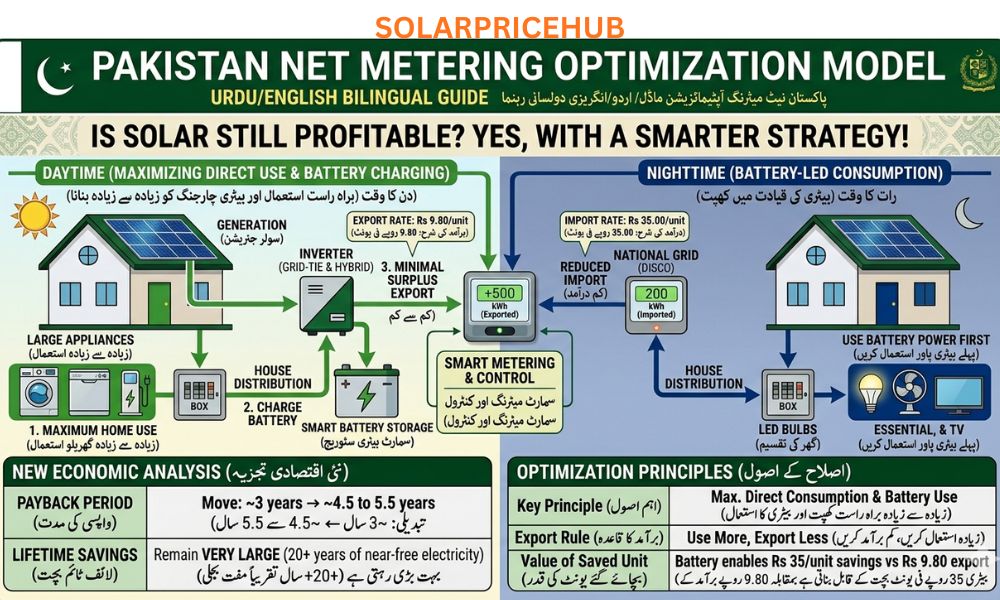
Yes, solar is still a smart investment, but the strategy has changed. The payback period moved from around 3 years to roughly 4.5 to 5.5 years for most households. After that, you still enjoy 20 or more years of near-free electricity, which means the total lifetime savings remain very large.
The new rate is a wake-up call for how you use your solar system. Success now depends on using as much of your own solar electricity as possible during the day, rather than sending it to the grid and getting only Rs 9.80 back per unit.
It is also an important thing that for homes that are empty during the day, adding a battery makes a lot of sense.
My personal tip: Instead of exporting solar power at Rs 9.80, you store it in batteries and use it at night. This saves you Rs 35 per unit instead, which is 3.5 times more value from the same electricity in Pakistan in 2026.
I have experienced from many installers that the simple new rule is this. Use more, export less, and consider a battery if your home runs mostly at night.
The sun still saves you a great deal of money. You just need to be a little smarter about how you use what it gives you.
How to Apply for Net Metering in 2026
The process is the same whether you are on LESCO in Lahore, MEPCO in Multan, or IESCO in Islamabad, and many others in Pakistan.
All applications go through the national PITC online portal at nmp.pitc.com.pk, and your solar installer usually handles most of the paperwork on your behalf.
Step-by-Step Process for LESCO / MEPCO / IESCO in Pakistan 2026
There are only 5 easy steps to apply for net metering in Pakistan nowadays, and here we will discuss them one by one in detail.
The process is the same whether you are on LESCO in Lahore, MEPCO in Multan, or IESCO in Islamabad.
All applications go through the national PITC online portal at nmp.pitc.com.pk, and your solar installer usually handles most of the paperwork on your behalf.
First, you install your solar system using a certified installer who is registered with AEDB. Only approved installers can submit a valid net metering application, so choosing the right company from the start saves you a lot of trouble later.
Second, your installer submits your application online through nmp.pitc.com.pk. This includes your personal details, meter number, system size, inverter information, and all required documents.
Third, your DISCO office reviews the application. They check whether your documents are complete and whether your system design meets NEPRA standards. They may come back with corrections if anything is missing or incorrect.
Fourth, a DISCO engineer visits your home for a physical site inspection. They check the solar panels, inverter, wiring, earthing, and safety equipment. Your system must pass this inspection before anything else can happen.
Fifth, once the inspection is passed, you sign the official Net Metering Interconnection Agreement with your DISCO. This is the legal contract that gives you the right to export electricity to the grid.
Sixth and finally, your DISCO installs the new bidirectional smart meter at your property. From the very next billing cycle, your exported and imported units are recorded separately, and your net billing officially begins.
Documents Required For Net Metering in Pakistan
There are two types of Documents Required For Net Metering in Pakistan like personal and physical, as given below.
Personal documents you need to arrange yourself:
- Copy of your CNIC (must match the name on your electricity bill exactly)
- Your most recent electricity bill (not older than 3 months)
- Proof of property ownership, such as a registry or transfer letter
- If you are a tenant, a No Objection Certificate (NOC) from the property owner
Technical documents your installer prepares for you:
- Single-line diagram of your solar system
- Inverter datasheet showing the brand, model, and capacity
- Solar panel specifications, including wattage and quantity
- AEDB-certified installer agreement and undertaking
- The load calculation report showing your system size matches your sanctioned load
- Interconnection Agreement downloaded from the PITC portal and signed by both you and your installer
One important thing to remember is that the name on your CNIC, your electricity bill, and your application form must all match perfectly.
Timeline and Fees For Net Metering in 2026
It is very important to note that the typical timeline from application to commissioning is 30 to 90 days, depending on your DISCO and how complete your documentation is. LESCO and IESCO tend to be faster when all papers are in order. Delays are most often caused by missing documents or a backlog of pending applications at the DISCO office.
On the cost side, the official government processing fee is around Rs 8,000, and the smart meter itself costs Rs 30,000.
It is also important to note that solar companies offer a complete net metering package that includes processing, meter, and installation assistance, with market rates in 2026 ranging from Rs 100,000 to Rs 150,000, depending on your DISCO.
City-Wise Net Metering in Pakistan Updates
There, we will also provide information on City-Wise Net Metering in Pakistan, updates one by one as follows.
Lahore — LESCO
LESCO is Pakistan’s busiest net metering zone, with Lahore alone accounting for 24% of all solar consumers in the country. However, 2026 has been a difficult year for new applicants here.
LESCO stopped accepting fresh net metering requests at one point, leaving applicants in limbo, with many reporting repeated visits to company offices without clear timelines or explanations.
After public pressure and government intervention, applications resumed, but delays remain common.
The Lahore High Court also stepped in, issuing an order that consumers who secured approval by February 9, 2026, will continue to receive relief under the old regulations.
For new applicants in 2026, the average approval timeline is 25 to 45 days when all documents are in order, though backlogs can push this to 60 to 90 days.
LESCO has also introduced new rules, including mandatory inverter registration with serial number and manufacturer details, and a shift to smart AMI meters for all new net metering connections.
Karachi — K-Electric
Karachi runs on K-Electric, which is a private utility and operates separately from the WAPDA-linked DISCOs. The good news is that K-Electric has been instructed to follow the same national rules.
The Power Minister issued clear instructions to all distribution companies, including K-Electric, to process net metering applications received before February 8 under the previous, more favorable regulations.
One important rule specific to K-Electric is that your connected load at home must match the sanctioned load listed on your K-Electric bill exactly, and if they do not match, your application will be rejected or delayed. You also cannot apply for net metering directly in Karachi.
Only AEDB-certified vendors are authorized to submit applications on your behalf. The typical end-to-end timeline with K-Electric is 60 to 90 days, which is longer than most other cities, so starting the process early is important.
Islamabad / Rawalpindi — IESCO
IESCO covers Islamabad, Rawalpindi, Attock, Jhelum, and Chakwal, and it has been one of the most active DISCOs for solar adoption. However, it has also been the centre of the most policy confusion in early 2026.
An internal IESCO circular dated February 25, 2026, directed field engineers to implement NEPRA’s Prosumer Regulations 2026 in full, even as the government’s review process was still ongoing, before the circular was later withdrawn.
IESCO has one stricter rule that sets it apart from other DISCOs. A three-phase connection is mandatory for net metering, while LESCO, MEPCO, and FESCO permit single-phase connections for smaller systems.
Single-phase consumers in IESCO’s territory face an additional Rs 50,000 to Rs 80,000 phase upgrade cost before they can even apply.
On the positive side, Rawalpindi City and Cantonment areas already have AMI smart meters installed, which actually reduces the meter cost for solar users in those areas compared to other cities.
Final words
It is very bad news that Net Metering Pakistan 2026 changed in May, and it directly impacts your solar savings by thousands of rupees to millions of rupees.
NEPRA set the new buyback rate at Rs 9.80 per unit for all new net metering applications, down from Rs 19-22, which was the old rate all over Pakistan.
FAQs
Net metering rates in Pakistan 2026
The Net metering rates in Pakistan range from just 9.80 rupees to 11 rupees for new solar system installers in PAKISTAN.
For old installers or users, rates are 19 to 22 rupees per unit in Pakistan, and now the policy has changed, which is bad news.
Solar net metering rates in Pakistan 2026
The Net metering rates in Pakistan range from just 9.80 rupees to 11 rupees for new solar system installers in PAKISTAN.
For old installers or users, rates are 19 to 22 rupees per unit in Pakistan, and now the policy has changed, which is bad news.
Net metering rates in Pakistan 2025
The Net metering rates in Pakistan range from just 9.80 rupees to 11 rupees for new solar system installers in PAKISTAN.
For old installers or users, rates are 19 to 22 rupees per unit in Pakistan IN 2025, and now the policy has changed, which is bad news.
Net metering demand notice fee 2026
The net metering demand notice fee is only 20k to 30k rupees in Pakistan, which totally depends on your specific DISCO (e.g., LESCO, IESCO, FESCO) nowadays in 2026.
This usually covers the bi-directional (green) meter, installation, and connection charges, though load extensions or name-change requests may incur additional fees.
MEPCO net metering demand notice fee 2026
MEPCO net metering demand notice fee is only 16k to 25k rupees in Pakistan. This fee structure changes from time to time according to the grid station instructions in Pakistan.