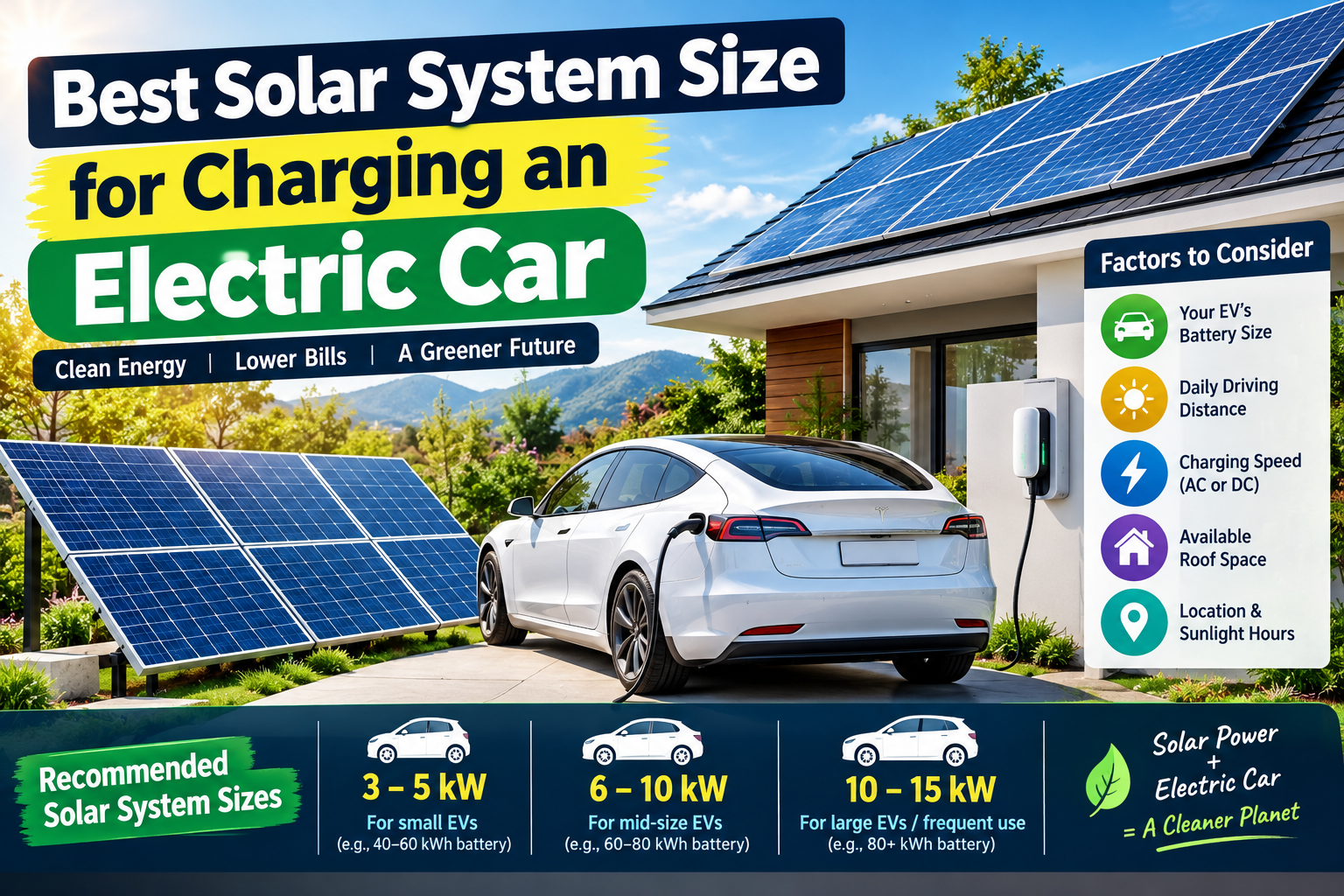
Best Solar System Size for Charging an Electric Car
Electric cars are getting too much popular with passage of time as the price or fuel is getting high and people look for cleaner, cheaper ways to get around. But if you actually buy the electric vehicle one question tends to come up pretty quickly: how much solar power do you actually need to charge it.https://citaevcharger.com.pk/how-many-solar-panels-to-charge-electric-car/
The short answer is the 5 kW to 10 kW solar system can work well for a lot of the owners of the electric-cars. the right size highly depends on the capacity of the battery of car, how far the car is drived daily, electricity use of household, how much sunlight you get, and whether you want to charge entirely off solar or not.https://solarpricehub.com/wp-admin/post.php?post=9091&action=edit
Normally for running one electric car the 6 kW to 8 kW system often give the practical balance between needs of electricity for home and charging the electric vehicle. If you are driving long distances every day or want to depend heavily on the solar electricity , the 10 kW system or bigger will make more sense and work properlyBest Solar System Size for Charging an Electric Car.
How Much Electricity Does an Electric Car Need?
All electric vehicles
Don’t use the same amount of electricity. Actual consumption of electricity by the electric vehicle highly depend on the size of vehicle, weight, battery, conditions of driving, speed, and weather.
A lot of electric vehicles use roughly 15 to 25 kWh to travel 100 km. For the easy round number, let’s say the electric vehicle use around 18 kWh per 100 km.
- 30 km per day: around 5.4 kWh
- 50 km per day: around 9 kWh
- 100 km per day: around 18 kWh
- 150 km per day: around 27 kWh
Charging also relate with some of the energy loss, so what actually pull from the solar system depends to run a bit higher than what ends up stored in the battery of electric car.
How Much Solar Power Is Needed to Charge the Electric vehicle?
The size of solar system is measured in kilowatts (kW), while the capacity of the Electric vehicle is measured in kilowatt-hours (kWh) Best Solar System Size for Charging an Electric Car.
That difference between them matters more than that people realize.
The 1 kW solar system can’t pump out 1 kWh continuously, hour after hour. The Solar panel mainly generate the electricity during the daylight, and their output shift highly depend on the sunlight, temperature, panel orientation, and other conditions on any given day.
In a sunny spot, a 1 kW system might produce several kWh of electricity per day on average, though actual output varies across the year Best Solar System Size for Charging an Electric Car.
Say your car needs around 9 kWh a day for 50 km of driving — a system somewhere around 3 kW to 4 kW could potentially cover that on average, assuming decent sunlight.
That doesn’t necessarily mean a 3 kW system is your best overall choice, though Best Solar System Size for Charging an Electric Car.
5 kW Solar System for an Electric Car
A 5 kW solar system’s a popular starting point for homeowners looking to pair solar power with EV charging Best Solar System Size for Charging an Electric Car.
A 5 kW system may work well if:
- Your daily driving is relatively low
- You already run an energy-efficient home
- You can charge the EV during daylight hours
- Your car has a relatively small battery
- You’ve got grid electricity to fall back on when solar isn’t enough
For someone driving around 30–50 km a day, 5 kW can be a genuinely practical choice.
7 kW Solar System: A Good Middle Ground
For a lot of households, 7 kW of solar capacity hits an attractive middle ground Best Solar System Size for Charging an Electric Car.
It gives you more generation capacity than a 5 kW system, leaving extra electricity for both household use and EV charging.
A 7 kW system can be especially useful if you:
- Drive around 50–80 km per day
- Want to cut down on grid electricity use
- Run several household appliances
- Want faster solar-powered EV charging during the day
- Plan to add another EV down the line
Actual production still depends on your location and how the system’s installed, of course Best Solar System Size for Charging an Electric Car.
8 kW Solar System for Home and EV Charging
An 8 kW solar system is worth a look if your household uses a fair bit of electricity and you also want to charge an EV.
The extra solar capacity buys you more flexibility. During sunny hours, solar electricity can get split between your home and your EV charger.
Say your house is drawing 2 kW while your panels are producing 6 kW — roughly 4 kW could potentially go toward EV charging, depending on your inverter, charger, and energy-management setup Best Solar System Size for Charging an Electric Car.
That’s one reason a bigger solar system can end up more convenient than sizing panels purely around the car’s battery.
10 kW Solar System for Heavy EV Use
If you drive a lot, or you’re running a large electric SUV with a bigger battery, a 10 kW solar system can be a solid option Best Solar System Size for Charging an Electric Car.
It can supply considerably more solar generation for:
- EV charging
- Air conditioning
- Refrigerators
- Washing machines
- Water pumps
- Other household appliances
A 10 kW system is especially appealing for households with high daytime electricity use Best Solar System Size for Charging an Electric Car.
That said, going bigger isn’t automatically better. The system should really be sized around your actual electricity consumption, available roof space, budget, and local regulations — not just picked because it’s the biggest option on the price list.
How Many Solar Panels are Needed to charge electric vehicle?
It highly depend on the wattage of the individual panels.
Using the modern 550-watt panels, will give the electricity given below:
| Solar System | Approx. 550W Panels |
|---|---|
| 3 kW | 6 panels |
| 5 kW | 10 panels |
| 7 kW | 13 panels |
| 8 kW | 15 panels |
| 10 kW | 19 panels |
These are approximate figures, since actual system capacity often gets adjusted to match the inverter and installation design.
Also worth remembering: panels need enough roof space to work with, and shading can seriously affect production Best Solar System Size for Charging an Electric Car.
Can Solar Panels Fully Charge an Electric Car?
Yes the solar panels can generate enough electricity to charge the Electric vehicle but whether they can fully charge it every single day highly depend on several things Best Solar System Size for Charging an Electric Car.
If the electric vehicle has the 60 kWh battery. You might assume you need a 60 kW solar system to charge it, but that’s not actually how solar sizing works.
The battery stores 60 kWh, while your solar panels are rated by their power output in kW — two different units doing two different jobs Best Solar System Size for Charging an Electric Car.
A properly sized solar system can generate the energy you need over several hours of sunlight throughout the day.
What About the 60 kWh or 75 kWh Battery of electric vehicle?
Best Solar System Size for Charging an Electric Car Battery size alone shouldn’t be what decides your solar system size.
Take a 60 kWh battery — if you only use 20% of it each day, you don’t need to replace all 60 kWh daily.
Solar EV Charging Speed Matters Too
Here’s another important distinction: solar system size and your EV charger’s charging power are two separate things entirely.
You might have:
- 5 kW of solar panels
- A 7 kW home EV charger
- the 60 kWh battery of electric vehicle
A 7 kW charger doesn’t mean that the solar panels will always deliver 7 kW.
Should You Install a Solar Battery?
A home battery can make solar EV charging a lot more flexible.
Solar panels produce the most electricity during daylight, while a lot of people get home and plug in their car in the evening — a mismatch worth noting.
Without a battery, you’d generally need to charge the EV during the day to actually use solar power directly. With battery storage, excess solar electricity can potentially get saved and used later instead.
Batteries do add to the overall cost of the installation, though, and they’re not necessary for everyone.
If you can charge your EV while the sun’s out, direct solar EV charging is often the simpler route.
Best Solar System Size for Different EV Users
Here’s a simple guide:
| Daily Driving | Suggested Solar Capacity |
|---|---|
| 20–30 km | 3–5 kW |
| 40–60 km | 5–7 kW |
| 60–100 km | 7–10 kW |
| 100+ km | 10 kW+ |
These are general estimates, not fixed rules. Your household’s electricity usage should factor into the calculation too.
A family running heavy air conditioning, for instance, might need a larger system even if the car’s only driven 30 km a day.
Is 5 kW Enough for an Electric Car?
For a lot of people, yes.
A 5 kW solar system can cover a significant chunk of EV charging, especially when the car isn’t driven heavily.
But if your goal is powering both your house and your EV primarily off solar, 5 kW might be on the smaller side.
In that case, 7 kW, 8 kW, or 10 kW gives you more breathing room to work with.
Is 10 kW Too Much for EV Charging?
Not necessarily.
A 10 kW system isn’t just there for the car — the extra generation can supply the rest of your home too.
If your household already uses a lot of electricity, adding an EV can meaningfully increase your total energy needs. A larger solar system can be a genuinely sensible long-term investment because of that.
That said, don’t install 10 kW just because it’s the biggest option on offer. Check your electricity bills and estimate your EV’s annual energy use first.
How to Calculate Your Solar Requirement
You can get a rough estimate with three steps.
Step 1: Calculate daily driving.
Say you drive 60 km every day.
Step 2: Calculate EV consumption.
If the vehicle uses 18 kWh per 100 km:
60 × 18 ÷ 100 = 10.8 kWh per day
Allow a bit extra for charging losses on top of that.
Step 3: Add your household electricity needs.
If your home already uses a fair amount of electricity, the solar system has to cover both the home and the EV together.
That’s why an EV owner might end up choosing a 7–10 kW system, even when the car itself doesn’t strictly require that much solar generation.
What Is the Best Solar Setup for an EV in Pakistan?
Before buying anything, get a professional installer to assess:
- Your annual electricity consumption
- Daily EV mileage
- Roof space
- Shading
- Inverter capacity
- EV charger’s power requirements
- Battery-storage requirements
- Local grid/net-metering rules
- Expected solar production
Final Thoughts
There’s no single solar-system size that’s perfect for every electric car owner out there.
If your EV sees light use, a 3–5 kW solar system may cover a good chunk of your driving. For an average household running an EV regularly, 5–8 kW tends to be a more practical range. And if you’re covering long distances or running a household with high electricity consumption, 8–10 kW or more is worth genuinely considering.
For a lot of homeowners, somewhere around 7 kW to 8 kW makes a good starting point, while 10 kW gives you extra headroom for heavier electricity use.
The real question isn’t “how big is my car battery.” It’s how many kilometres you actually drive, how much electricity your home uses, how much sunlight your roof gets, and when you plan on charging the car.
A properly sized solar system can turn your EV into something more than just a way to skip petrol — it can become part of a genuinely more energy-efficient home overall.